
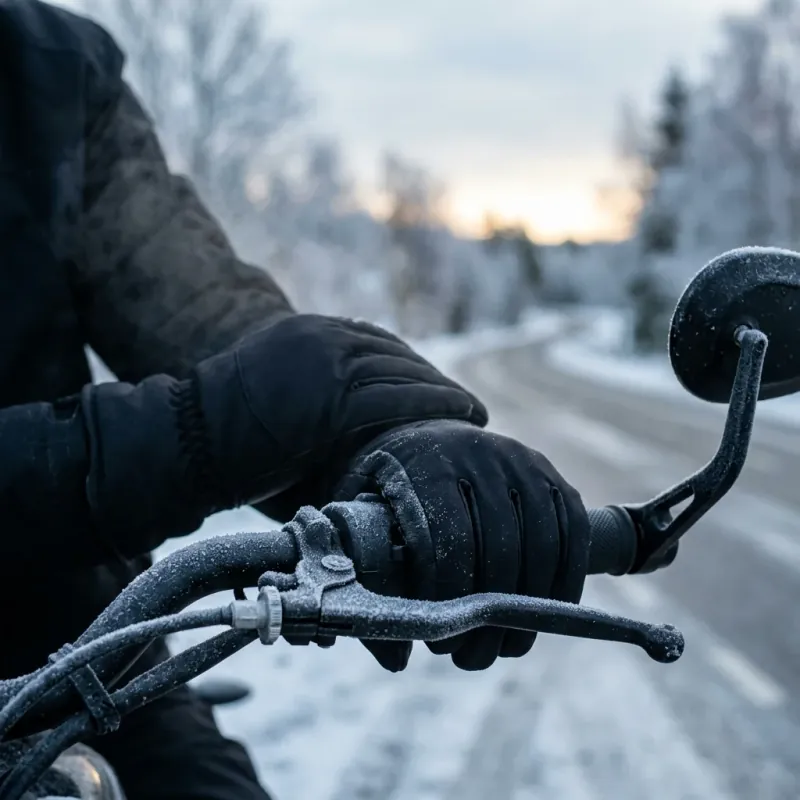
The question gets asked every autumn and almost never gets a straight answer, because it’s framed wrong. Heated grips and heated gloves are not two solutions to one problem. They heat different parts of your hand, and only one of them is the part that goes numb.
Get that straight and the buying decision follows easily.
They heat different halves of your hand
This is the whole comparison in one idea.
Heated grips put a heating element inside the bar grip. Heat moves by conduction — bar to glove to skin — so it reaches whatever part of your hand is physically pressed against the grip. That’s the palm and the inside of the fingers. It does not reach the back of your hand, and it reaches your fingertips only weakly, because your fingertips are wrapped around the front of the bar rather than clamped to it.
Heated gloves put elements into the glove itself, typically across the back of the hand and running out along the fingers. That’s the opposite coverage: the surfaces facing the wind.
Now the part that decides it. The cold you feel riding is overwhelmingly windchill, and windchill lands on the surfaces facing forward — the back of the hand and the fingers. Your palm is shielded by the bar and by your own hand. So the area grips warm best is the area that was already least exposed, and the area that actually goes numb is the area grips reach worst.
That isn’t an argument against grips. It’s an explanation of the complaint riders have every winter: I fitted heated grips and my fingertips are still cold. Yes. They would be.
Disclosure: some links below are affiliate links. If you buy through them we may earn a small commission at no extra cost to you.
Where grips still win
Having said all that, grips are the first thing most riders should fit, and it isn’t close.
They’re permanent. Fitted once, they’re on the bike forever. No charging, no remembering, no pack that died in the garage over summer.
They work with any glove. You keep the gloves you’ve already chosen for fit and protection — and glove fit is not something to compromise, since it’s the difference between working the controls properly and not.
They cost less. Both to buy and, unlike battery gloves, to keep running.
They warm the bar as well as the hand, which matters more than it sounds. A cold aluminium bar is a heat sink pulling warmth out of your palm all day. Stopping that is worth something even before you count the heat going the other way.
The costs are real and belong here rather than buried further down. Fitting means removing the old grips and wiring into the bike’s electrics, so it’s either an afternoon with the tank off or a bill from a shop. They’re permanent in the sense that they’re a commitment as well as a convenience — the wrong choice stays on the bike. And grip bodies come in bar diameters and lengths that don’t suit every machine, so check the fitment before the heat settings.
Check Oxford Heaterz Premium Adventure on Amazon →
If the budget is tighter, the entry-level version of the same idea does the core job with fewer heat settings and simpler controls.
Check Oxford Essential HotHands on Amazon →
The cheaper thing to try first
Before either, there’s an option that costs less than both and that this comparison usually skips: stop the wind hitting your hands at all.
Your hands lose heat two ways on a bike, and only one of them is windchill. The palm loses it by conduction into a cold metal bar it’s clamped to; the back of the hand and the fingers lose it to moving air. Grips attack the first. Handguards attack the second — and they do it by removing the cause rather than adding heat to outrun it, which on a lot of bikes buys more comfort per pound than any heating element.
They also do a second job on an adventure bike, which is protecting the levers in a drop. That dual purpose is why they’re near-universal on serious ADV machines and why fitting them is rarely wasted money even if you go on to heat things afterwards.
Check Barkbusters VPS on Amazon →
For wind protection alone, without the lever-protection bar structure, a simpler aluminium set does the job for less.
Check Kemimoto handguards on Amazon →
What handguards won’t do is make a genuinely cold day warm. They shift the threshold — the temperature at which your hands start to suffer — rather than removing it, and how far they shift it depends on the guard, the screen and how much of you sits in clean air. We’re not putting a number on that, because the honest answer varies by bike. What’s reliable is the direction: a rider who fits handguards first often finds they need less heating afterwards than they expected, not more.
The sensible order for most people, then, is: handguards, then grips, then gloves. Each one addresses something the previous one leaves alone.
The power question, which is bigger than people assume
Heated grips have a reputation for drawing almost nothing. That reputation is wrong.
Oxford rates the Heaterz Premium range at 48 watts — 4 amps at 12 volts. That’s the bottom of the same band as a 12V heated liner, not a negligible figure of its own, which is the opposite of the category’s reputation.
The consequence for small-displacement bikes — and the arithmetic for working out whether yours can spare it — is set out in the heated gear guide, and there’s no point repeating it here. The one line that matters for this decision: if your bike’s electrical budget is tight, that argues for battery gloves over anything wired, because they take nothing from the bike at all.
Runtime versus permanence
This is the second real axis, and it splits the glove category in two.
Battery gloves run at around 7.4V from packs in the cuffs. Nothing to wire, nothing taken from the bike, and they keep working when you park and walk into a cafe. The costs are runtime — measured in hours and shorter on high settings — and lower peak heat than a wired system. How much lower is calculable from the makers’ own figures, and it is a bigger gap than the marketing suggests: the heated glove guide works it out pair by pair.
Check Savior Heat heated gloves on Amazon →
If you want to find out whether heated hands suit you before committing properly, the cheapest way in is a basic pair.
Check ORORO heated gloves on Amazon →
Wired 12V gloves never run out and put out more heat, but you’re tethered to the bike by a lead you have to unplug every time you get off, and the system has to be wired in. For long days in deep cold this is the stronger answer; for most riding it’s more commitment than the problem deserves.
There’s also a fit warning specific to this category. Heated gloves are gloves first — the elements and the battery pockets add bulk, and a heated glove that’s too thick to work the levers cleanly is worse than a cold hand. Buy them in person if you can, and treat the heating as a feature of a glove rather than a glove built around a feature. Our adventure glove roundup covers what fit should feel like.
The answer neither option gives you
If you ride in genuinely cold conditions, the most effective thing you can heat is not your hands.
When your core gets cold, your body restricts blood flow to the extremities to protect its central temperature. That’s why hands and feet go first, and it’s why heating the hands alone is treating a symptom. Warm the core and the vasoconstriction eases — your hands get warmer as a consequence, on top of the rest of you being warmer.
Check the Gerbing 12V jacket liner on Amazon →
This is why the honest hierarchy isn’t grips-versus-gloves at all. It’s: fix the worst local cold spot cheaply (grips), then fix the system (core), then fix what’s left (fingers).
What each one costs you, roughly
This post deliberately doesn’t quote prices, because they move and because the button next to each product shows the current one. But the shape of the decision is stable and worth knowing before you start:
- Handguards are the cheapest intervention here, and a plain wind-blocking set costs less than any heated item on the page.
- Budget grips sit just above them. Premium grips are a step up again, and that step buys heat levels and controller refinement rather than more heat.
- Battery gloves are the most variable, because you’re buying a glove and a heating system in one object — a cheap pair costs about what premium grips do.
- A wired 12V liner is the largest single spend of anything discussed here, and it’s also the one that changes the most about cold riding.
Figures for the individual products are in the heated gear guide, with the same caveat: approximate guides, not live quotes.
What breaks, and when
Nobody sells you the failure modes, so briefly.
Grips fail at the wiring far more often than at the element — connectors that sit exposed under the tank, a lead chafed through where the bar turns, or a switch unit that fills with water. Route the loom so it isn’t stretched at full lock, put the connectors somewhere dry, and the elements themselves generally outlast the grips’ rubber.
Battery gloves have two consumables rather than one: the glove, which wears like any glove at the palm and thumb, and the packs, which lose capacity over years like every lithium cell. A pair that heated beautifully for two winters and now barely lasts an hour usually needs cells, not gloves.
Handguards are the exception — there’s nothing electrical to fail, which is part of the argument for fitting them first.
So which do I buy?
| Your situation | Buy |
|---|---|
| Riding into mild cold, want the cheapest real fix | Grips |
| Fingertips specifically go numb, palms are fine | Gloves |
| Long days in deep cold | Core layer first, then both |
| Small bike, little electrical headroom | Battery gloves — nothing taken from the bike |
| Want to test whether heated kit suits you | Cheap battery gloves, then commit |
| Already have grips and still cold | Gloves — you’re missing the wind-facing half |
The combination most cold-weather riders converge on is grips for constant baseline warmth plus gloves for the fingers, and it covers far colder riding than either alone. That’s not fence-sitting; it’s what happens once you understand they’re heating different surfaces.
What none of this fixes
Heated anything is a comfort and control aid, not a substitute for the rest of cold-weather riding. Wind management, layering, tyre temperature and the simple fact that reactions slow when you’re cold all still apply — our guide to riding in cold weather covers the parts that aren’t electrical.
And if you’re buying any of this for someone else, note that grips are the only item here that isn’t sized to a body, which makes them the one safe heated gift. The reasoning is in our gift guide.
For the full picture of the heated category — vests, jackets, the 12V-versus-battery decision in detail — start with our heated gear guide.
Frequently Asked Questions
Are heated grips better than heated gloves?
They are not competing solutions, which is why the question rarely gets a satisfying answer. Heated grips warm the palm side of your hand by conduction — heat passes from the bar, through the glove, into the skin touching it. Heated gloves warm the back of the hand and the fingers with elements built into the glove itself. That distinction matters because the cold you actually feel on a motorcycle arrives as windchill on the back of the hand and the fingertips, which is the area grips barely reach. Grips are cheaper, permanent, need no charging and never run out; gloves address the part of the hand that goes numb first. Most riders in genuinely cold conditions end up running both, and that combination covers far colder riding than either does alone.
Why are my fingertips still cold with heated grips?
Because heated grips barely reach your fingertips, and this is the single most common disappointment in the category. A grip warms by conduction — heat passes from the bar into whatever skin is pressed against it, which is your palm and the inside of your fingers. Your fingertips curl around the front of the bar rather than clamping to it, so they get very little of that heat, and they are simultaneously the part most exposed to the moving air. The fix is not more grip heat; it is either blocking the wind with handguards or heating the wind-facing surfaces directly with gloves. A rider who has grips and still has cold fingertips is missing the other half of the problem rather than owning inadequate grips.
Do heated gloves need to be wired to the motorcycle?
Not necessarily, and this is the main split in the category. Battery-powered gloves run at around 7.4 volts from rechargeable packs in the cuffs, so they need no wiring at all and keep working when you walk away from the bike, at the cost of limited runtime and lower peak output. Wired 12V gloves draw from the motorcycle, which gives unlimited runtime and more heat, but you are tethered to the bike by a lead and you have to wire the system in. For riders who want warmth without touching the bike's electrics — or whose small bike has no electrical headroom to give — battery gloves sidestep the whole problem.
Do handguards work as well as heated grips?
They do a different job, and for some riders they are the better first purchase. Handguards do not add heat; they remove the thing taking heat away, which is moving air hitting the back of the hand. That makes them the cheapest meaningful intervention available and the only one with nothing electrical to fail. What they cannot do is make a genuinely cold day warm — they shift the temperature at which your hands start to suffer rather than removing the limit, and how far they shift it depends on the guard, the screen and how much of you sits in clean air. On an adventure bike they also protect the levers in a drop, which is why fitting them first is rarely wasted money even if you go on to heat things afterwards.
Can you use heated grips and heated gloves at the same time?
Yes, and it is what a lot of riders in genuinely cold conditions end up doing, because the two heat different surfaces rather than competing for the same one. Grips give constant baseline warmth to the palm with nothing to charge; gloves cover the back of the hand and the fingers, which is where windchill lands. Together they cover considerably colder riding than either manages alone. The two things to watch are electrical budget if both are wired to the bike, and glove thickness — a heated glove stacked over a heated grip still has to let you work the levers cleanly, and a glove too bulky to do that is worse than a cold hand.