The first time I rode down to a real wild-camp bay alone, I was twenty meters from the water when my rear wheel slid out on loose pine needles, and I dropped the CFMOTO 250NK on its left side at maybe 8 km/h. Nothing was hurt — bike, me, or panniers — but I sat there in the dirt for a long moment, ears ringing with that quiet you only get when nobody else is around, and I thought: this is exactly why I came.
The famous beaches of the Turkish coast are not why you bring a motorcycle. Fethiye, Bodrum, Kaş, Antalya — they have boutique hotels, parking fees, and a thousand other tourists. You don’t need a bike for any of that.
What you need a bike for is the next bay over. The one with no road, no signage, and no cell service. The one where the asphalt ends at a wire gate and the route to the water is a forgotten forest track that’s been there since before the highway. Over the last two seasons I’ve ridden my CFMOTO 250NK down some of the worst — and best — of those tracks along the Aegean, Mediterranean, and Black Sea coasts. These are five remote Turkish bays you can only reach on an adventure motorcycle or a willing dual-sport. Real GPS coordinates, real warnings, and a few stories about what went wrong.
1. Kabak Valley Offroad Descent (Fethiye)
Most visitors to Kabak get there one of two ways. They pay 100 TL for the rattling village shuttle that runs from the cliffs of Faralya down to the bottom on a winding paved road, or they hike down the steep walking trail that drops 300 vertical meters in about an hour. Both are legitimate.
The third way — and the only one that matters here — is to ride down the old forest tractor trail that switchbacks through the pine forest east of the main road. It starts as a rocky single-track behind the last houses in Faralya, descends roughly 350 meters of elevation over 4 kilometers, and dumps you out at the back of the valley near the olive groves.
What the Descent Is Actually Like
The surface is loose: chunky gravel, soccer-ball-sized stones, and deep ruts cut by winter runoff. The gradient hits maybe 18-20% on the steepest pitches. There are five or six tight hairpins where the bike has to be steered on the rear brake because the front wants to wash out on loose surface.
I rode it on my CFMOTO 250NK with about 30 kg of camping gear strapped across the passenger seat. Stood up on the pegs. Weight back over the rear wheel. First gear or second, light throttle, modulated rear brake the whole way. It took me 40 minutes to descend a 4 km track. I dropped the bike once — soft fall, picked it up, kept going.
A heavy ADV bike like an Africa Twin or BMW R 1250 GS can make it down with the right rider, but you need real off-road experience and dual-purpose tires. Continental TKC80 or Anakee Wild in a 50/50 dirt/road compound — not road-biased touring tires. If you’re on touring tires, walk the bike down. I’m serious. Touring tires on loose 18% grade gravel is how people break collarbones.
Camp Setup at the Bottom
The valley floor is a long, narrow strip of land between the cliffs and the Mediterranean. There’s a permanent eco-village community — half a dozen low-impact stone cabins, a vegetarian restaurant or two, and a tolerated wild-camping area at the south end of the beach.
I pitched my tent on a flat patch under three old olive trees, maybe 40 meters from the waterline. Pine needles for a floor, complete shade in the afternoon, the sound of waves at night and rooster crowing at 5 a.m. There’s a small cold-water tap behind the main restaurant building that’s been there for years; I filled my bottles from it but treated the water with chlorine drops as insurance.
If you want a fire, gather driftwood from the south beach (not pine deadfall from the forest — fire-restriction enforcement is real). Keep the fire small, on the sand, and drown it before you sleep.
- Best technical riding-to-payoff ratio on the whole coast
- Small permanent community at the bottom — food and emergency help
- Olive tree shade and pine-needle camping floor
- Drinkable cold-water tap if you treat it
- Technical descent — beginners will hurt themselves
- Main beach can be busy in July and August weekends
- No cell service in the valley — emergency calls require hiking out
2. Delikli Koy (Çeşme / Alaçatı)
If you’re riding the central Aegean near Izmir, Delikli Koy is the bay that makes the detour worth it. The name means “the one with a hole” — a natural limestone arch carved by wind and sea separates two small pebble coves. The whole landscape is white. Smooth, sun-bleached limestone shelves slope down to water so clear you can count the stones on the bottom from ten meters out.
It’s the most photographed of these five bays. It still beats anything within a hundred kilometers of Izmir.
How to Get There
The main road from Alaçatı toward the wind-surf zones is paved all the way to a parking pull-off above the cliffs. From the pull-off, two options. The hiking trail down the cliff face (15 minutes, fine on foot). Or — the option that matters — a side track running west along the clifftop for roughly 2 km until it descends to the back of the bay.
That side track is mostly hard-packed dirt with two ugly sections of deep loose sand. Each sand patch is maybe 15 meters long. Cars regularly get stuck in them — I’ve helped push a Renault Clio out once. On a light motorcycle you can either skirt the sand on the firm shoulder or keep momentum and float through. Either way, this is where the tourist filter kicks in.
Pitching on the Rocks
The flat limestone shelves above the water are the best wild-camp spots on the bay. The rock is smooth enough that a Big Agnes or Naturehike floor sits fine on it; bring extra stakes designed for rocky ground (or large stones to weight the corners) because you cannot drive aluminum stakes into limestone.
There is zero shade. None. A 3x3 meter packable tarp is mandatory in summer. I learned this on my second visit when I pitched the tent at 11 a.m. in July and by 1 p.m. the inside was 48°C and I sat in the water until the sun moved.
The bay faces northwest, which means brilliant evening light and zero morning sun. The water is calm — almost no swell — and the limestone arch frames every sunset photograph you take. Couples ride in for this view. I usually wait until they leave.
- Unique white-limestone landscape — feels like another planet
- Crystal-clear, calm water perfect for swimming
- Mostly paved approach — easier than other bays here
- Spectacular sunset light through the natural rock arch
- Absolutely zero shade — pack a tarp or suffer
- Busy on weekends with day-trippers from Izmir
- Limestone won't hold stakes — bring weights
3. Katrancı Hidden Bay Path (Muğla)
The official Katrancı Bay is a managed national park between Fethiye and Göcek with a paid car park, family campground, café, and shower blocks. It’s fine. It’s also exactly what you came here to avoid.
The bay I want to talk about is one ridge east — unnamed on any map I’ve seen, accessible only by a fire-break road that branches off the highway near a small lay-by with a green wooden sign that says nothing in particular. If you’re not looking for it you’ll ride past it three times.
Riding the Pine-Needle Track
The fire-break is one of the trickier surfaces I’ve ridden in Turkey. The base is hard-packed clay, but the entire surface is covered in years of accumulated dry pine needles and pine cone husks. On a dry afternoon it’s fine — slightly slippery, predictable. After even a light rain, the pine needles turn into something between butter and bath soap. The rear wheel will step out without warning. The front will plow.
I learned this the hard way after a 30-minute drizzle in October. Dropped the bike at maybe 12 km/h on a gentle right-hand bend, slid the bike and myself about three meters into a pine sapling. No damage to either of us except for a snapped right-side chain guard, which I rode the rest of the trip without. That’s where my DIY maintenance philosophy earns its keep — I unbolted the broken plastic, stowed it in a pannier, adjusted the chain tension by half a notch, and kept going. None of those operations needed anything beyond the bike’s stock tool kit.
The Beach Itself
After 2.7 km of pine-needle descent the track opens onto a narrow strip of dark-grey sand framed by 30-meter limestone cliffs on both sides. The bay is maybe 80 meters across at the waterline. Pitching a tent is best done on the sand a few meters above the high-water line — you want some buffer because the wind kicks afternoon spray well inland.
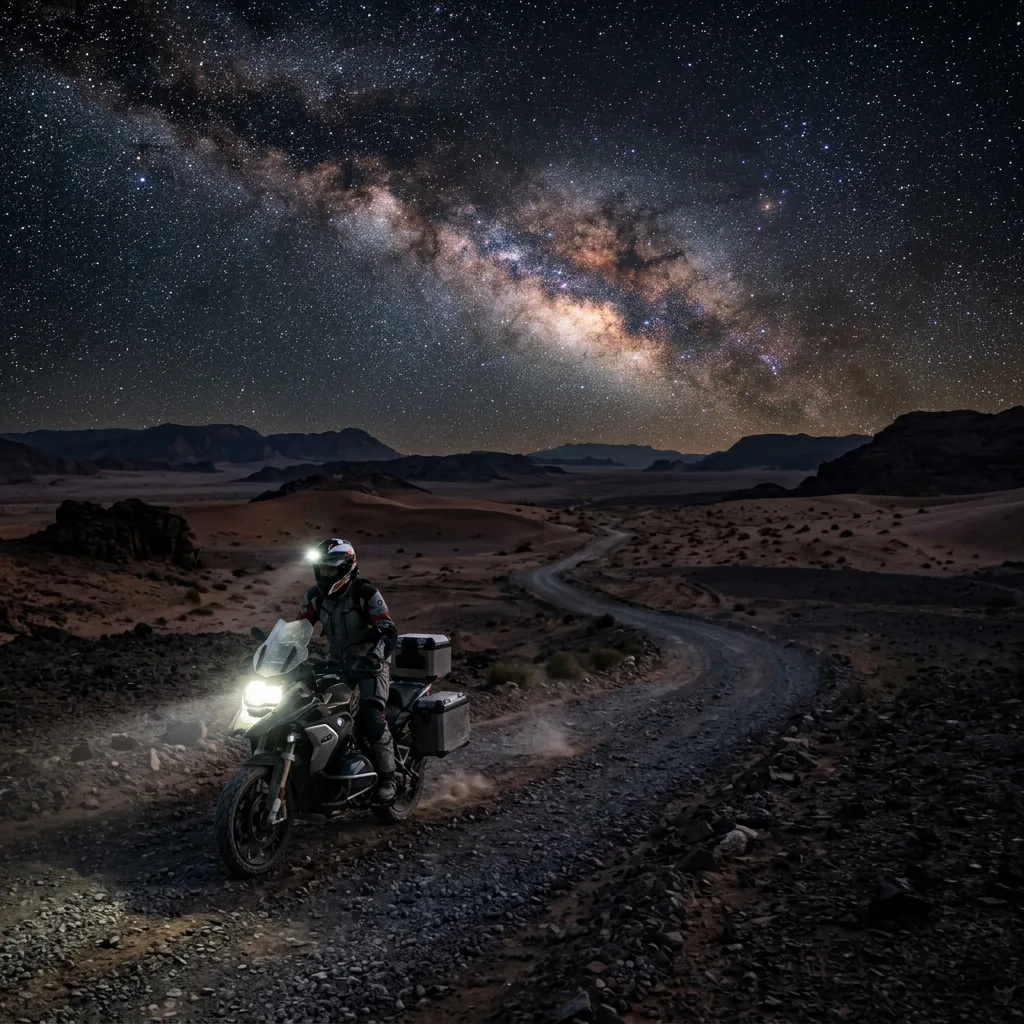
The silence here is different. No road noise, no other humans, the cliffs block the wind down to a soft breeze. At night the bay turns into a stargazing amphitheater — no light pollution for 20 km in any direction. I’ve slept here three times and only once seen another tent, and that was a German couple on bicycles who had hiked in from the coastal path.
Choose the Katrancı Hidden Bay if...
- You want true solitude with zero light pollution — best stargazing of the five bays
- You enjoy slippery, technical forest descents and you're confident on pine needles
- You're fully self-sufficient — no nearby village, no tap, no help
4. Akbük Secret Bays (Gökova Gulf)
The Gulf of Gökova is one of the cleanest pieces of riding in all of Turkey. The D330 highway between Marmaris and Akyaka winds through pine forest with the gulf glittering on your left for 40 km — tight enough to be fun, wide enough to be safe. Most riders treat the gulf as a passing-through road. They miss the dirt trails that branch off the asphalt and follow the coastline east.
The official Akbük beach is the obvious one — paved access, a few restaurants, parking, mid-tier swimmable water. Skip it. The bays you want are east of Akbük, along a 6 km string of rocky single-track that hugs the coastline.
The Slate Trail
This trail is rocky in a specific, painful way. The surface is sharp slate fragments — flat, angled stones that will slice a road-biased tire wide open if you ride them at street pressures. I drop my rear tire to roughly 1.4 bar (20 psi) before riding this section, which gives the rubber more flex to absorb the sharp edges without cutting. I run dual-sport tires (Mitas E-07 on the 250NK), and I’ve still picked one slate point out of the rear tire with pliers at the end of a long day.
If you’re on touring tires at street pressures, you will get a puncture on this trail. Not a maybe — a certainty inside 6 km. Bring a tubeless plug kit and a 12V compressor, or don’t ride this one.
The Payoff
Every 800 meters or so, the trail opens onto a tiny cove — 20 to 40 meters of pebbles or coarse sand, calm gulf water, pine trees right down to the beach. Most of these coves can fit one or two tents, max. You can literally park the bike next to the tent and dive into water that feels like a swimming pool — the gulf is so sheltered that there’s almost no current.
My favorite of the string is the third one east of the official beach. There’s a single olive tree that throws afternoon shade, a flat pebble shelf for the tent, and a natural rock platform you can dive from at low tide. Wake up at 6 a.m., unzip the tent, ten steps to swim, breakfast on the rocks. That’s what these offroad bays coastal turkey trips are for.
- Calm gulf water that feels like a heated pool
- Park your bike literally next to your tent
- Sunset views over the Datça peninsula across the gulf
- Multiple coves to choose from — easy to find privacy
- Sharp slate trail will puncture road tires — lower pressures or stay home
- Mosquitoes brutal at dusk — bring DEET, not citronella
- Limited tent capacity per cove (1-2 tents max)
5. Kardilli Beach (Black Sea Coast)
The Black Sea coast is a different country. The Mediterranean is dry, scrubby, hot. The Black Sea is dense forest, frequent rain, cool air, and grey-green water that looks more like the Atlantic than anything in the south. If you’ve only ridden the Aegean, the Black Sea will surprise you.
Kardilli Beach is northeast of Istanbul, near the town of Şile — about a two-hour ride if you take the back roads. The beach itself is a long stretch of wild sand dunes, several kilometers of it, with no buildings and almost no signage. Behind the dunes is a dense oak and pine forest that the locals call the Şile çamlıkları.
The Mud Test
The road in is the problem. From the small village of Akviran, a clay forest track runs through the trees toward the dunes. In dry weather it’s easy — hard-packed, slightly rutted, no real obstacles. After rain, which on the Black Sea coast is roughly every other day, it turns into a brown porridge that grabs your tires and tries to pivot the bike.
I rode this in late September after two days of steady rain. The mud was up to my pegs in places. I lowered my front tire pressure to about 1.0 bar to widen the contact patch, kept a deliberate steady throttle, and tried not to look at the bike’s wheels because watching them sink panics you. The trick on deep mud is the same as the trick on deep sand: stand on the pegs, lean back, throttle through, never coast.
Twice the bike stalled and I had to walk it out using leg power and the clutch. Both times my left boot came back up out of the mud with the sole half-pulled off the upper. Cleaned both boots and the bike with a garden hose at a friend’s gas station in Şile after the trip.
The Beach at the End
Worth every meter of mud. The dune system at Kardilli is enormous — you can ride the bike straight onto the firm sand at the back of the dunes (don’t ride on the soft sand near the water, you’ll get stuck), pitch a tent in the wind shadow of a dune, and gather driftwood from the surf line for a fire that won’t violate any restriction (the Black Sea coast has different fire rules than the Mediterranean).
The waves on the Black Sea are real — 1 to 2 meter rollers on a windy day. Don’t expect Mediterranean swimming. This is the kind of beach where you walk for an hour, watch the storm clouds move on the horizon, and feel like you’re somewhere a thousand kilometers from a city. (You’re not — Istanbul is 80 km away. The dunes hide it completely.)
What to Pack for Wild Camping at These Bays
The packing list for any of these remote Turkish bays adventure motorcycle trips is shorter than you’d think — but every item has to earn its place. Since none of these bays have infrastructure, you carry everything in and you carry everything out. Here’s my honest checklist for a 2-day wild-camp trip, with the items that actually matter:
- Water — minimum 6 liters per person for 2 days. I run a Hydrapak 6L collapsible reservoir strapped to my passenger seat. Lighter than a hard jerrycan, packs flat when empty. Don’t trust local taps without treating the water — bring chlorine drops or a SteriPen as backup.
- Tubeless plug kit + 12V compressor. Non-negotiable for any of the offroad bays. The Akbük slate trail alone will reward you for carrying these.
- Tarp (3x3 m packable). Mandatory at Delikli Koy. Useful at all the others as rain shelter, kitchen cover, or dry-gear staging area.
- DEET-based bug repellent. Akbük and the Black Sea coast both have serious dusk mosquito populations. Citronella does nothing here. Get the real stuff.
- Trash bags. Pack out everything you brought in, plus a bag’s worth of what previous people left. These bays stay beautiful only as long as the riders who use them respect them.
- Headlamp + spare batteries. Pitching a tent or fixing the bike at 11 p.m. with no moon is a different experience than doing it with a 300-lumen headlamp.
- Basic tool kit beyond the bike’s stock kit. A real socket set, tire spoons, chain breaker. The Katrancı pine-needle drop is the kind of place where you fix the bike yourself or you walk out.
A Word on Local Conditions and Common Sense
These remote turkish bays adventure motorcycle spots aren’t extreme by international enduro standards. What makes them serious is the isolation. You’re alone, far from cell service, on tracks that locals don’t use because they don’t have to. That cuts both ways — you get the bay to yourself, and you also have nobody to help if something goes wrong.
The honest rules I follow:
- Tell someone your route. A friend, a partner, your mother — anybody who’ll notice if you don’t message by Sunday evening.
- Ride within your skill level. Walking a hard section is not a defeat. Dropping the bike in a way that injures you 12 km from a paved road is.
- Carry more water than you think. Heat exhaustion is the real summer risk on the south coast.
- Respect the spaces. No fires in fire-restricted months. No camping inside marked ruins or fenced areas. No leaving trash. The reason these bays are still open to riders is because the local jandarma and forest service tolerate motorcycles. That tolerance is conditional on us not abusing it.
If you ride these bays in the same spirit they were left to us in — quiet, careful, respectful of the land and the locals — you’ll have the experience that made me fall in love with motorcycle camping in the first place. The bay all to yourself, the pine smell at dusk, the sound of waves at 3 a.m., the stars overhead with no city glow to mute them. That’s the whole point.
The world hasn’t run out of these places. You just have to be willing to ride a few kilometers nobody else will.
Disclosure: Some of the links in this article are affiliate links. If you buy gear through them, we may earn a small commission at no extra cost to you. It helps fund the road trips that find these bays — every spot in this guide got a tent pitched on it before it made the cut.
Frequently Asked Questions
Can I reach these bays on a standard street bike?
Delikli Koy and the asphalt approach to Akbük are doable on a street bike if you ride slowly and accept some sand patches. Kabak Valley, Katrancı's hidden path, and Kardilli on the Black Sea coast are not — you need real ground clearance, dual-purpose tires, and the willingness to drop the bike at least once. My CFMOTO 250NK is closer to a street bike than an ADV, and I made it down all five, but I dropped it twice and walked sections I didn't trust. Don't take a fully-loaded sport-tourer down these tracks.
Is wild camping legal in Turkey?
Tolerated, not strictly legal. In remote forest roads and beaches outside marked national parks, nobody bothers you. Inside official protected zones, archaeological sites, or private land, you can get told to leave — usually politely. The jandarma (rural police) almost never interfere if you're respectful, you don't light open fires in fire-restricted months (June through October in most coastal provinces), and you leave the spot cleaner than you found it. Don't camp inside ruin sites or fenced areas. Don't park inside what looks like a goat enclosure. Use common sense.
Is there fresh water at these beaches?
No. Zero. You carry every drop you'll drink, cook with, and rinse your face in. I pack a minimum of 4 liters per day per person plus an extra liter as buffer. A 6-liter Hydrapak collapsible bladder lives on my passenger seat for trips longer than one night. The nearest tap water is usually a village 10-20 km back up the road you just descended, so plan to be self-sufficient from the moment you leave the last paved road.
How dangerous are these descents, honestly?
They're not technically extreme by enduro standards, but they punish mistakes. Loose gravel on a steep gradient with a fully loaded bike will pitch you off if you grab too much front brake or let off the throttle at the wrong moment. The danger isn't terrain difficulty — it's that you're alone, miles from help, with no cell service. If you crash and break a leg at the bottom of Kabak Valley, you're walking three hours uphill to get back to a phone signal. Ride within your skill level, tell someone your route, and budget more time than you think you need.