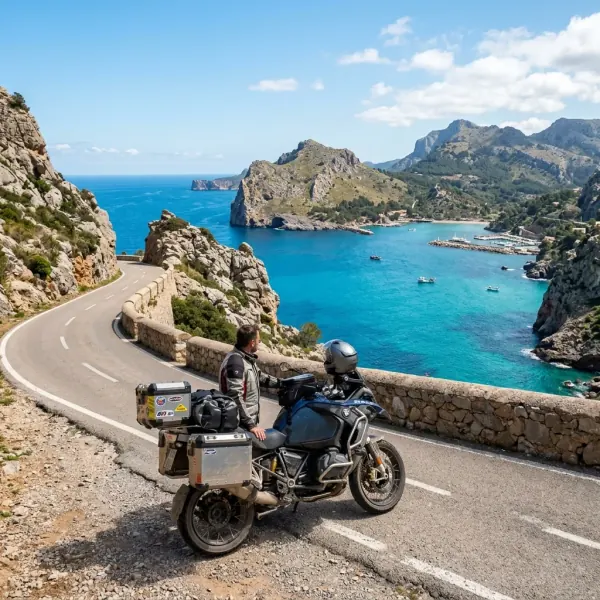
The first time I rode the coast from Fethiye to Antalya, I did it in three days and skipped almost everything that makes it worth doing. I saw the road but not the route. I rode past Kekova without realizing what it was, blew through Kaş in under an hour, and missed Çıralı’s beach completely because I’d already booked a hotel in Antalya for that night.
The second time, I gave it a week. Seven days, 475 kilometers, with the ride itself taking maybe 12 hours of saddle time. The rest was the point of the trip — boat trips to sunken cities, swimming in bays where no road reaches, meals in fishing villages where the catch came in that morning, and one night camped on a headland watching the moon rise over the Mediterranean.
This guide is what I wish I’d had the first time. A working Lycian Way motorcycle route guide that treats the route as a destination, not a corridor. The roads between Fethiye and Antalya hold what is genuinely the best 35 kilometers of motorcycle riding in Turkey, plus a string of bays, ancient cities, and mountain villages that earn the seven days you give them.
Why the Lycian Coast Is Turkey’s Best Motorcycle Road
Turkey has two great motorcycle coasts. The Black Sea is wild, green, less developed, and brutal in winter. The Mediterranean is built around the ancient Lycian civilization that occupied this coast 2,000 years ago — which means every bay holds a ruined city, every headland has a sarcophagus carved into the rock, and the roads were originally built to connect a network of Lycian ports.
The road that does the heavy lifting today is D-400 — a well-maintained two-lane highway that hugs the coast from Fethiye east to Antalya. In places it climbs hundreds of meters above the sea and descends to beach level in a single 5 km switchback. The pavement is consistently good. Truck traffic is light outside high summer. Police presence is moderate but reasonable.
The route doesn’t ride like a highway. It rides like a coastal touring road built specifically for two-wheelers. You round a corner and a turquoise bay opens 200 meters below. You climb a switchback to a viewpoint with a roadside teahouse. You drop into a fishing village where lunch is whatever came in that morning. Repeat for 475 kilometers.
The Route at a Glance
| Day | Stage | Distance | Highlight |
|---|---|---|---|
| 1 | Fethiye → Kalkan | 120 km | Ölüdeniz, Patara beach |
| 2 | Kalkan → Kaş | 35 km | Best coastal road in Turkey |
| 3 | Kaş → Kekova/Üçağız | 60 km | Sunken Lycian city boat trip |
| 4 | Kekova → Finike via mountains | 90 km | Inland Lycian villages |
| 5 | Finike → Olympos/Çıralı | 70 km | Wild camping headlands |
| 6 | Olympos → Antalya | 100 km | Mountain pass + city arrival |
| 7 | Antalya rest day | 0 km | Old town, bike service |
Total: roughly 475 km of riding spread across 6 riding days, with day 7 a rest day in Antalya. The actual saddle time totals 12-14 hours — most days are 2-3 hours on the bike with the rest of the day free.
Day 1: Fethiye to Kalkan (120 km)
Start in Fethiye. The town is the natural western anchor of the route — it has rental bike shops, mechanics, hotels in every price range, and the marina is worth a morning wander before you set off.
Leave Fethiye on D-400 heading south. Within 15 km you’re climbing above Ölüdeniz, the lagoon-and-blue-bay combination that anchors every Turkey tourism poster. The viewpoint from the road is the best free photo of the trip. Skip the descent to the beach itself unless you want crowds.
Continue south on D-400. The road climbs through pine forest, descends to Kınık, climbs again, and at about kilometer 75 you reach Patara — an 18 km stretch of empty sand backed by ancient ruins. The Patara archaeological site is one of the most extensive on the coast, and the beach is wide, sand-floored, and almost completely undeveloped. Spend an hour here.
Continue 25 km east to Kalkan, a former Greek fishing village that has become a mid-range resort town. Whitewashed houses, narrow stepped streets, harbor restaurants. Stay one night here.
Road notes: D-400 the entire way. Smooth pavement, moderate traffic. Watch for slow trucks on climbs — overtake on straights, not in switchbacks. Fuel in Fethiye, Kınık, and Kalkan.
Day 2: Kalkan to Kaş — The Best Coastal Road in Turkey (35 km)
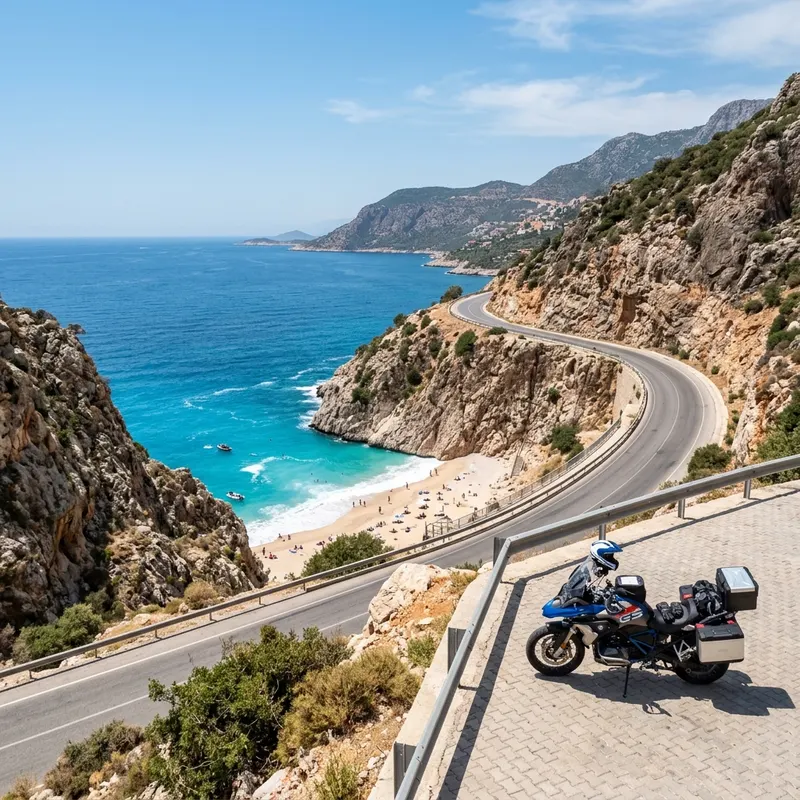
Short day on paper. Don’t let the distance fool you. This 35 km stretch of D-400 between Kalkan and Kaş is the finest single piece of motorcycle road on the Turkish Mediterranean and arguably in the country.
The road clings to the coast 100-200 meters above the sea on a continuous traverse of headlands and bays. Every corner reveals a new view. The pavement is excellent. Traffic is light outside July-August. The corner-to-corner rhythm is medium-speed sweepers — 60-90 km/h pace, never frantic, always engaging.
Mid-route, about 15 km out of Kalkan, you reach Kaputaş Beach. The road climbs over a narrow gorge that drops 200 meters to a small turquoise beach. Park at the roadside layby, descend the 187 stone steps, and swim. The beach is small enough to feel discovered and developed enough to have a small shop selling cold drinks. This is the unmissable stop.
Continue east to Kaş for lunch. Kaş is a working town with a fishing harbor, a 4th-century BC Lycian tomb in the middle of a residential street, and a network of dive shops because the water off the harbor is some of the clearest in the Mediterranean.
Stay in Kaş or push 10 km further to Bayındır for quieter accommodation.
Road notes: Pure D-400. Watch the Kaputaş switchback descent — tight, blind, occasional gravel.
Day 3: Kaş to Kekova and Üçağız (60 km)
From Kaş, ride east on D-400 about 40 km to the Üçağız turn-off — a 7 km side road that descends to the small fishing village of Üçağız. Park here for the day. Üçağız is the boat launch for Kekova, the sunken Lycian city.
Kekova was a Lycian harbor town that was destroyed by an earthquake in the 2nd century AD. The city sank into the bay. Today you can take a 2-3 hour boat trip from Üçağız over crystal-clear water and look directly down at the foundations of houses, the carved stone steps of ancient streets, and amphoras still embedded in the seabed. Glass-bottom boats are €25-35 per person and run multiple times daily.
After the boat trip, ride 5 km uphill to the village of Kaleköy, accessible only by motorcycle, boat, or hiking trail. Kaleköy has a 14th-century Crusader castle perched above the bay with views that justify the climb. Lunch at one of the harbor restaurants below the castle.
Return to Üçağız and ride 25 km east to Demre for the night. Demre is the modern town built next to the ancient Lycian city of Myra — famous for its rock-cut tombs in the cliff face above the theater. The tombs are 5 km outside town, open daily, and worth the small entry fee.
Road notes: D-400 plus a 7 km side road to Üçağız (paved, narrow). The motorcycle route from Üçağız to Kaleköy is paved but tight.
Day 4: Kekova to Finike via Mountain Roads (90 km)
This is the day to leave the coast for the mountains. From Demre, take the D-635 inland road that climbs over the Beydağları range. Within 20 km you’re at 1,200 meters elevation in pine forest, with the coast below visible through gaps in the ridges.
The route loops through the village of Kasaba, the Lycian rock tombs at Sura, and descends to Finike on the coast 90 km later. The road is paved the entire way but narrow, with sections of 5-10 km where you’ll see no other vehicle. The corners are tight, the surface is mostly good with occasional gravel patches in spring after winter washouts, and the views are dramatically different from the coast — alpine meadows, mountain villages, shepherd flocks.
Plan a full fuel tank before leaving Demre. There are no reliable petrol stations on this loop until you reach Finike. Carry water — there are few villages, fewer shops.
Finike itself is a working agricultural town (oranges are the regional crop) with a long, gray-pebble beach. It’s less touristy than Kaş or Kalkan, which means cheaper accommodation and quieter evenings.
Road notes: D-635 inland is technical and remote. Suitable for any motorcycle but not the route for inexperienced riders or large heavy tourers without confidence on narrow mountain roads.
Day 5: Finike to Olympos and Çıralı (70 km)
From Finike, ride east on D-400 along the coast 50 km to the Olympos/Çıralı turn-off. The descent from D-400 down to the coast is a 6 km switchback through pine forest that delivers you to one of the most atmospheric stops on the entire route.
Olympos is an ancient Lycian city now half-buried in lush riverside forest — you walk through ruins overgrown with vines and arrive at a 4 km beach backed by mountains and protected as a national park. The beach is wild, undeveloped, and quiet outside high summer.
Çıralı is the sister village 1 km north, sharing the same beach. Çıralı has small family-run pensions, beachfront restaurants, and a more accessible vibe. Both villages are connected by a 20-minute beach walk.
The unmissable evening activity is the hike up to the Chimaera flames — natural methane vents in the mountainside above Çıralı that have been burning continuously for thousands of years. The hike is 1 km, easy, and best done at dusk when the flames are most visible. Bring a headlamp for the descent.
For wild camping, ride past Çıralı north on the small coast road toward Adrasan. Multiple headland pull-offs along this stretch are common wild-camp territory — flat enough to pitch a tent, well above the road, with sea views and afternoon shade.
Road notes: D-400 plus a 6 km steep switchback descent. Watch the descent in wet weather.
Day 6: Olympos to Antalya (100 km)
Final long riding day. From Çıralı, climb back to D-400 and continue east. The road traces the coast for 40 km past Adrasan and through small holiday villages, then climbs into the Beydağları mountains on a 30 km pass with views back toward Olympos and forward toward Antalya bay.
The descent into Antalya is long and gradual. The city sprawls along the bay, the old town (Kaleiçi) clings to the cliffs above the harbor, and the urban traffic builds in the last 15 km. Stay in Kaleiçi if you can — the old town is a maze of Ottoman-era streets, restaurants in restored stone houses, and the entire district is closed to most through-traffic.
Park your bike at your accommodation. Walk Kaleiçi in the evening. The Hadrian’s Gate, the Yivli Minaret, and the harbor at sunset are all 10-minute walks from anywhere in the old town.
Road notes: D-400 with one mountain pass. Smooth pavement, moderate traffic, urban density in the last 15 km.
Day 7: Antalya Rest Day — Bike Service and City
Most riders skip the rest day. Don’t. After 6 days and 475 km of coastal riding, your bike needs a chain clean and lube, a tire pressure check, and probably a wash. Your body needs a day off the saddle.
Antalya has several motorcycle service shops. Get a basic chain service and a tire check, ideally for under €20. While the bike is in the shop, walk the old town, visit the Antalya Archaeological Museum (one of the best in Turkey for Roman and Lycian artifacts), and eat a long lunch at one of the harbor restaurants.
The return trip is yours. Many riders ride the same D-400 back west to Fethiye. Others continue east toward Side, Alanya, and the Taurus Mountains. The Lycian Way ends in Antalya. The Turkish coast continues for another 700 km east before the road ends at the Syrian border.
Lycian Way Rider Packing Checklist
What you actually need for a 7-day Lycian Way ride beyond standard touring gear:
- Downloaded offline maps for Muğla and Antalya provinces (0 g)
- Cash in Turkish Lira for rural fuel and accommodation (minimal weight)
- Sunscreen SPF50+ Mediterranean summer essential (100 g)
- Swimming gear — bays are unmissable (200 g)
- Tyre plug kit coastal sections (180 g)
- Lightweight dry bag for wet swim gear after beach stops (50 g)
- Small daypack for boat trips and Kaleiçi walking (200 g)
For wild camping nights, layer in a compact sleeping pad, a lightweight tent, and a small camp stove — see the linked guides for specific picks.
Best Season and Weather
Late April to mid-June: best overall season. Daytime 22-28°C, water 20-23°C, wildflowers, light traffic. The coast is fully open but not crowded.
Mid-September to late October: second-best season. Daytime 24-30°C, water still 23-25°C from summer warmth, stable weather, light traffic. The most reliable autumn riding window.
July-August: avoid. Daytime 35-40°C inland, coastal traffic heavy, accommodation prices double. Possible if you ride early-morning only and beach in the afternoon, but the experience suffers.
November-March: D-400 stays open and rideable. Rain is more frequent, mountain alternates can wash out, and many coastal restaurants close. A different trip — quieter, cheaper, occasional wet days, no swimming.
Internal Connections
This route connects to other Turkey content on Bikes and Bays:
- For longer dual-sport routes inland, see the Turkey TET route guide.
- For wild-camping bay options along the same coast, see remote Turkish bays only an adventure motorcycle can reach.
- For hot-weather riding gear that handles Mediterranean summer, see the Klim Badlands Pro jacket review.
FAQ
Five common questions are answered at the top of this page. The short version: ride this route in spring or fall, give it 7 days, and plan around the day-2 Kalkan-Kaş road, the day-3 Kekova boat trip, and the day-5 Çıralı wild camp. Those three stops are what separate a memorable trip from an average one.
Whatever shape your version of this lycian way motorcycle route guide takes, the best advice I can give is to ride short days. The road is short. The country is deep. Spend the saved hours swimming, eating, and looking at things older than your country.
This guide is based on multiple personal trips along the route. Some links in this article are affiliate links — if you buy gear through them, we may earn a small commission at no extra cost to you.
Frequently Asked Questions
When is the best time to ride the Lycian Way?
Late April through mid-June and mid-September through October. Spring gives you wildflowers, cool mornings, water still warm enough to swim, and minimal tourist traffic. Autumn gives you stable warm weather, sea temperatures still around 22°C, and quiet villages after the summer crowds leave. Avoid July and August — temperatures hit 38-40°C inland, coastal traffic is heavy, and accommodation prices double. Winter is rideable on the coastal D-400 but mountain alternates close after heavy rain.
Can I ride this on a small dual-sport like a CFMOTO 250?
Yes, easily. The D-400 coastal road is paved highway the entire way. The mountain alternates I describe in days 4 and 6 have some 5-10 km gravel sections but nothing technical. The actual challenging Lycian Way hiking trail is not motorcycle-passable — it's a footpath. The motorcycle route runs parallel on roads. A 250cc dual-sport handles this trip comfortably; a sport-tourer or naked bike does the road sections fine but skips the mountain alternates.
Where can I find fuel on remote sections?
The coast is well-served. Fethiye, Kalkan, Kaş, Demre, Kumluca, Olympos junction, and Antalya all have multiple stations. The longest gap is the mountain route from Demre to Finike via the inland road — about 80 km between stations. Plan a full tank before any mountain alternate. The standard fuel range of a 250-650cc tank covers every stage on this route with margin.
Is wild camping legal in Turkey?
Turkey has a tolerant approach to wild camping in remote areas. You're not allowed in national parks (Olympos is one — use the established campgrounds at Çıralı and Olympos village). Outside protected zones, camping on undeveloped coast or in forest is widely tolerated as long as you leave no trace, don't build fires in dry months (July-September fire bans are strict and enforced), and don't camp on private agricultural land. The bays near Kabak, the Datça peninsula, and the headlands past Çıralı toward Adrasan are all common wild-camp territory.
How much should I budget per day?
For a moderate-comfort trip — guest house or pension accommodation, local meals, fuel, and one boat or museum entry per day — budget €60-80 per person per day in 2026. Wild camping with self-cooked meals drops this to €25-35 (mostly fuel and bread). Hotel-and-restaurant comfort raises it to €120+. The Lycian coast spans every price range; villages like Üçağız and Çıralı are cheap, resort towns like Kalkan and Antalya old town are not.