The first time I rode the Algarve I spent the whole trip looking for the version of Portugal in the tourism brochures and not finding it. I rode the main N125 inland road between Lagos and Vila Real, slept at chain hotels in resort towns, and saw nothing of what makes the Algarve worth the ride. The brochures had cliff roads. I had inland Algarvian back-country, which is fine, but it’s not the same place.
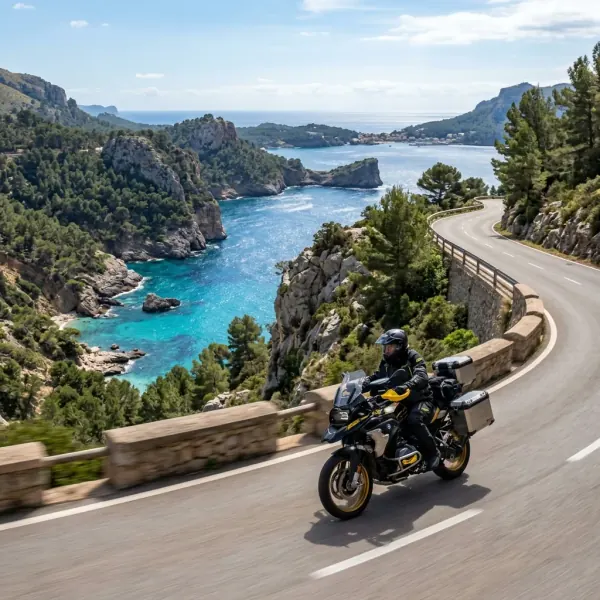
The second time I knew to ignore the main road and ride the N125 west from Lagos to Sagres. That single 30-km stretch is what the Algarve is for. Cliff-edge tarmac, the Atlantic 80 meters below, headlands extending into the ocean every few kilometers, and at the end of it Cape St Vincent — the southwestern corner of continental Europe, where the lighthouse marks the last land before America.
This guide is the working version. Algarve coast motorcycle camping — the cliff roads worth riding, the established campgrounds that work for motorcycles, the wild spots that still tolerate one-night camping in 2026, and the realistic legal situation after Portugal’s 2021 wild camping crackdown.
Why the Algarve Is a Motorcycle Rider’s Secret
Portugal’s southern coast packs more dramatic geography into 200 km than most countries fit into 1,000. The Algarve is a sequence of golden cliffs eroded into arches, sea caves, and hidden coves, fronted by Atlantic surf and backed by a quiet inland of cork forests, olive groves, and small whitewashed villages.
For motorcycle riders, the Algarve works because the supporting infrastructure is excellent — paved roads throughout, frequent fuel stations, good motorcycle-friendly accommodations (Portuguese guest houses and small hotels), and affordable prices by Western European standards. A two-week Algarve trip costs roughly half what an equivalent French Riviera trip costs.
The challenge is the popularity of the central Algarve (Lagos through Albufeira). Summer turns these towns into resort cities with traffic, queues at famous beaches, and limited wild camping tolerance. The strategy is to use the central Algarve as a base for the cliff roads but pitch camp elsewhere — the western Costa Vicentina coast above Sagres, the inland mountains, or the quieter eastern Algarve toward Spain.
The Best Algarve Coastal Roads for Motorcycles
Lagos to Sagres — The Cliff Road
The N125 west of Lagos is the defining Algarve motorcycle road. 30 km of paved cliff-edge tarmac from Lagos through Vila do Bispo to Sagres at the southwestern tip.
The road sits 50-100 meters above the Atlantic, with the cliffs continuously visible from the riding position. Multiple pull-offs let you stop for views or descend short side roads to specific beaches (Praia do Camilo, Praia da Cordoama, Praia do Castelejo). The villages along the route are small and quiet — Sagres at the end is the largest town and the natural overnight base.
Riding notes: Two-lane paved road, well-maintained. Speed limits 50-80 km/h depending on section. Moderate traffic outside July-August. Watch for cyclists on weekend mornings.
Ponta da Piedade — The Dramatic Headlands
3 km southwest of Lagos, the Ponta da Piedade headland features the most-photographed cliffs of the Algarve. Eroded golden sandstone, sea arches, and small coves accessible only by boat or hiking.
For motorcycles, the road to the Ponta da Piedade lighthouse is short (3 km) but provides direct access to the headland walks. Park at the lighthouse, walk the 1-km trail along the clifftop, and continue back to Lagos or onto the N125 west.
Cape St Vincent — End of Continental Europe
At the western terminus of the N125, Cape St Vincent (Cabo de São Vicente) is the southwestern corner of continental Europe. The cape has a 16th-century lighthouse, a small museum, and views back along the southern coast and north along the Costa Vicentina.
The cape is genuinely the end of the road — beyond it is the Atlantic. The 6-km ride from Sagres to the cape lighthouse is essentially mandatory for any Algarve trip.
N120 North — The Costa Vicentina
From Sagres, the N120 turns north along the western Atlantic coast. This stretch — the Costa Vicentina — is the wild Portugal that the central Algarve isn’t. Empty cliffs, surf beaches (Carrapateira, Aljezur), small villages, and almost no tourism infrastructure.
The road continues north all the way to Lisbon (300+ km) for riders who want to extend. For an Algarve-focused trip, the 80 km from Sagres to Aljezur and back is a perfect half-day ride and a complete contrast to the central Algarve.
Where to Camp: Established Sites vs Wild Spots
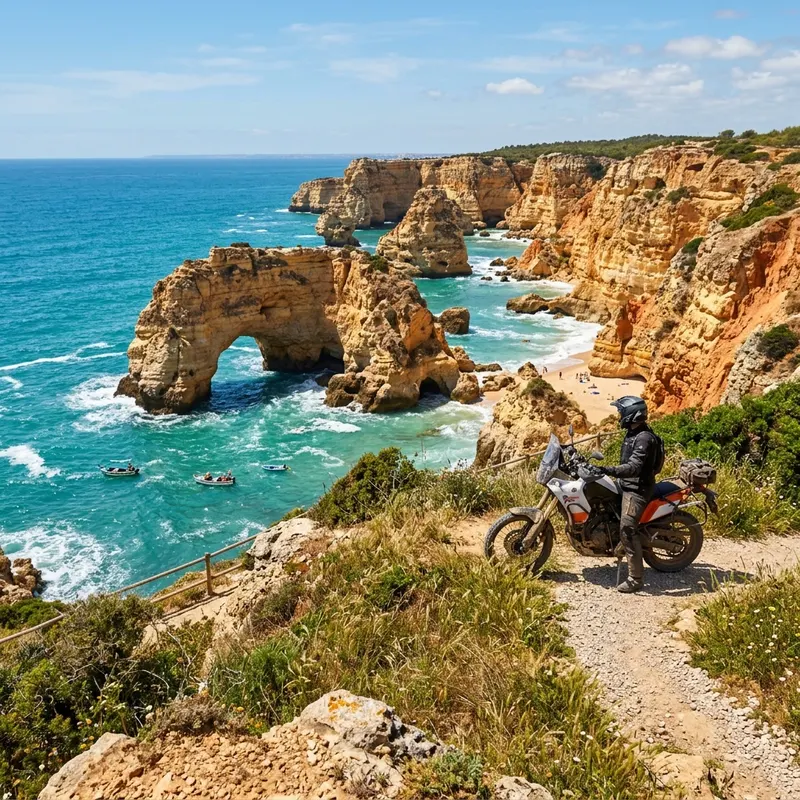
The Algarve has good established campgrounds throughout the region. Notable for motorcycle riders:
Parque de Campismo de Sagres. Family-run campground at Sagres, near Cape St Vincent. Motorcycle-friendly, hot showers, restaurant, walking distance to town. €15-22/night. Open year-round.
Camping Olhão. Eastern Algarve, near the Ria Formosa wetlands and the islands offshore (Ilha da Armona, Ilha da Culatra). €18-24/night. Quieter than central Algarve campgrounds.
Camping Armação de Pêra. Central Algarve coast. Larger campground with full facilities including pool. €25-32/night in summer.
Camping Quarteira/Albufeira. Resort-area campgrounds, fully developed, summer-busy. Best avoided unless you specifically want beach-club Algarve.
Wild camping spots in 2026:
Inland Costa Vicentina hinterland. The hills 5-10 km inland from the western coast have multiple dirt tracks leading to flat camping spots in cork-forest clearings. Tolerated, almost no enforcement.
Mountain back-country (Serra de Monchique). The inland mountains rising to 900m offer cool nights, eucalyptus and pine forest, and excellent privacy. Wild camping widely tolerated.
Less-visited western coast bays. Specific spots near Carrapateira and Bordeira have dirt-track access to remote pull-offs. Use late-arrive-early-leave discipline.
Algarve Wild Camping Reality in 2026
Portugal’s Decree-Law 31/2021 changed the wild camping legal framework in response to motorhome overuse during 2020-2021. The headline changes:
- Overnight stays outside designated camping areas restricted, particularly for motorhomes
- Beaches and beach-adjacent zones actively patrolled in summer
- Tourist hotspots (Praia da Marinha, Benagil beach area, Lagos area) see regular ranger checks
- Fines €60-300 for non-compliance, vehicles can be moved
For motorcycle tent campers (as distinct from motorhome users), enforcement is lighter — a small tent set up at sunset and packed at sunrise rarely draws attention. The targets of the crackdown are mostly large RVs parking for multiple nights at popular coastal viewpoints.
The realistic strategy:
- Use established campgrounds for any planned multi-night stop near the central Algarve
- Wild camp the inland mountains and the western Costa Vicentina coast
- Single-night discreet camping at smaller bays still tolerated
- Avoid wild camping at named tourist beaches in July-August
Rider Camping Packing Checklist
What you actually carry for Algarve coastal camping:
- Arrive late leave early rule for wild spots — especially in summer (0 g)
- WindyApp checked for overnight Atlantic wind direction (0 g)
- Cash in euros — rural Algarve sites often cash only (minimal)
- Sun protection — UV index extreme in summer (100 g)
- Tyre plugs — some Sagres cliff roads have loose gravel (180 g)
- Swim gear — beaches are the point (200 g)
The Atlantic wind point matters more than most riders expect. The western Algarve and Costa Vicentina coast catches consistent Atlantic westerly winds — 15-25 km/h is typical, gusts to 50 km/h during summer pressure changes. Tent pitching must account for the wind. Pitch the back of the tent into the wind, stake every guy line, and use rocks or your luggage on tent corners as backup weight.
Check SPF50 Sport Sunscreen on Amazon →
Check Quick-Dry Travel Towels on Amazon →
Getting to the Algarve: Routes from UK and Northern Europe
Three options for non-Iberian riders:
Channel + drive (4-5 riding days from UK to Algarve). Fastest cumulative time but the most riding fatigue. Calais → Bordeaux → San Sebastian → Madrid → Lisbon → Algarve. 2,500 km. Choose this if you want to ride through France and Spain en route.
Brittany Ferries Portsmouth/Plymouth to Santander (1 ferry crossing + 1-2 riding days to Algarve). 33-hour ferry crossing arrives Santander, then 800 km south through Spain to the Algarve. The arrival rest helps; the Spanish riding is excellent (Salamanca, Cáceres, then south). Total UK to Algarve: 3 days. See UK to Spain motorcycle ferry guide for ferry details.
Fly to Faro + rent locally. Direct flights from major European cities to Faro Airport. Multiple rental agencies in Faro (Hertz Adventure, Algarve Bike Tours). Best for focused 7-14 day Algarve trips without the riding-to-and-from time burden.
For UK riders specifically, the Brittany Ferries route is the recommended approach — saves 1,000 miles of French motorway, arrives rested in Spain, allows a leisurely 2-day ride south through Salamanca and Cáceres to reach the Algarve.
Internal Connections
This guide pairs with related content:
- UK to Spain motorcycle ferry guide — the recommended UK approach
- Best wild camping bays Mediterranean — Portugal in context (though Atlantic, not Mediterranean)
- Best coastal motorcycle routes Mediterranean — for riders combining Algarve with Mediterranean coastal touring
FAQ
Five common questions are answered at the top of this page. The short version: ride April-June or September-October, the N125 Lagos-Sagres is the defining road, Cape St Vincent is mandatory, established campgrounds for popular areas plus wild camping for less-visited Costa Vicentina, and Atlantic wind requires proper tent staking.
Whatever your version of an Algarve coast motorcycle camping trip looks like, the principle is to use the central Algarve for the cliff roads but base your camping in less-trafficked areas — the western Costa Vicentina coast, the Serra de Monchique mountains, or the eastern Algarve toward Spain. The famous beaches are worth visiting. The camping that supports the trip is better elsewhere.
Disclosure: Some links in this article are affiliate links. If you buy gear through them, we may earn a small commission at no extra cost to you.
Frequently Asked Questions
Is wild camping legal in Portugal in 2026?
Portugal tightened wild camping rules in 2021 — Decree-Law 31/2021 restricts overnight stays outside designated camping areas, particularly affecting motorhomes and camper vans near tourist beaches. Enforcement focuses on coastal hotspots in summer. Inland and in less-touristed sections of the Algarve, discreet one-night camping is still tolerated. The realistic rule: established campgrounds for the popular Algarve beach areas, wild camping for the inland mountain hinterland and less-visited western Costa Vicentina coastline. Arrive late, leave early, no fire, no trace.
What's the best Algarve motorcycle road?
The N125 cliff road from Lagos west to Sagres is the classic. 30 km of cliff-edge tarmac with dramatic Atlantic views, climbing and descending across the headlands. The road ends at Cape St Vincent (Cabo de São Vicente) — the southwestern corner of continental Europe and the most westerly point. Side roads down to specific beaches (Ponta da Piedade, Praia do Camilo) are short but worth riding. The N120 north from Sagres up the Costa Vicentina is the lesser-known continuation — wild, empty, less developed than the southern Algarve coast.
When should I avoid the Algarve?
July and August. Peak Portuguese and British holiday season, daytime temperatures hit 30-35°C, accommodation prices double, and the famous beaches (Praia da Marinha, Benagil) become full from morning. Wild camping enforcement also peaks in summer as ranger patrols increase. The right windows are April-June and September-October — warm sea, manageable crowds, lower prices.
Can I ride from the UK to the Algarve in one trip?
Yes, with two options. Option 1: Channel Tunnel + 4 days riding through France and Spain (Calais → Bordeaux → San Sebastian → Lisbon → Algarve, ~2,500 km). Option 2: Brittany Ferries from Portsmouth to Santander, then 6-8 hours south to Lisbon and on to the Algarve (saves 1,000 miles of French motorway, see [UK to Spain motorcycle ferry guide](/blog/uk-to-spain-motorcycle-ferry-guide)). Most riders combining the Algarve with longer Iberian trips choose the ferry. Direct fly-and-rent from Faro Airport is also viable for short focused trips.
Is the water actually swimmable at Algarve beaches?
Yes in summer (June-September), water temperatures 18-22°C. Atlantic swell is moderate to strong — the Algarve is exposed to Atlantic waves and the western coast (Costa Vicentina) has serious surf even in summer. Watch for rip currents at the larger beaches. Smaller protected coves (Praia do Camilo, Praia da Marinha) have calmer water and easier swimming. The eastern Algarve coast (Tavira, Olhão) faces the calmer Gulf of Cádiz and has gentler swimming year-round.