
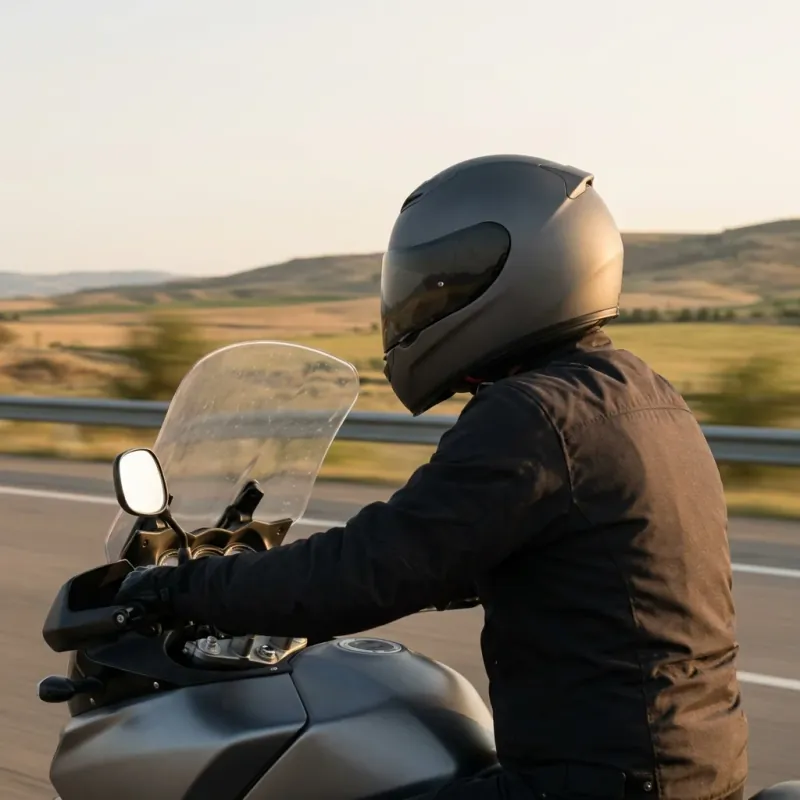
Buffeting is the shaking and roaring that starts when your helmet meets the turbulent air peeling off the top of the windscreen. On an adventure bike, with a short screen and an upright seat, it tends to arrive right at highway speed. Screen makers have a standard answer: set the top edge just below your eyes so you look over it. A wind tunnel study from the University of Southampton, on two 1990s touring BMWs, measured that position as at or near the loudest place to put your head.
We read two university research programmes on windscreen airflow and helmet noise, the screen pages of eight adventure bikes’ owner’s manuals, the height guides of four screen makers, and the product pages, approval documents and owner reviews for the add-on spoilers sold to fix the problem. Every figure below was checked against the page it came from. None of the studies measured an adventure bike or an add-on spoiler, and where we rely on makers’ descriptions or owner reports, we say so.
Disclosure: some links below are affiliate links. If you buy through them we may earn a small commission at no extra cost to you.
The five-minute test: which side of the wake are you on?
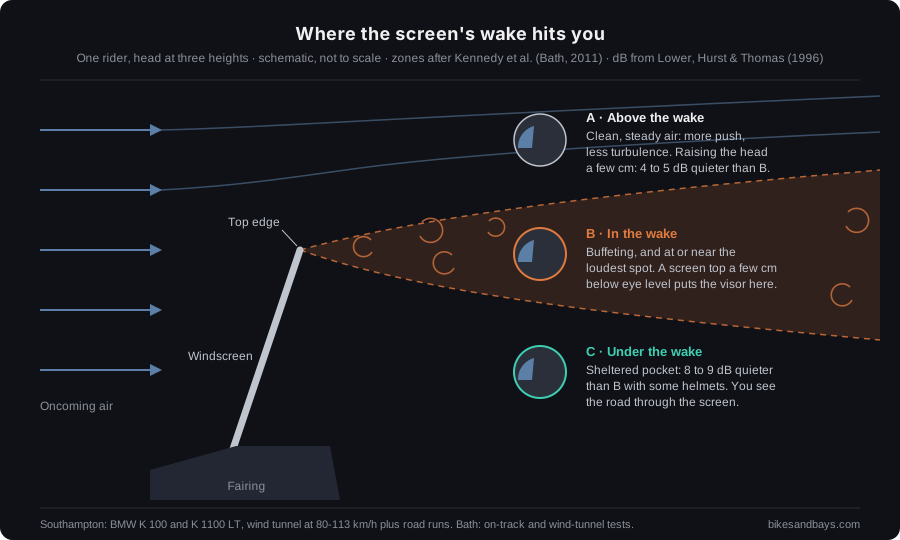
The diagram shows one rider with the head at three heights. In zone A the helmet is in clean air: the wind pushes on it, but steadily. In zone B it sits in the turbulence coming off the screen’s edge, which is where the shaking and most of the noise are. In zone C it is in the screen’s shelter. The aim is to get out of B, and a few centimetres decide it.
First clue: where do you feel it? Southampton found that a low screen aimed the turbulence at the base of the helmet, the neck and the shoulders, and a higher screen aimed it at the visor and the shell just above it. If the roar and the pressure sit around your collar, the wake is low on you. If they sit on your visor, the edge is near your eye line.
Then run the test:
- Pick a calm day and a straight, empty road, and ride at the speed where the buffeting bothers you, within the limit, with your earplugs in as usual.
- Sit normally for 30 seconds. Judge the shake rather than the noise: with earplugs in, small changes in noise are harder to judge than the helmet moving.
- Lower your head a few centimetres for a few seconds, eyes still on the road ahead and both hands on the bars. If the shake eases, you were in the lower part of zone B and dipped towards C.
- Sit a few centimetres taller for a few seconds. If that eases it, you were in the upper part of B and rose towards A.
- Keep your head at the same height and tip your chin slightly down, then slightly up. Bath found that riding position and helmet angle together changed the sound at the ear by more than 10 dB on track, so the angle can matter as much as the height.
- Repeat each position twice, then ride the same stretch the other way, so a crosswind doesn’t fool you.
Keep every movement small and brief, and never look down at the tank to do it. Run it solo, loaded the way you usually tour if you can. If your helmet has a peak, start slowly: Arai’s own manual warns that air catching its peak at speed can make it hard to bring your head back to a level position, and says to find the speed at which it should come off by starting low.
What the result means:
- Calmer when you drop your head (lower B): you need the edge a little higher. Raise an adjustable screen one step; on a fixed screen, that is the case for a spoiler or a taller screen.
- Calmer when you sit taller (upper B): you need the edge a little lower, or your head a little higher. Lower an adjustable screen one step. On a fixed screen, a shorter replacement or a higher seat option, if your bike has one, does it. An air cushion will not: inflated as its maker says, it lifts you only 3 to 6 mm (the numbers are in our seat cushion guide), a fraction of the few centimetres that mattered in the tunnel.
- No change either way: the screen’s edge probably isn’t your main problem. Check the helmet side (next sections), and check that the screen itself isn’t loose or vibrating on its mounts.
This is an application of what the researchers measured, not a tested procedure. It costs five minutes, and it tells you whether to buy height, lose height or leave the screen alone.
Why it works: what two research groups measured
Researchers at the University of Bath measured helmet noise on a track and in a wind tunnel. They describe the vortices shed by a motorcycle windscreen as creating three flow regions around the rider’s head: the free stream above, the path of the vortices, and the shielded area underneath. In their road tests the noise at the ear traced back to that vortex street, and they concluded that most of the variation in helmet noise comes from the motorcycle’s configuration and the rider’s build and posture rather than from the helmet.
The Southampton work, done for the Home Office, put miniature microphones at a police instructor’s ears in a wind tunnel at 80 to 113 km/h (50 to 70 mph), on a BMW K 100 and a K 1100 LT with their engines off, and mapped the airflow with a pitot tube and a hot-wire probe. Its findings:
- The edge of the screen’s wake was highly turbulent, and depending on screen height it hit the rider anywhere between the neck and the top of the helmet.
- That turbulence was the main noise source. Air flowing over the helmet’s own surface was not a major source by comparison.
- The screen’s design, height and angle were an important factor in the noise at the ear.
The limits of this evidence. Southampton measured one rider on two fully faired 1990s touring bikes, not a short adventure screen with an upright rider, and its decibel figures belong to those bikes and helmets. Bath’s work is the newer and confirms the mechanism, not the numbers. Nobody we read measured an adventure bike, and nobody measured an add-on spoiler. Treat the wake-and-zones picture as the part that carries over and the decibel figures as what happened on the bikes that were tested.
The height rule screen makers repeat
| Screen maker | Where the top edge goes | How you look |
|---|---|---|
| National Cycle | Tip of nose, or just below eye level | Over it |
| Clearview | 1-2″ below your sight line | Over it |
| Klock Werks | Below sight line, not below chin | Over it |
| WindVest | ”Mustache height” | Over it |
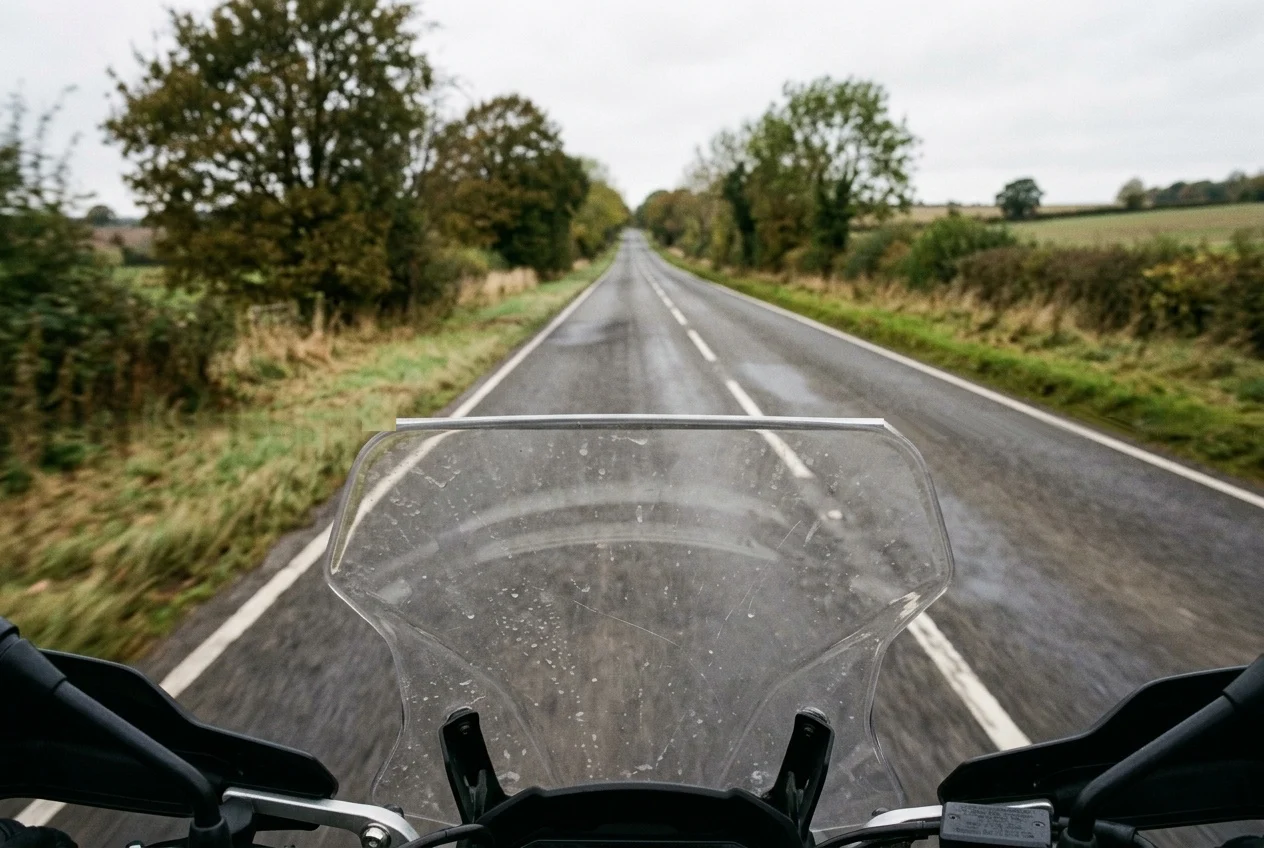
National Cycle sights over the screen to the road 50 feet ahead, Clearview does the same with a rope 50 feet out, and Clearview adds that if you fall between two sizes you should pick the lower one. WindVest says its screen is designed to work as if it were 3 to 4 inches taller than it is, which is a reminder that each rule is tuned to that maker’s shape. All four are windshield makers whose ranges lean towards cruisers and tourers; we found no equivalent sizing guide from an adventure-screen maker.
National Cycle and Clearview put your eyes within an inch or two of the edge. Southampton found police riders setting their screens the same way, “a few centimetres below eye level”, so they could look above an optically poor screen. At that height the turbulent zone hit the top of the visor, and a rider looking just over the screen was “at or near a position of maximum noise”. Raising the head by a few centimetres cut the noise by 4 to 5 dB. Lowering it into the shelter of the screen cut it by 8 to 9 dB with some helmets. WindVest’s and Klock Werks’s lower settings aim the wake further down, towards your chin and neck, which is Southampton’s low-screen case.
The authors’ conclusion was that the height that keeps the wind off your body and gives a good view over the top is poor for noise at the ear. That does not make the screen makers wrong. Looking over the screen is the right call for vision, and Klock Werks points out that if you look through a screen full time, every scratch and water spot becomes your problem. The rule answers a question about vision; the buffeting rider is asking about the wake.
What your adventure bike’s screen lets you change
Four of the eight adventure bikes we checked have a screen you can adjust without buying anything:
| Bike | Adjusts (per manual) | How | Settings |
|---|---|---|---|
| Honda Africa Twin | Yes | Two lock levers | 5 |
| Triumph Tiger 900 GT / Rally Pro (2024) | Yes | Handle, no tools | 5 |
| BMW R 1300 GS | Yes | Lever; electric optional | Not stated |
| Suzuki V-Strom 800DE | Yes | Unbolt and refit | 3 |
| Yamaha Ténéré 700 | Not described | — | — |
| Honda Transalp (2025) | Not described | — | — |
| KTM 890 Adventure R (2024) | Not described | — | — |
| Royal Enfield Himalayan 450 | Not described | — | — |
- Africa Twin: five positions, set with the right and left lock levers, and Honda says not to adjust it while riding. Honda’s 2022 manual lists the adjustment only for some variants; Honda UK’s current page says the screen “adjusts through 5 positions for maximum forward visibility or maximum wind protection”.
- Tiger 900: five positions without tools. Triumph warns that both sides must be set to the same position, because an incorrectly adjusted screen can affect handling and stability.
- R 1300 GS: a lever, and BMW says to adjust it only when the bike is stationary. The optional electric screen lowers itself when you switch off and has a finger guard; BMW says that with a screen it has not approved, it cannot guarantee that guard works.
- V-Strom 800DE: three heights, but you remove the screen, move its nuts and refit it, so it is a job for a stop with tools, not a quick change at a fuel stop.
- The other four: the manuals describe no height adjustment, and Yamaha’s 2026 feature list calls the Ténéré’s screen a “tall windscreen” without mentioning any. These are the bikes where spoilers and replacement screens make the most sense, and two of the most detailed owner reviews we read for the clip-ons below came from Transalp riders.
Screens change between model years, so check your own manual.
Fixes, from free to the most work
1. Adjust before you buy
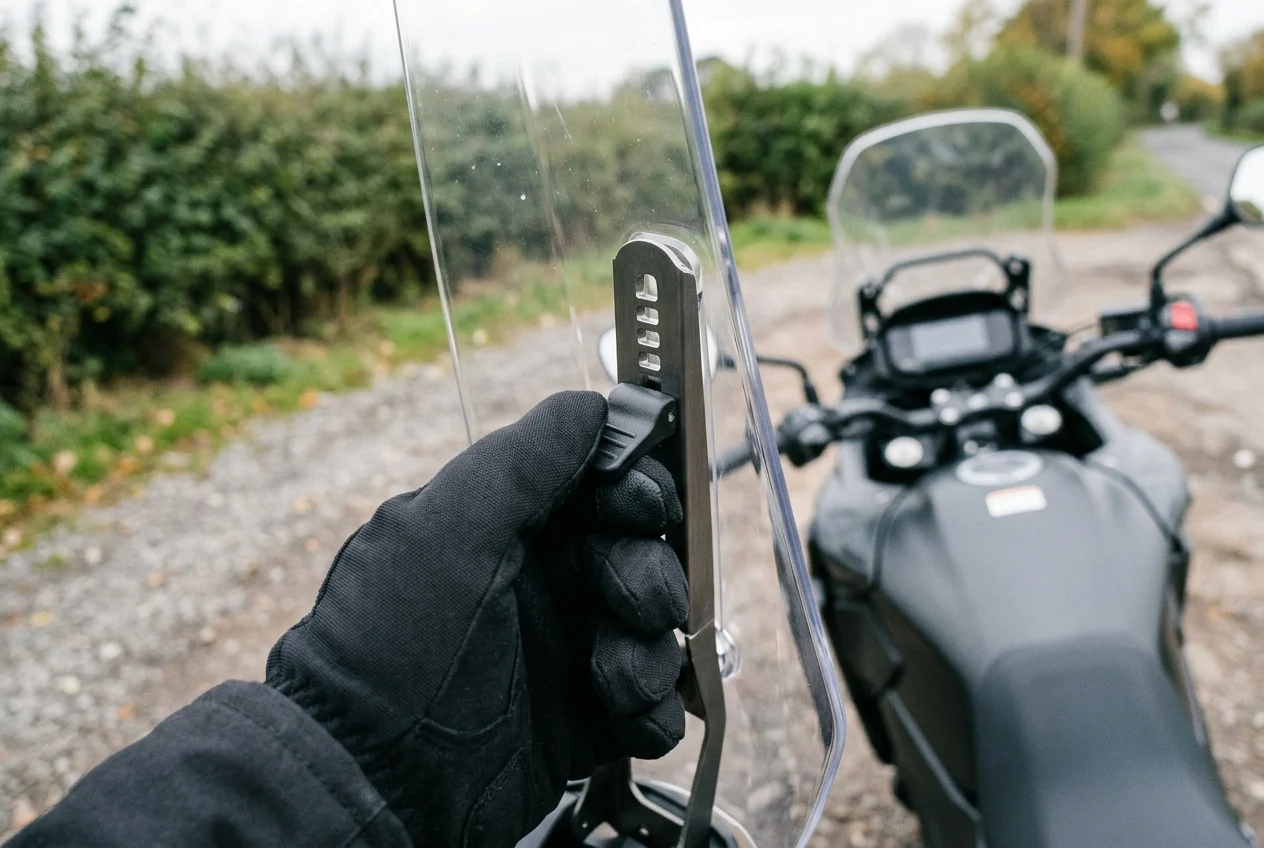
If your screen adjusts, run the test at each setting, stopping to change it. Honda and BMW both tell you not to adjust while moving. On a five-position screen the quietest setting may be the lowest: the aim is to move the wake, not to make the screen as tall as possible.
2. The helmet side
- Peak off on the highway, if your helmet allows it. Arai’s XD-5 manual says its peak “is not suitable for high-speed use”, and with the peak removed it recommends fitting the pressure plates over the side-pod holes to cut wind noise. (Our adventure helmet guide covers peaked helmets and the alternatives.)
- Seal the opening the turbulence actually hits. Southampton found that with a very low screen, better sealing around the neck cut the noise by up to 6 dB, and with higher screens, sealing around the visor cut it by 5 to 8 dB. Those were workshop modifications, not products, but the logic carries over: if you feel it at the collar, close the gap under the helmet (its chin curtain if it has one, or a snug neck tube); if you feel it at the visor, check the visor seal.
- Ignore “quietest helmet” lists made on someone else’s bike. In Southampton’s tests, the quietest helmet in a set on a low-screen bike became the noisiest with a higher screen, and the authors called a single noise rating for comparing helmets misleading. Bath found the cavity around the chin bar to be a key noise source, with flow speed and helmet angle deciding how much it contributes.
3. A spoiler on the screen you have
A spoiler clamps or screws to the top of your screen. It raises the edge, so the wake starts higher, and some designs leave a slot between spoiler and screen. MRA, which builds its Vario spoiler that way, says the airflow through the slot reduces the turbulence at the end of the screen, and that the steeper you set the spoiler, the more the air passing through is slowed. No study we read measured an add-on spoiler, so that explanation is the maker’s.
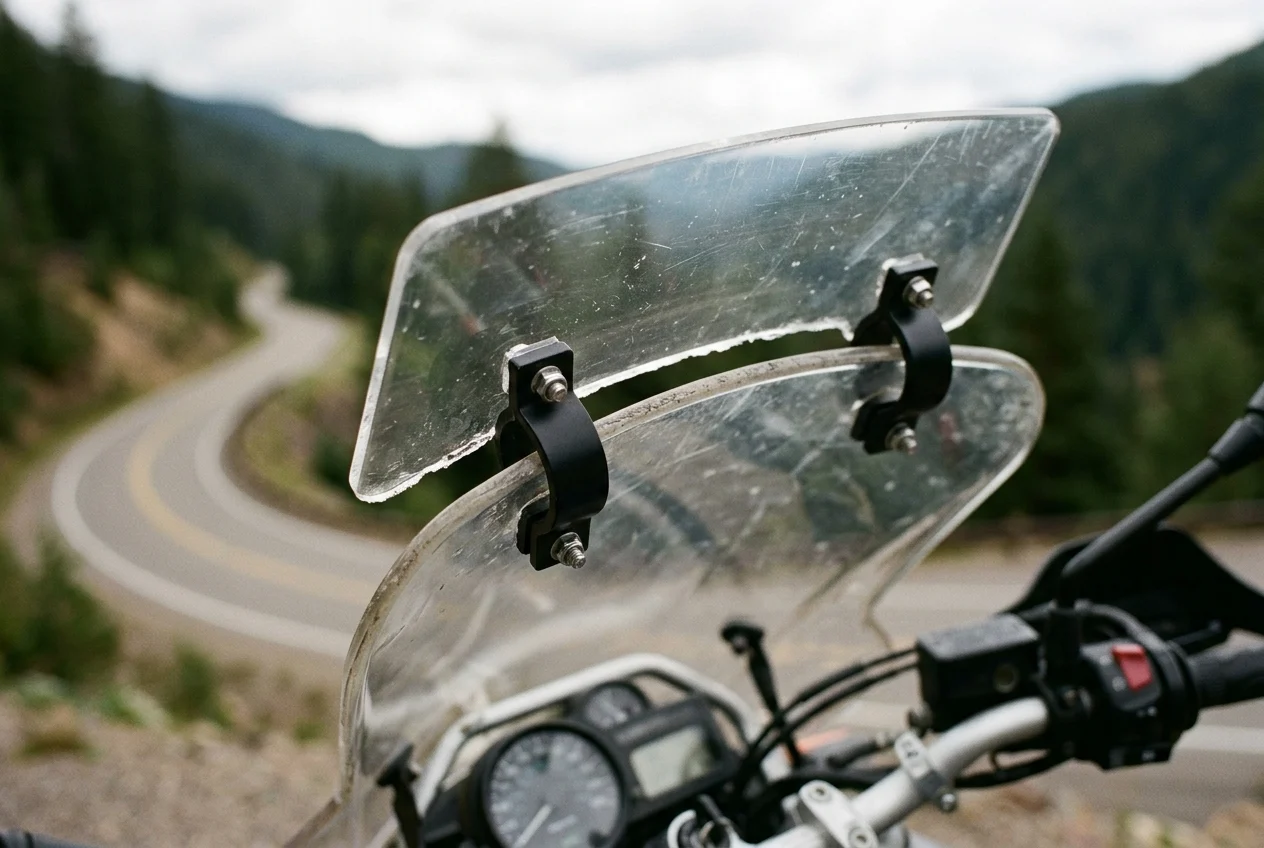
To set one up, start low and flat, then raise or steepen it one step at a time, rerunning the test after each change. Some owners in the reviews below say they tilt theirs on hot days to let more air reach them. Before buying, check the fit: MRA publishes printable templates to test whether your screen’s width and shape suit its X-Creen, Puig says compatibility must be checked first, and Givi says the original screen must be rigid enough to carry its Shield+.
4. A different screen
A replacement is the bigger step, and it is model-specific. Buy height only if the test said “calmer when you drop your head”. On the Ténéré 700, for example:
- AltRider’s adjustable windscreen for 2025-on bikes, including the Rally and World Raid, sits 10 to 100 mm above stock and adjusts by hand with thumb nuts. AltRider lists it at $178.97 and sells a separate version for earlier T7s. (For older bikes, our Ténéré 700 owner-report review covers what owners change first.)
- Puig’s Touring Screen for the 2025-26 bike (type DM201) is 100 mm taller than stock, 550 by 360 mm and 4 mm thick, and fits with the original screws.
The manuals are clear that bigger is not free. Yamaha warns that bulky accessories can affect stability through aerodynamic effects, including in crosswinds and when passing or being passed by large vehicles. Suzuki says to mount anything aerodynamic as low and as close to the bike’s centre of gravity as possible, on rigid mounts. Royal Enfield says large surfaces such as windshields can adversely affect the Himalayan’s handling, tells owners to use genuine model-specific accessories, and sets a 110 km/h (68 mph) limit on an accessory-equipped bike. A screen tall enough to put you in zone C also means you look through it, so pick clear rather than tinted if you ride at night.
Add-on spoilers: what’s sold and what owners report
Add-on spoilers for an existing screen
| Spoiler | Mount | Size (maker) | Adjusts | Where to buy |
|---|---|---|---|---|
| Puig Multi-Adjustable Visor 2.0 Clip-On | Clips | 300 × 130 mm | Height + 4 angles | Amazon, Puig dealers |
| Kemimoto aluminium extension | Metal clamps | Not published | Angle, fore-aft | Amazon, Kemimoto |
| MRA X-Creen Touring | Clamps or screws | 360 × 150 mm | Height, angle, gap | MRA shop |
| MRA Vario spoiler (VSA) | Clamps or screws | 3 sizes | 7 steps, no tools | MRA shop |
| Givi S180 Shield+ | Lockable aluminium kit | Not published | Height + angle | Givi dealers |
Which one? There is no test that ranks them, so choose by what matters on your bike:
- Mostly road, and you want the lightest clip-on: the Puig, after checking the fit, and recheck its clamps if you ride dirt.
- Rough roads, or you distrust plastic hardware: the Kemimoto’s metal clamps are what its owners praise most, at the cost of weight.
- A German-registered bike, or you want the most paperwork: MRA, bought from its remaining stock.
- You want it locked to the screen: the Givi.
Puig Multi-Adjustable Visor 2.0 Clip-On
Puig’s visor is 300 mm wide and 130 mm high, in anti-scratch polycarbonate, and adjusts through four angles on guides that give 100 mm of height, by hand and without tools. The clip-on version clamps to the top of the screen; Puig also sells one that screws through it. Buy the clear one if you will ever look through it at night. Puig doesn’t publish a price on its own site, and we don’t print Amazon’s, which changes.
We read the 13 reviews Amazon showed on the listing. A six-foot Transalp owner with a long torso says the stock screen put the air into his eyes and the visor moved it to the top of his helmet, and that it was still working 14 months on. Others say it quietened the ride at its highest setting. The complaints are about the mounts: a KLR owner says that on a hot day, washboard dirt softened the rubber grip pads and their adhesive and the visor shook off within ten miles; riders in the Netherlands and Italy say the plastic threads stripped or the visor came loose in heavy rain; and one says Puig replaced failed rubber mounts free. When we checked, the smoked version (20764H) had more stock than the clear one.
Check the Puig Visor 2.0 Clip-On on Amazon →
Kemimoto aluminium clip-on extension
Kemimoto says its extension is universal, fits off-road bikes such as the CRF300L, clamps on with metal brackets and adjusts back and forth. It doesn’t publish the panel’s dimensions, and the Amazon listing’s material fields contradict each other, so we aren’t quoting any. Kemimoto’s own store listed it at $77.99 on 2 October 2026.
In the 13 reviews Amazon showed, the most common praise is the metal hardware, and some reviewers compare it favourably with Puig’s plastic. A V-Strom rider says it put him in clean air; a 2025 Transalp owner says it made the bike much quieter at 70 mph. The complaints: the clear panel scratches easily (Amazon’s own summary of its reviews adds that some find it blurry to look through), the weight can make the screen vibrate, screws can back out (reviewers recommend thread-locker), and the positions hold by friction rather than a lock.
Check the Kemimoto extension on Amazon →
MRA X-Creen and Vario spoilers (buy direct)
MRA, the German screen maker, has the most thorough paperwork in this category. Its shop lists the X-Creen Touring at 360 by 150 mm, and its Vario spoiler adjusts through seven steps by hand in three sizes. Both clamp on or screw through the screen, and MRA says the clamps hold to top speed. On 2 October 2026 the shop listed the X-Creen Touring at €49.90, the X-Creen Sport at €54.89 and the Vario at €99.90, including German VAT.
What a buyer should know: MRA’s own imprint lists the company as “MRA-Klement GmbH i.L.”, in liquidation, with two named liquidators. Its shop was still listing these spoilers when we checked, but we can’t say for how long. Treat it as buying from remaining stock, and don’t count on spares or warranty support later. The only listing on amazon.com was a Japanese reseller’s import of an older code with 11 to 12 days’ shipping, so we haven’t linked it.
Givi S180 Shield+ (lockable clamp kit)
Givi’s Shield+ mounts with an aluminium fitting kit that needs no modification to your screen, adjusts for height and angle, comes with lock keys, and uses a 4 mm screen material Givi says is TÜV-approved. Givi tells buyers to confirm the original screen is rigid enough to carry it. On amazon.com only the smoked S180F was listed when we checked, so for the clear S180T, go to a Givi dealer.
Riding a German-registered bike? Check the approval
MRA’s X-Creen and Vario spoilers carry a national type approval from the KBA, the German federal motor transport authority (ABE 31048, last amended on 30 September 2025 after TÜV Rheinland testing). It says the parts may only be used as set out in the test report, and its annex lists the bikes they are approved for, including the Ténéré 700, the Africa Twin and Adventure Sports, the R 1300 GS and GS Adventure, and the KTM 890 Adventure, with model-by-model limits on which spoiler sizes are covered. Puig’s product page tells buyers to “check the ABE carefully” for their bike. Nothing we found says the Kemimoto has one.
Whatever you choose, wear earplugs
Fixing the buffeting lowers the noise; it doesn’t make it safe. Southampton’s road runs measured 78 to 90 dB(A) under the helmet at 48 km/h (30 mph) and 114 to 116 dB(A) at 193 km/h (120 mph). NIOSH’s guidance is that above 85 dBA a daily exposure must be shortened, halving it for every 3 dB more, so by that yardstick the 4 to 5 dB you might gain by moving out of the wake more than doubles the time you can safely ride at that level. In the same project, foam earplugs measured 8 to 16 dB below the level outside the plug. Our motorcycle earplug guide explains how to read the ratings and which plugs still let you hear traffic.
The brands older guides still send you to
Some buffeting guides still recommend names that we could not find trading:
- MadStad, whose adjustable bracket system turns up in older guides and owner reviews. Its domain now redirects to an unrelated Italian website, and posts on two owners’ forums (Honda Gold Wing and Triumph Rocket 3) in autumn 2025 say it shut down without warning in late September 2025.
- Laminar Lip, the screen-lip maker. Its domain now redirects, behind an expired security certificate, to an unrelated shooting forum. On amazon.com, “laminar lip” survives as a generic description on unbranded lips made for Harley-Davidsons.
- MRA, covered above: in liquidation, shop still open when we checked.
We checked all three on 2 October 2026. If you buy a used screen or spoiler from any of them, assume there is no maker support.
Bottom line
Buffeting is a position problem before it is a product problem. The screen’s wake has a calm side and a loud side, and the height most guides recommend puts your visor next to it. Run the five-minute test, use your bike’s adjustment if it has one, and take the peak off for highway days. If your screen is fixed, a spoiler that suits its shape is the cheapest way to move the wake, as long as you check its clamps. Whatever you end up with, wear earplugs.
What we read
Research and guidance:
- M. C. Lower, D. W. Hurst and A. Thomas, “Noise levels and noise reduction under motorcycle helmets”, Proceedings of Internoise 96, pp. 979-982 (ISVR and University of Southampton, for the Home Office Police Scientific Development Branch).
- J. Kennedy, M. Carley, N. Holt and I. Walker, “The effects of windscreen flow on noise in motorcycle helmets”, Proceedings of Meetings on Acoustics 12, 040005 (2011), University of Bath; and the same group’s “Noise mechanisms in motorcycle helmet noise” (2010) and “Aeroacoustic sources of motorcycle helmet noise”, Journal of the Acoustical Society of America 130(3), 1164-1172 (2011).
- NIOSH, “Understand Noise Exposure”.
Owner’s manuals and handbooks (printed page numbers):
- Honda CRF1100 Africa Twin (2022): p. 312; Honda UK Africa Twin page (2026). Honda XL750 Transalp (2025).
- Yamaha Ténéré 700 (BAG-F8199-E0, April 2022): p. 1-4; Yamaha 2026 Ténéré 700 features.
- Suzuki V-Strom 800DE: pp. 1-27, 2-129. KTM 890 Adventure R (2024, a retailer-hosted copy of KTM’s manual): pp. 108-109.
- Triumph Tiger 900 GT, GT Pro and Rally Pro (2024, an importer-hosted copy): p. 96. BMW R 1300 GS rider’s manual (US model): pp. 124-125. Royal Enfield Himalayan 450: p. 12.
- Arai XD-5 operation instructions: p. 3 and the peak removal pages.
Screen makers, products and forums:
- Sizing guides from National Cycle, Clearview, Klock Werks and WindVest.
- Puig Multi-adjustable Visor 2.0 Clip-on and Puig Touring Screen for the Ténéré 700; the MRA shop, imprint and KBA approval ABE 31048 (amendment 15); Givi S180 Shield+; Kemimoto; AltRider Ténéré 700 2025+ windscreen.
- Owner reviews on the amazon.com listings for the Puig and Kemimoto products, read on 2 October 2026. For MadStad’s status, a thread on the Triumph Rocket 3 owners’ forum (r3owners.net) quoting a Gold Wing forum post. We didn’t use other forum threads.
Manuals are model-year specific. If your bike is not listed, its own manual is the source that counts.
Related guides
- Motorcycle earplugs: how loud it is under the helmet and how to read the ratings.
- Adventure motorcycle helmets: peaked adventure helmets, modulars and full-faces for highway riding.
- Best motorcycles for long-distance touring: wind protection as one of the four things that decide a 500 km day.
Frequently Asked Questions
What causes helmet buffeting on a motorcycle?
The top edge of the windscreen throws off a turbulent wake, and buffeting is your helmet sitting in it. Researchers at the University of Bath describe three places your helmet can be: in the free stream above the wake, in the vortices the screen sheds, or underneath them in the screen's shelter. Southampton's wind tunnel found that this turbulence hitting the helmet was the main noise source, more than the air flowing over the helmet itself.
What height should a motorcycle windshield be?
Screen makers do not agree: National Cycle says level with the tip of your nose, Clearview says look over the top by one to two inches, WindVest says 'mustache height' and Klock Werks says below your sight line but not below your chin. The first two put your eyes just above the edge, which is the height Southampton's police riders used and the one its wind tunnel found at or near the loudest on its bikes. Run the head-height test in this guide before choosing: you want your helmet clearly above the wake or clearly below it.
Why did a taller windscreen make my buffeting worse?
Because raising the screen raises the wake, and it can lift the turbulence from your chin or neck up to your visor. Southampton found that a low screen aimed the turbulence at the base of the helmet and a higher one at the visor and the shell above it, and that one helmet which was the quietest on a bike with a low screen became the noisiest with a higher one. A taller screen only helps once its wake clears your helmet, or once your head sits fully below it.
Should you look over or through a motorcycle windshield?
It is a trade. Looking over keeps scratches, rain and night glare on the screen out of your view, which is why Klock Werks recommends it and why Southampton's police riders set their screens a few centimetres below eye level. It also puts your visor next to the wake. Looking through puts your head in the sheltered pocket, which was 8 to 9 dB quieter with some helmets in Southampton's tunnel, but then the screen's optics and cleanliness decide what you see.
Do clip-on windshield extensions work?
No study we read measured one, so the case rests on how they work and on owner reports. They raise the screen's edge, and designs like MRA's Vario leave a slot that MRA says reduces the turbulence at the edge. Amazon reviews for the Puig and Kemimoto clip-ons include Transalp and V-Strom owners who say the air moved over their helmets, alongside reports of clamps loosening on hot, rough dirt roads and in heavy rain. Check that the clamp suits your screen and recheck the screws.
Is it my helmet or my windshield?
Run the head-height test. If moving your head a few centimetres up or down changes the shake, it is the screen's wake. If nothing changes, look at the helmet: the peak on an adventure helmet, the gap at the neck, the visor seal and the chin area, which Bath identified as a key noise source. Don't judge helmets by someone else's bike: Southampton found that helmet noise rankings changed with the motorcycle and the screen.