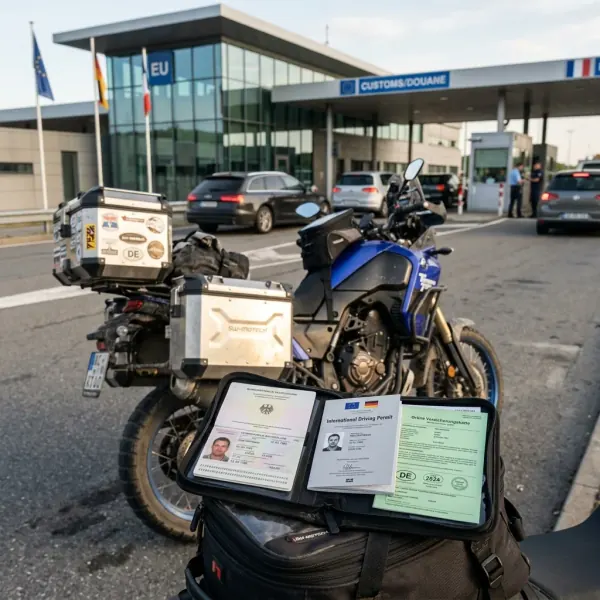
The first time I crossed a European border on a motorcycle I’d brought everything except the one document that actually mattered. Passport, license, IDP, full kit. The Hungarian-Serbian border officer asked for my vehicle registration. I had a photocopy. He shook his head, pointed to the line of cars I’d been about to skip, and sent me back to the EU side of the border to find someone who could fax the original.
That trip taught me everything about documentation. Every country has its own version of “the one document that matters.” The Green Card. The original registration. The high-vis vest. The vignette sticker. The IDP. Skip any of them at the wrong border and you’ve turned a 20-minute crossing into a 3-hour problem.
This guide is the working version. Europe motorcycle border crossing documentation that actually covers what you need in 2026 — including the new EES and ETIAS systems coming online — without the marketing fluff from insurance companies and rental agencies.
What Every European Motorcycle Rider Needs to Know in 2026
European motorcycle travel in 2026 is mid-transition. The old framework — Schengen open borders, simple insurance reciprocity within the EU, passport stamps at non-EU entries — is being replaced by digital systems that streamline some crossings and add steps to others.
The riders most affected by the changes are non-EU citizens — particularly UK riders post-Brexit, plus US, Canadian, Australian, and other visa-exempt nationals. EES biometric registration goes live April 2026. ETIAS pre-travel authorisation goes live October 2026. Both apply at the EU’s external Schengen border.
For EU citizens, the day-to-day border experience is unchanged: invisible crossings between Schengen states, standard insurance reciprocity, no new procedures.
The country-specific rules — vignettes, high-vis vests, helmet types, headlight-always-on requirements — remain the same as previous years. Get those right and you’ll never have a problem.
The Core Documents: What You Must Always Carry
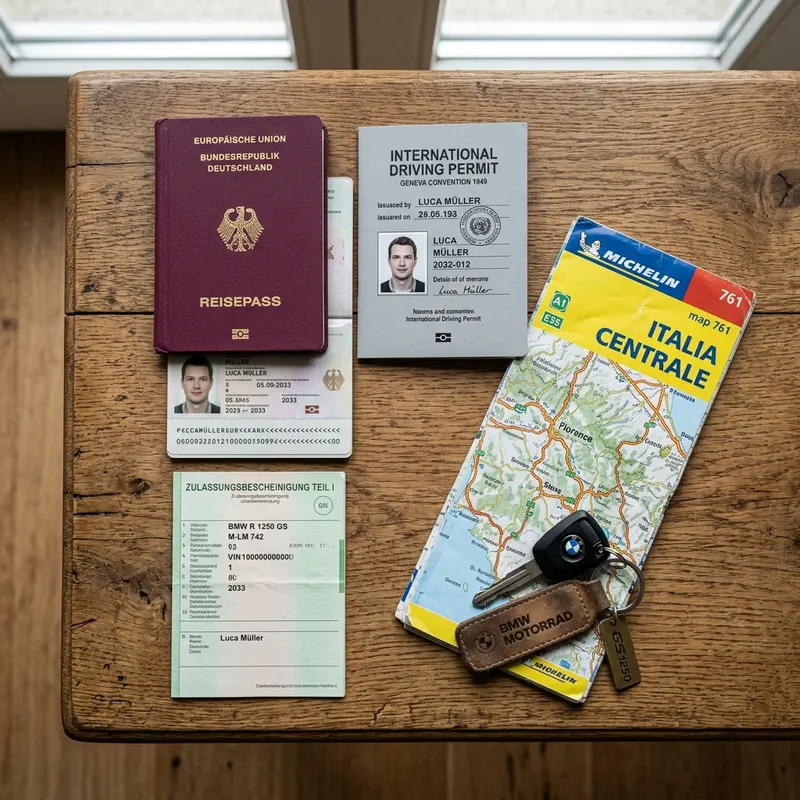
Six documents on every European trip. Carry originals where possible, with digital backups for emergencies:
-
Valid passport with at least 6 months remaining beyond your trip end date. Many non-EU countries enforce this; the EU itself usually doesn’t but better to be safe.
-
National driving license — your home country motorcycle license. Plus an International Driving Permit if non-EU or if specific countries require it (Albania, Bosnia, Moldova, Ukraine, others).
-
Vehicle registration document — original, not photocopy. The V5C in the UK, Carte Grise in France, Fahrzeugschein in Germany, etc. If you’re riding a vehicle registered to someone else (borrowed, leased), carry written authorisation from the registered owner.
-
Insurance certificate — proof of valid motor insurance covering the countries you’ll visit. The EU/EEA standard certificate covers all EU/EEA countries. For non-EU European countries, you need:
-
Green Card insurance — international insurance certificate confirming third-party liability coverage in non-EU countries (Albania, Bosnia, Belarus, Kosovo, Moldova, Montenegro, North Macedonia, Russia, Serbia, Turkey, Ukraine).
-
Travel insurance — personal insurance covering medical evacuation, especially important for motorcycle riding in remote areas. Verify your policy explicitly covers motorcycle riding and pillion passengers; many standard policies exclude motorcycles or require an add-on premium.
Store originals in a waterproof document holder under the seat or in a tank bag. Store digital backups in cloud storage and on a phone that’s offline-accessible.
Check Waterproof Document Holders on Amazon →
Schengen vs Non-Schengen: How Border Crossings Actually Work
The European Schengen zone is the area within which border controls between member states have been abolished. As of 2026, it includes most EU countries plus Switzerland, Norway, Iceland, and Liechtenstein. Croatia joined in January 2023, eliminating the former busy Slovenia-Croatia summer queue.
Schengen-internal crossings are effectively invisible. You ride across without stopping. Random police checks inside a country can still request documents but borders don’t slow you down.
Schengen external border crossings (entering or leaving the zone) involve passport control, vehicle inspection if requested, and from April 2026 onward, EES registration for non-EU nationals on first entry.
Non-Schengen European borders (between any two non-EU countries, or between Schengen and a non-EU European country) involve full passport stamping (until EES rollout), insurance verification, and customs inspection if requested. Time required: 15-30 minutes off-peak, 1-3 hours during summer peak at busy crossings.
EES and ETIAS: New Requirements in 2026
Entry/Exit System (EES) — Live April 2026.
EES is a database that records every non-EU national’s entry to and exit from the Schengen zone, replacing the manual passport stamps. First entry after EES activation requires biometric registration:
- Facial photo at the border
- Fingerprints (4 fingers on first entry)
- Linked to your passport
Subsequent entries are faster — usually a quick passport scan and facial check. The first registration takes 5-15 minutes per traveler. Expect significant delays at major border crossings during the rollout period (April-July 2026).
For motorcycle riders, the practical impact: budget extra time at your first Schengen entry of any 2026 trip. Cross at off-peak times. Have your passport ready well before the booth.
European Travel Information and Authorisation System (ETIAS) — Live October 2026.
ETIAS is a pre-travel authorisation required for non-EU visa-exempt nationals entering Schengen. Apply online before travel:
- €7 fee for applicants aged 18-70 (free for under 18 / over 70)
- Approval typically within minutes, can take up to 30 days for additional review
- Valid 3 years or until your passport expires
- Multiple entries permitted within validity
Without ETIAS approval from October 2026 onward, you’ll be denied boarding (airline / ferry) or entry (border crossing). The €7 cost is negligible; the process matters. Apply at least 1 week before any 2026 trip from late October onward.
Affected riders include: UK, US, Canadian, Australian, New Zealand, Japanese, South Korean, and many other nationalities. Full list at the official EU ETIAS website. Always apply through the official channel (travel-europe.europa.eu/etias) — third-party sites charge premium fees for the same process.
Green Card Insurance: When You Need It and When You Don’t
The Green Card system is an international insurance reciprocity framework operated by the Council of Bureaux. It confirms that your motor insurance provides third-party liability cover in the country you’re visiting.
You DON’T need a Green Card for:
- Travel within the EU and EEA (your standard certificate is sufficient)
- The UK and EU as of 2021 (Brexit deal preserved insurance reciprocity)
- Switzerland (covered by EU agreements for member-state insurers)
- Andorra, Serbia (covered by separate agreements for many EU insurers)
You DO need a Green Card for:
- Albania
- Bosnia and Herzegovina
- Belarus
- Kosovo
- Moldova
- Montenegro
- North Macedonia
- Russia
- Turkey
- Ukraine
How to obtain: contact your motor insurer 2-3 weeks before travel. Most issue Green Cards on request, typically for free. The Green Card is a single A4 sheet listing all covered countries; you’ll get it emailed or by post. Print and carry on the bike.
Border officers in non-EU countries DO check for Green Cards. Insurance bought at the border is expensive (€30-100 per week) and inconvenient. Get it from your home insurer.
Country-Specific Rules That Catch Riders Out
A handful of country-specific requirements that surprise riders:
France: Requires every motorcyclist to carry a high-visibility vest accessible at all times (not buried in luggage). Penalty for not having one accessible: €11-135 fine. Tape the vest to the inside of a pannier lid or carry in a tank bag.
Spain: Reflective vest required to be worn when exiting the vehicle on motorway shoulder. Carry one.
Italy: Motorcycles must have headlights on at all times, day and night. Most modern bikes do this automatically.
Germany: Strict on noise — modified exhausts that exceed manufacturer specs can be cited. Carry original ECE-compliance documentation if your exhaust is aftermarket.
Austria: All motorcycles 50cc+ require a motorway vignette to use the Autobahn. Buy at any petrol station near the border.
Switzerland: Annual motorway vignette only — no shorter-duration options. Costs CHF 40 for the year. Required on all motorways and many semi-motorways.
Czech Republic, Hungary, Slovakia, Slovenia, Romania, Bulgaria: All require digital vignettes for motorway use. Buy via app or at border petrol stations.
Greece: Helmet visor must be ECE 22.06 certified — older 22.05 is being phased out. Check yours.
Norway and Sweden: Strict on drink-driving — 0.02% BAC limit. Even one drink can put you over.
UK: Drive on the left. Sometimes overlooked by newly-Brexit-era European riders riding into the UK.
Motorway Vignettes: Which Countries Require Them
| Country | Vignette Required | Motorcycle Price 2026 |
|---|---|---|
| Austria | Yes | ~€11 (10 days) |
| Switzerland | Yes (annual only) | CHF 40 |
| Czech Republic | Yes (digital) | ~€13 (10 days) |
| Hungary | Yes (digital) | ~€16 (10 days) |
| Slovakia | Yes | ~€10 (10 days) |
| Slovenia | Yes | ~€15 (7 days) |
| Romania | Yes (digital) | ~€3 (7 days) |
| Bulgaria | Yes (digital) | ~€8 (7 days) |
| Italy | No (toll booths) | Pay as you go |
| France | No (toll booths) | Pay as you go |
| Spain | No (toll booths) | Pay as you go |
| Croatia | No (toll booths) | Pay as you go |
Always buy vignettes before entering the motorway. Several countries (Czech Republic, Hungary, Slovenia) have transitioned fully to digital vignettes — your registration plate is recorded against a database, no physical sticker needed. Buy via app (eDalnice for Czech, e-matrica for Hungary).
European Border Crossing Checklist
Eight items, organized by what they protect against:
- Passport valid 6+ months (0 g)
- Driving licence national + IDP if required (minimal)
- Vehicle registration certificate original (minimal)
- Insurance certificate or Green Card as needed (minimal)
- UK/home-country sticker if not on plate (5 g)
- High-vis vest accessible in France and some other countries (250 g)
- Austria/Switzerland/Czech vignette if using motorways (sticker, minimal)
- ETIAS authorisation from October 2026 for UK/non-EU riders (digital)
The UK sticker requirement catches British riders out. Since September 2021, the old “GB” sticker is no longer valid for European driving — you need either a “UK” sticker on the bike or a UK flag/UK identifier built into your registration plate. Cars with the EU stars and “GB” are non-compliant. Same applies to bikes.
Internal Connections
This guide pairs with regional content:
- Riding motorcycle Balkans guide — the documentation requirements applied to non-EU Europe
- Trans-Euro Trail for beginners — the TET crosses multiple European borders
- UK to Spain motorcycle ferry guide — UK-specific documentation strategy
FAQ
Five common questions are answered at the top of this page. The short version: carry passport, license, IDP if non-EU, original registration, insurance, and Green Card for non-EU countries. EES live April 2026, ETIAS live October 2026 — affects non-EU riders. Buy vignettes before motorway use in Austria, Switzerland, and Central European countries.
Whatever your specific route, the Europe motorcycle border crossing documentation picture in 2026 is straightforward if you prepare it in advance. The cost of full preparation is maybe €30 and an hour of your time. The cost of getting it wrong at a border is hours of delay and potentially significant fines. Worth doing right.
Disclosure: Some links in this article are affiliate links. If you buy gear through them, we may earn a small commission at no extra cost to you.
Frequently Asked Questions
Do I need an International Driving Permit to ride in Europe?
Not for EU citizens riding within the EU — your national license is valid everywhere in the EU and EEA. For non-EU citizens (UK, US, Australian, etc.) inside the EU, your home license is technically sufficient if accompanied by a recognized translation, but an IDP simplifies things at police stops and is required in some non-EU European countries (Albania, Bosnia, Moldova, Ukraine). Get an IDP from your home country's auto club for $20-30; carry it alongside your home license. It's a 10-minute insurance policy.
Is Green Card insurance still required in 2026?
Within the EU and EEA, no — your standard insurance certificate is recognized across all member states without a separate Green Card. For European countries outside the EU/EEA (Albania, Bosnia, Belarus, Kosovo, Moldova, Montenegro, North Macedonia, Russia, Serbia, Turkey, Ukraine), yes, Green Card insurance is required and verified at borders. Most EU insurers issue Green Cards on request — typically free. Request it 2 weeks before travel.
What is EES and when does it actually start?
The Entry/Exit System is an EU border database that replaces passport stamping for non-EU nationals. First entry to the Schengen zone after EES activation requires biometric registration (fingerprints, facial photo) — typically 5-15 minutes at the border. Subsequent entries are faster. EES launches April 2026 for all non-EU travelers entering Schengen. UK riders crossing the Channel will be the largest single affected group. Plan for 30-60 minute delays at first crossings during the first weeks of the rollout.
Do I need ETIAS for a motorcycle trip in 2026?
From October 2026 onward, yes — if you're a non-EU national from a visa-exempt country (UK, US, Canada, Australia, New Zealand, Japan, etc.) entering the Schengen zone. ETIAS is a pre-travel authorisation, not a visa. Apply online before travel, pay €7, get approval typically within minutes (sometimes up to 30 days). Valid 3 years or until your passport expires. Without ETIAS approval, you'll be denied boarding or entry from October 2026.
Which countries require motorway vignettes?
Austria, Switzerland, Czech Republic, Hungary, Slovakia, Slovenia, Romania, Bulgaria — all require a paid vignette to use the motorway network. Motorcycle vignettes are typically half the car rate. Buy them at petrol stations near the border, at automatic terminals, or via app (most countries now offer digital vignettes). Riding without one and getting caught means a €120-300 on-the-spot fine plus retroactive vignette purchase. Italy, France, Spain, Portugal, Croatia use toll booths instead — pay as you go.