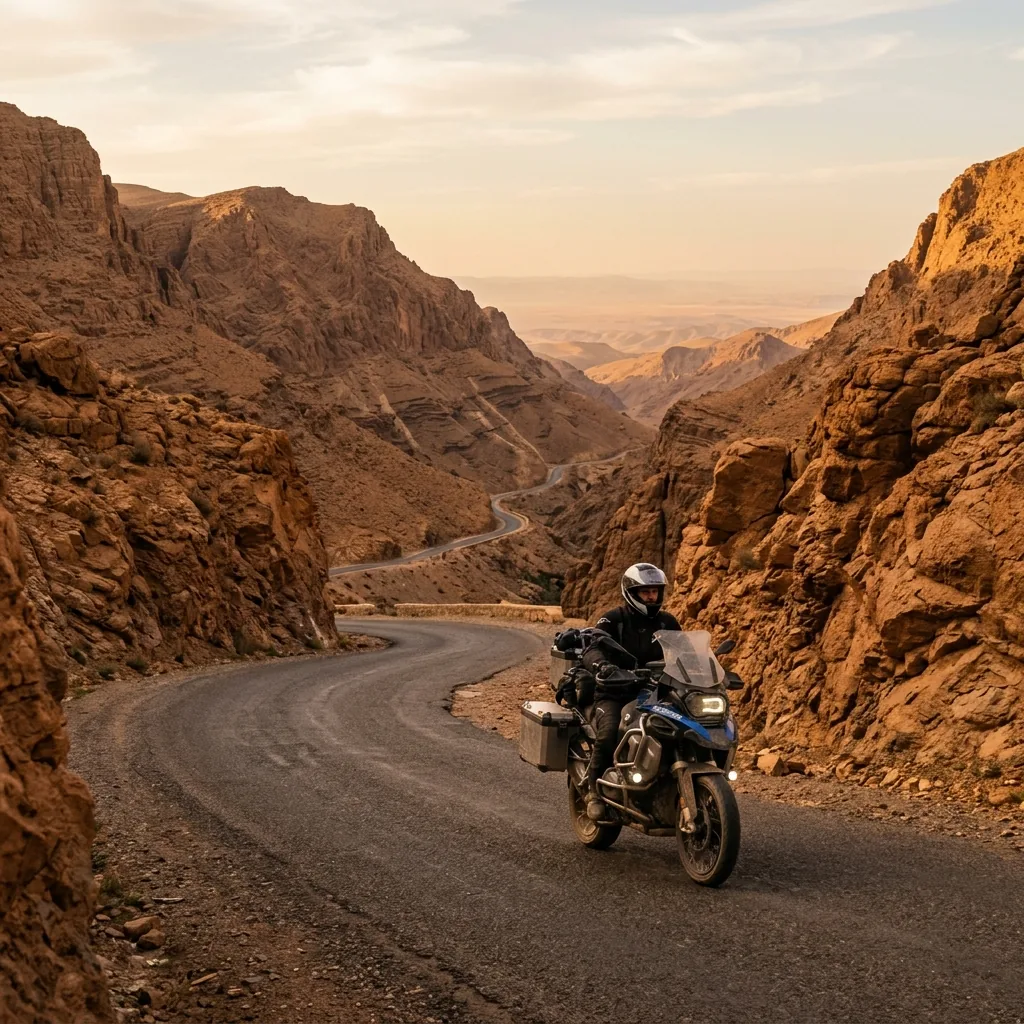
Morocco is the closest place to mainland Europe where you can ride from sea-level palm groves to 2,200-metre mountain passes to true desert dunes in a single week. The whole country sits within a 36-hour ferry ride of Spain. The 1,500-kilometre Tangier-Marrakech loop covers more terrain variety than most riders see in a year of riding at home.
This morocco motorcycle tour guide lays out the classic route, the right season, the paperwork, and the gear choices that matter. After two trips into Morocco and conversations with riders who’ve done a dozen more, the country rewards preparation and punishes improvisation. Get the basics right and the riding does the rest.
Introduction: Why Morocco Is Every ADV Rider’s Next Trip
Morocco hits different from European riding. The roads are mostly empty by European standards. Fuel is cheap. The mountain passes are real mountain passes, with switchbacks that go on for an hour. The Sahara is exactly what you imagine the Sahara is, and you can stand next to your bike on it.
The country also offers a working visa policy, English- and French-speaking infrastructure, and a maturing motorcycle-tourism scene with workshops in Marrakech that know how to handle a Tenere or a GS. It’s adventure riding for grown-ups — challenging enough to feel real, civilised enough not to break you.
The Classic Route: Tangier to Marrakech via Sahara
The standard loop runs roughly 1,500 km over 10 to 14 days. Pick it up at Tangier Med after the ferry from Algeciras, head south, finish at Marrakech, fly home or ride back to Tangier.
The sequence most riders run:
Tangier → Chefchaouen (the blue city in the Rif Mountains) → Fes (medieval medina) → Midelt (gateway to the High Atlas) → Merzouga (Sahara, Erg Chebbi dunes) → Todra Gorge → Dades Gorge → Ouarzazate (film studios, Aït Benhaddou) → Marrakech.
This sequence builds intensity. You start in the cool green north, work your way south through ancient cities, hit the highest country in the middle, then drop into the desert as your reward. The riding peaks around days six through nine, when you’re in the Atlas-to-Sahara-to-Gorges stretch.
Two weeks is the right amount. Less and you’re rushing the Sahara nights. More and you’re sitting around because you’ve over-planned.
The High Atlas Passes: Tizi n’Test vs Tizi n’Tichka
The High Atlas range runs 750 km diagonally across Morocco, peaking at Mount Toubkal (4,167m). Two passes cross it: Tizi n’Test and Tizi n’Tichka. Both top 2,000 metres. Both are extraordinary motorcycle roads.
Tizi n’Tichka is the larger, busier, recently-widened pass on the N9 between Marrakech and Ouarzazate. It’s been resurfaced and straightened in places, which makes it faster but slightly less dramatic than it used to be. Still a top-five mountain road in Africa.
Tizi n’Test is the smaller, narrower, more technical pass on the R203 between Marrakech and Taroudant. It’s the road riders actually talk about. Tight switchbacks, exposed sections, less traffic. If you can only ride one, ride this one.
A common rider mistake: trying to do both passes in a day. Don’t. Each one deserves a full day with stops.
The Sahara: Merzouga and the Erg Chebbi Dunes
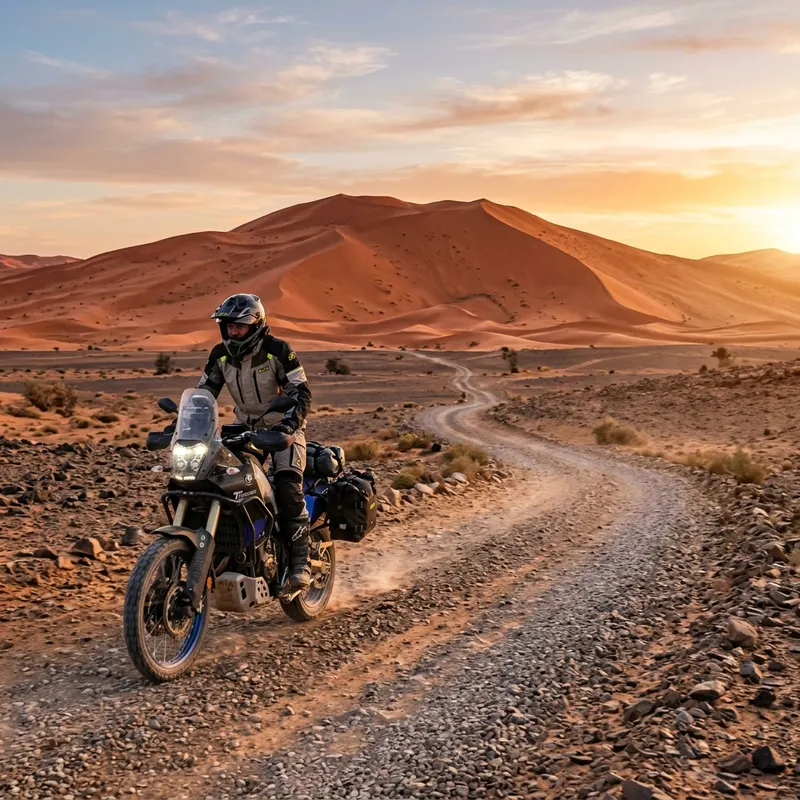
Merzouga is the southeastern town that serves as the entry to the Erg Chebbi dunes — a 28-km strip of true Sahara dunes that rise up to 150 metres above the surrounding plain.
The riding into Merzouga is paved (the N13 from Rissani is excellent). The riding on the dunes themselves is not for everyone. Soft sand is technical, exhausting, and unforgiving on big adventure bikes. Plenty of riders book a guided dune ride on a smaller bike (often a TT-R or a 250cc dual-sport) rather than risking their own bike. There’s no shame in this.
Stay overnight at a desert camp. The Sahara at night is one of those experiences that survives the inevitable cliché. Bring warm layers — desert nights drop fast, even in spring.
The Dades and Todra Gorges
Two of the most photographed roads in Africa. The Dades Gorge cuts through dramatic red rock with a series of tight switchbacks. The Todra Gorge is narrower, with sheer 300-metre walls and a road that threads through the bottom.
Both are easily ridden in a single day each, on paved surfaces, and both are best in early morning or late afternoon for light and traffic. Stay overnight in the gorge towns (Tinerhir for Todra, Boumalne Dades for Dades) rather than blasting through.
Morocco Rider Preparation Checklist
The non-obvious gear and paperwork list. Get all of this sorted before you board the ferry.
- Downloaded offline maps Morocco — OsmAnd or Maps.me (0 g)
- Passport valid 6+ months beyond entry date (0 g)
- 50/50 or knobby tyres fitted for piste sections (0 g, fitted)
- Cash in Moroccan Dirham — rural areas are cash only (minimal)
- Spare fuel canister 1L — remote piste sections (900 g full)
- Sun protection SPF50+ — Sahara UV is extreme (100 g)
- Water minimum 2L for desert sections (2 kg)
- Travel insurance confirmed covers Morocco and off-road riding (0 g)
- Bike registration document — original, not photocopy (0 g)
- Green Card from home insurer (0 g)
- Basic tool kit and tyre repair plug kit (1.2 kg)
- inReach Mini 2 for Sahara stretches (100 g)
Shop Spare Fuel Canisters on Amazon →
Shop Garmin Zumo XT2 GPS on Amazon →
Road Quality and Tyre Choice
Main routes (N-prefix national roads) are excellent — fresh tarmac, clear signage, well-engineered. Regional routes (R-prefix) are mixed — some are immaculate, some are pothole-ridden with no warning. Piste tracks (unmarked) are rough by definition and should be ridden with appropriate tyres and skill level.
For the standard Tangier-Marrakech loop with optional piste detours into the Atlas or south of Merzouga, 50/50 dual-sport tyres are the right call. Continental TKC 80 is the rider favourite. Mitas E-07 is the budget alternative.
Best Time to Ride Morocco
March to May: the prime window. Warm days, cool nights, mountain passes open, desert tolerable. Roads are quiet.
September to November: also excellent. Slightly hotter in September, more variable weather by November, but generally a great time.
June to August: avoid the south. The Sahara hits 45°C+ and the Atlas plateau holds 35°C+. Riding becomes a survival exercise rather than a tour.
December to February: workable in the lowlands and Marrakech area. Atlas passes can be snowed in. Some piste tracks become impassable mud.
Practicalities: Ferry, Fuel, Border, Currency
Ferry: Algeciras to Tangier Med is the right route for most riders. 90-minute crossing, frequent departures, full Moroccan customs and immigration at Tangier Med. Book ahead in July-August.
Fuel: Widely available in towns. Diesel and petrol both reliable. Prices roughly half of Western European prices. Carry a small spare can for piste sections — fuel stations are sparse south of the Atlas.
Border: Moroccan customs at Tangier Med issues a temporary import permit for the bike. Keep it. You’ll need it on the way out. No carnet required for tourist stays under six months.
Currency: Moroccan Dirham. ATMs work in cities, cards accepted in tourist hotels, but rural areas and small restaurants are cash only. Bring or withdraw enough cash for several days at a time.
Emergency: Dial 15 (medical), 177 (police), 19 (fire).
FAQ
For more on European border crossings and the ride south, see our Europe motorcycle border crossing guide, UK to Spain motorcycle ferry guide, and best adventure motorcycle panniers.
Disclosure: Some of the links in this article are affiliate links. If you buy gear through them, we may earn a small commission at no extra cost to you. It helps fund the road trips that make these independent route guides possible.
Frequently Asked Questions
When is the best time to ride a motorcycle in Morocco?
March through May, and September through November. Avoid July and August in the south — the Sahara routinely hits 40°C+ and riding becomes dangerous. Winter (December-February) is fine in the lowlands and Marrakech area but the High Atlas passes can snow and close. Spring and autumn give you the best balance of warm-but-not-extreme temperatures and minimal weather disruption.
Do I need a visa to ride a motorcycle in Morocco?
Most Western nationals (US, UK, EU, Canada, Australia) get a 90-day visa on arrival at no cost. Your passport must be valid for at least six months beyond the entry date. The bike itself enters under a temporary import permit issued at the border — no carnet de passages is required for tourists staying under six months. Bring your registration document and a Green Card from your home insurer.
Is it safe to ride a motorcycle in Morocco?
Yes, broadly. Morocco is one of the safer countries in North Africa for foreign riders. Petty theft happens in cities (especially Marrakech and Fes), so park in monitored lots overnight. The main risks are traffic in cities (chaotic) and remote piste sections in the south where breakdowns become serious. Carry water, basic tools, and a satellite communicator like an inReach Mini 2 for the Sahara stretches.
What tyres do I need for a Morocco motorcycle trip?
Depends on your route mix. If you're staying on tarmac and graded gravel, a 90/10 road-biased tyre like a Michelin Anakee Adventure is fine. If you're doing real piste sections through the Atlas or into the Sahara, fit 50/50 dual-sport tyres like Continental TKC 80 or Mitas E-07. For aggressive piste only, full knobbies like the TKC 80 in MT trim. Most riders running the Marrakech-Merzouga loop find 50/50 is the right compromise.
How do I get to Morocco from Europe by motorcycle?
Ferry from Algeciras in southern Spain. Two destinations: Ceuta (Spanish enclave, 35-minute crossing) or Tangier Med (full Morocco entry, 90 minutes). Tangier Med is simpler for most riders because customs and bike paperwork happen there directly. FRS, Balearia, and Trasmediterranea all run the route — book ahead in summer.