
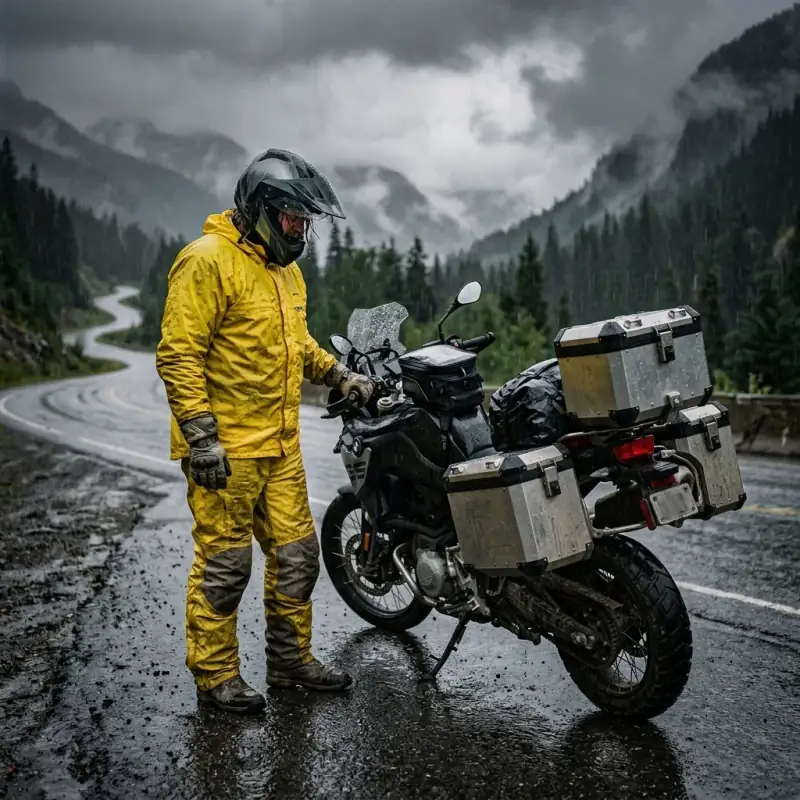
The rain suit is the piece of kit everyone owns and nobody has with them.
It’s cheap, it packs down to nothing, and it turns a day that would have been genuinely miserable into a day you barely remember afterwards. And it spends most of its life in a garage cupboard, because rain wasn’t forecast, because the jacket says “waterproof” on the label, or because it’s a faff to put on.
This guide is about the gear you pull over what you’re already wearing: packable oversuits, boot covers and over-gloves. It’s the equipment companion to two guides we’ve already published — how to ride in the rain, which is about technique on a wet road, and motorcycle camping in the rain, which is about staying dry once you’ve stopped. This one is about the hour in between, when it’s hammering down and you’ve still got 200 km to go.
Why an Oversuit, When Your Jacket Is Already Waterproof?
This is the fair objection, and the answer depends on how your jacket is built.
Drop-liner gear — the great majority of touring jackets — hangs a separate waterproof membrane inside the outer shell. It works: you stay dry. But the outer fabric wets through completely and stays wet, which means you’re riding around in several kilos of soaked textile that chills you all afternoon and is still damp the next morning. On a multi-day trip, that compounds.
Laminated gear bonds the membrane to the outer fabric, so the shell itself doesn’t wet out. It’s better in the rain and it costs a lot more, which is exactly the distinction our adventure jackets guide digs into. If you own laminated gear, you have the strongest case for skipping an oversuit.
Even then, three arguments survive:
- It’s a wind shell. Windproofing is what keeps you warm at road speed, so the same suit does a second job on cold dry days — a point we make at more length in the cold-weather riding guide.
- It keeps grime off your good gear. Road spray is filthy, and technical fabrics don’t enjoy repeated washing.
- It weighs and costs almost nothing. Which is really the whole argument: the suit that’s in your pannier is worth more than the better suit at home.
Rain Gear Compared — Side by Side
5 Picks — Side by Side
| Item | Type | Key spec | Best for | Price | Rating |
|---|---|---|---|---|---|
| Best All-RoundNelson-Rigg SR-6000 Stormrider | Two-piece oversuit | PVC-backed polyester, storm flaps, underarm vents | Touring, everyday use | $$ | |
| Best Packed SizeAlpinestars Hurricane Rain V2 | Suit | PU-coated poly-nylon, all seams tape-sealed | Riders short on luggage space | $$$ | |
| Alpinestars Hurricane Rain Jacket | Jacket only | Same fabric and sealed seams, top half only | Waterproof trousers already sorted | $$ | |
| Best BudgetFrogg Toggs Hogg Togg | Two-piece oversuit | Very light, very packable | The suit you'll actually carry | $ | |
| Most UnderratedNelson-Rigg WPRB-100 | Boot covers | PVC-backed polyester, half rubber sole, reflective | Keeping feet dry, which nothing else does | $ |
On price tiers: $ is genuinely cheap — less than a tank of fuel; $$ is where most motorcycle-specific oversuits sit; $$$ is the premium end. We don’t publish exact prices because they move constantly with size, colour and sales — check the live figure on each button. Note that rain suits are sized per listing, so the buttons below land on one size; pick yours on the page, and if you’re between sizes go up, because this goes on over armour.
1. Nelson-Rigg SR-6000 Stormrider — Best All-Round
Nelson-Rigg makes rain gear for people who ride in rain rather than people who own rain gear, and the SR-6000 is the one to start with. It’s a two-piece suit built from a soft polyester outer with a PVC backing, which is the workhorse construction for motorcycle rain gear: not breathable, entirely waterproof, and tough enough to cope with wind flap at speed.
The detailing is where it earns its keep. A full-length zip with hook-and-loop storm flaps covering it, so the zip isn’t the weak point. Vents under each arm, which matter more than they sound — a non-breathable suit over an armoured jacket gets clammy fast, and being able to dump some of that heat is the difference between wearing it and taking it off. A soft corduroy inner collar and a hood. Adjustable hook-and-loop cuffs on the trousers, an elasticated waist, and reflective striping on both pieces, which is exactly right for gear you’ll wear in the worst visibility of the year. It’s sold in sizes from small to 4X, in black and in hi-viz yellow.
Our take: the default recommendation because it’s designed around the real problems — sealing the zip, venting the heat, being seen in the rain — rather than around a fabric spec sheet. It isn’t breathable and doesn’t pretend to be; on a long warm-wet day you will be damp inside it, which is true of every suit at this price and honest to say. Buy the hi-viz version unless you have a reason not to.
Disclosure: some links below are affiliate links. If you buy through them we may earn a small commission at no extra cost to you.
Check Nelson-Rigg SR-6000 on Amazon →
2. Alpinestars Hurricane Rain V2 — Best Packed Size
The Hurricane is the suit for riders whose luggage is already full. It uses an ultra-lightweight PU-coated poly-nylon, and the two specifications that matter are both stated by Alpinestars: all seams are tape-sealed, and the fabric is specially treated so it doesn’t stick to the textile or leather gear underneath.
That second one sounds like marketing until the first time you try to pull an untreated nylon oversuit over a damp textile jacket in a lay-by while it hammers down. Gear that slides on is gear you’ll actually put on in time.
Being very light and very packable is the trade-off in both directions: it disappears into a pannier corner, and it’s less robust over years of hard use than a heavier PVC-backed suit. Alpinestars also sells the range as separates and as a one-piece, so you can pick the format that suits how you ride.
Where it fits: the pick when space and weight are the binding constraint, and the one with the clearest published seam-sealing claim on this page. Rated just below the Nelson-Rigg for touring because it costs more and the lighter fabric flaps and wears harder at sustained speed — but if your criterion is “what will I still be carrying in six months”, light and small wins arguments.
Check Alpinestars Hurricane Rain V2 on Amazon →
3. Alpinestars Hurricane Rain Jacket — When You Only Need the Top Half
Same fabric, same tape-sealed seams, jacket only.
This is more useful than it first appears, because a lot of riders have the trouser problem solved — laminated riding trousers, or over-trousers that came with a jacket — and only need something to stop the top half wetting out. It’s also the sensible half to carry if your bike has decent weather protection at the legs but leaves your chest and shoulders in the airstream.
Where it fits: rated lower than the full suit only because it does half the job; as half a solution it’s exactly as good. Buy it if your legs are already covered, and don’t buy it as a “mostly” solution if they aren’t — wet legs on a cold day are worse than wet arms.
Check Alpinestars Hurricane jacket on Amazon →
4. Frogg Toggs Hogg Togg — Best Budget
The Frogg Toggs suit is the reason a lot of tours didn’t turn into disasters, and it costs so little that not having one is a decision rather than a budget constraint.
It’s light, it’s genuinely packable, and it keeps the rain out. What you’re not getting at this price is long-term durability against sustained high-speed wind flap, or premium closures. Riders who use one occasionally get years out of it; riders who wear one daily through a wet winter will replace it.
The value case: the honest recommendation for anyone who doesn’t currently carry anything, because the gap between “no rain gear” and “cheap rain gear” is enormous and the gap between “cheap” and “premium” is not. Buy this today, use it, and upgrade later if you find you’re reaching for it every week.
Check the Frogg Toggs Hogg Togg on Amazon →
5. Nelson-Rigg WPRB-100 Boot Covers — The Most Underrated Item Here
Ask riders what ruined a wet day and most of them will say their feet.
Water finds boots by two routes: straight through boots that aren’t as waterproof as advertised, and — much more commonly — running down your trousers and into the boot top, because the trouser was tucked in rather than pulled over. Once there’s water inside a boot it stays there all day, and cold wet feet drain morale faster than almost anything else on a bike.
The WPRB-100 is a boot cover: 100% waterproof polyester with a PVC backing, worn over your boots and under your trousers or chaps, with a half rubber sole so you can walk in them and reflective binding so your feet are visible in the dark and wet. Sizes M, L and XL, sold singly and in a two-pack.
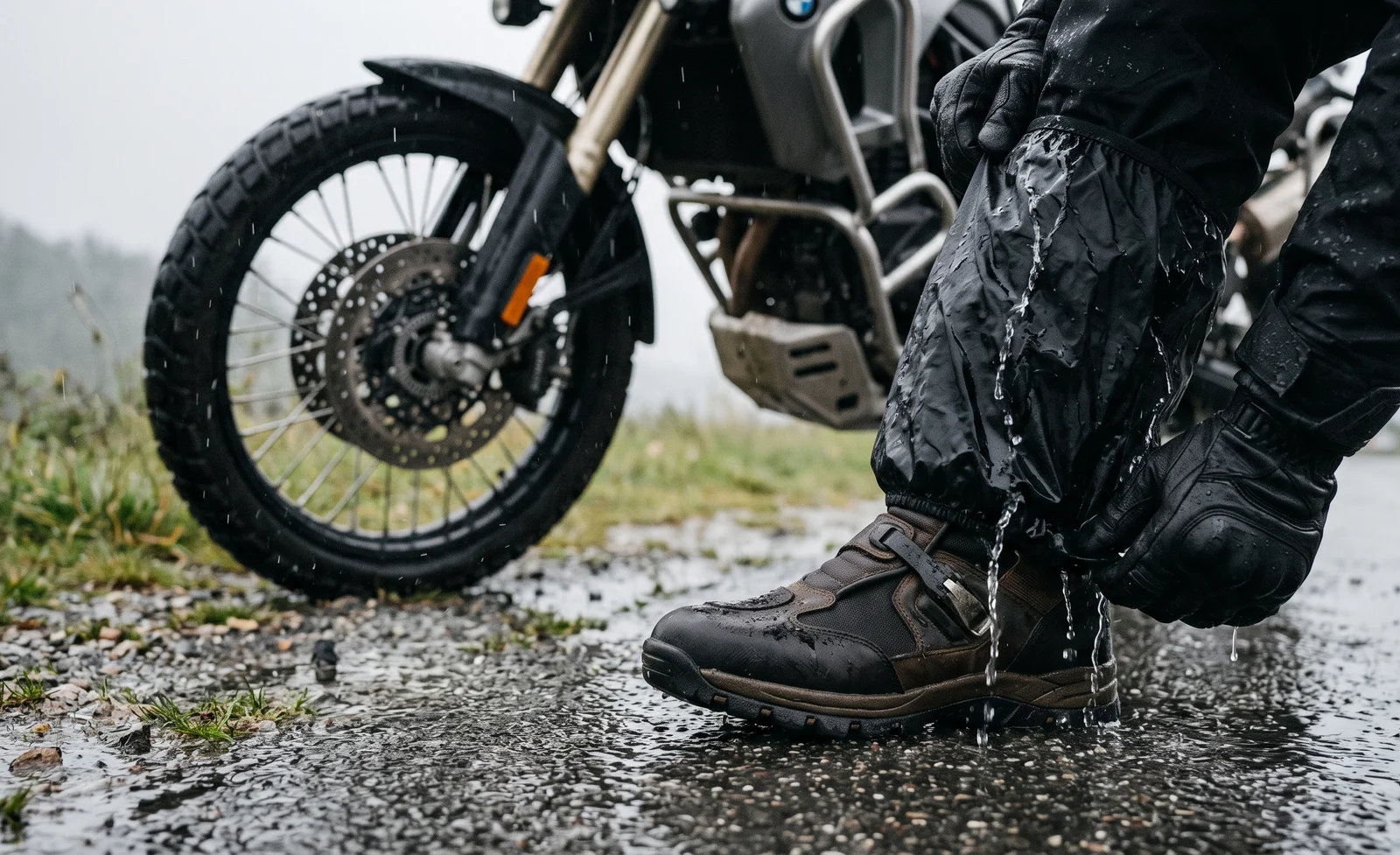
Our take: the highest-value few euros in this whole article, and rated above two of the suits deliberately. A cheap oversuit plus boot covers will leave you drier and happier than an expensive suit alone. If your boots are the problem rather than the overlap, the waterproofing options in our adventure boots guide are the longer-term fix.
Check Nelson-Rigg boot covers on Amazon →
Hands: the Honest Section
We’re not naming a single over-glove here, and it’s worth explaining why.
Waterproof over-gloves — thin shells you pull over your riding gloves — are sold by a lot of small brands, and the ones on Amazon at the cheap end mostly don’t publish specifications we could verify against a manufacturer source. Given that this site’s rule is not to make performance claims we can’t stand behind, we’d rather tell you the category is useful and let you buy on price than pretend we’ve validated a particular one.
What we can say confidently is how hands get wet, because it’s a geometry problem more than a fabric one:
- Gauntlet gloves go over the jacket cuff. Under it, your sleeve delivers water straight into the glove.
- Short-cuff gloves go under a tight, adjustable jacket cuff, with the cuff closed down onto the glove.
- No glove stays dry indefinitely in sustained rain. This is the part gear marketing doesn’t say. Even good waterproof gloves eventually let water in at the cuff, and once wet they stay wet.
Which is why the most reliable answer isn’t a better glove, it’s a second dry pair in a dry bag. Swapping to dry gloves at a fuel stop transforms the second half of a wet day, and it costs nothing beyond the space. If you’re buying gloves rather than covers, the waterproof picks in our adventure gloves guide are the place to start, and the dry bag you keep the spares in is covered in our dry bags guide.
Buying and Using It Properly
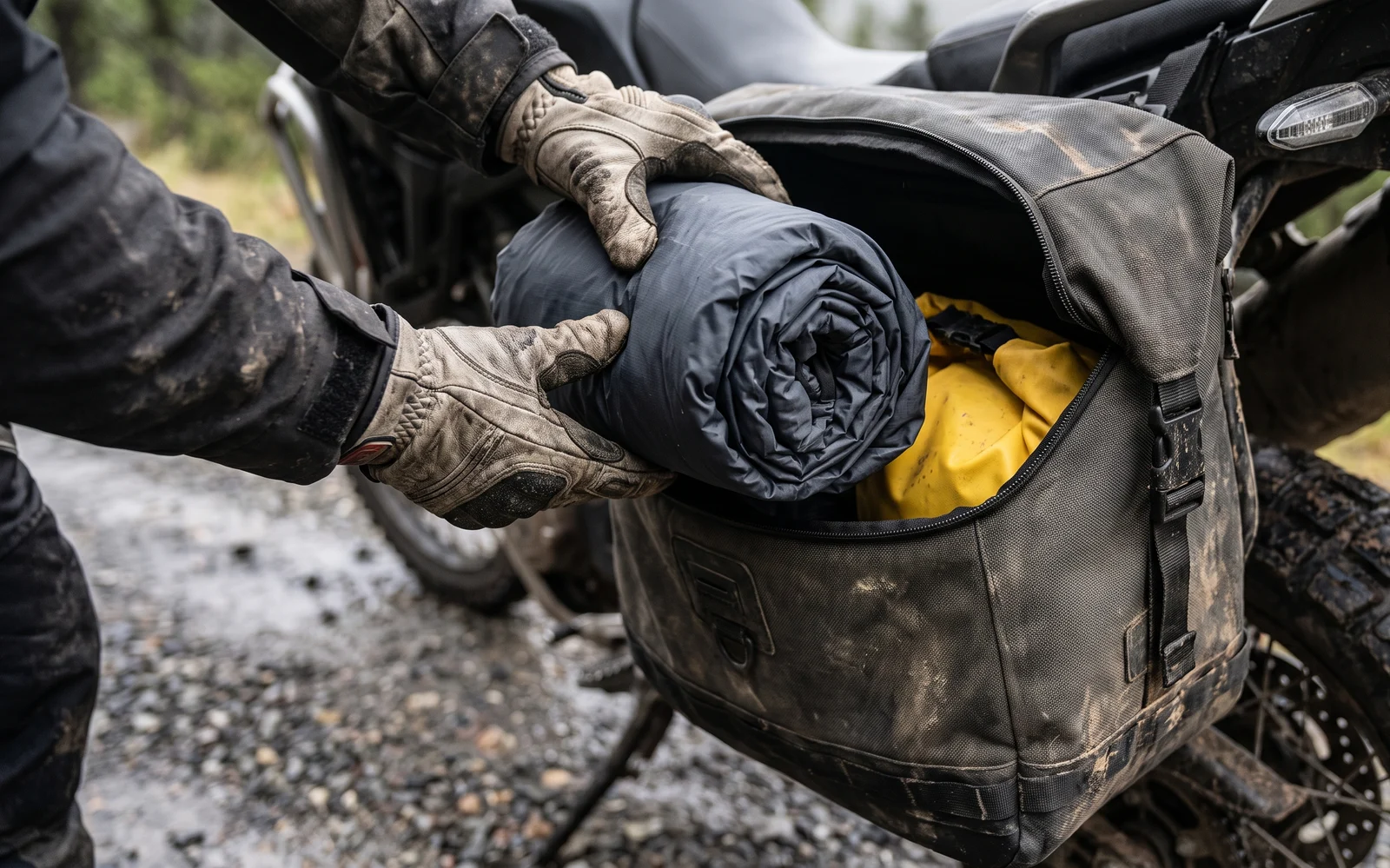
Size up. This goes over armour. A rain suit that fits you in a shop over a t-shirt will not go over an adventure jacket at the roadside in the wet.
Buy hi-viz if you can stomach it. The days you wear it are the days with the worst visibility of the year, and drivers are looking through wet glass and spray.
Check the seams before the closures. Fabric rarely fails; needle holes do. A suit advertising taped or welded seams is making a meaningful claim. A suit that says nothing about seams is telling you something too.
Ignore breathability claims at this price. Cheap and mid-priced rain gear is not breathable in any useful sense, so you’ll get damp from the inside on a warm wet day. That’s a comfort issue, not a failure — and it’s exactly what those underarm vents on the Nelson-Rigg are for.
Put it on early. The universal mistake is waiting to see whether the rain settles in. By the time you admit it has, your gear is soaked and the suit is going on over wet clothes, which achieves very little.
Get the overlaps right. Trousers over boots, always. Gauntlets over cuffs. Collar closed before the jacket zip.
Store it where you can reach it. Not at the bottom of a pannier under the tent. The top of a tail bag, or a tank bag, so putting it on is a two-minute decision rather than a full unpack in a lay-by.
Dry it properly. Hang it up rather than stuffing it away wet — PVC-backed fabrics in particular don’t like being packed damp for days, and a suit stored wet in a hot pannier is a suit that smells and eventually delaminates.
The Bottom Line
Rain gear is the cheapest, least glamorous and highest-return equipment on a touring motorcycle. A suit you actually carry beats a better one at home, which is the entire logic behind buying something inexpensive and leaving it permanently in a pannier.
Get a two-piece so you can put it on at the roadside without taking your boots off. Get boot covers, because feet are where wet days go wrong. Carry a second pair of gloves rather than hunting for a glove that never leaks. Size it to go over your armour, buy the bright one, and put it on before the rain has properly started rather than after.
Do that and rain stops being the thing that decides whether you ride. Which, on a long trip, is most of the point — and once you’re wet-weather-proofed on the bike, our guides to wet-road technique and staying dry in camp cover the other two-thirds of a rainy tour.
Disclosure: Some links in this article are affiliate links. If you buy gear through them, Bikes & Bays earns a small commission at no extra cost to you. We only link to gear that earns its place, and skip the button when nothing’s worth recommending.
Frequently Asked Questions
Do I need a rain suit if my riding jacket is already waterproof?
Often yes, for three reasons that have nothing to do with your jacket being bad. First, most touring jackets use a drop liner — a waterproof membrane hung inside the outer shell — which means the outer fabric soaks through and stays wet even though you don't. That fabric then sits against you as dead weight, chills you through the rest of the day, and takes hours to dry overnight. Second, an oversuit is also a wind shell, and windproofing is what keeps you warm at road speed, which makes the same item useful on cold dry days. Third, an oversuit keeps road grime off your good gear, which matters if you'd rather not wash a technical jacket every week. Riders with genuinely laminated jackets — membrane bonded to the outer fabric, so the shell itself doesn't wet out — have the strongest case for skipping one, and even then plenty carry one for the wind and the dirt.
One-piece or two-piece rain suit?
Two-piece for most touring riders, one-piece if you can reliably get it on. A two-piece is far easier to put on at a lay-by with boots already on, and you can wear just the jacket when it's drizzling or just the trousers when your jacket copes but your legs don't. A one-piece has fewer seams and no waist join for water to find, so it tends to keep you drier in sustained heavy rain, but getting into it at the roadside in a hurry is genuinely awkward. The practical compromise most experienced tourers land on: a two-piece that lives permanently in a pannier, so it's always there rather than always at home.
What actually makes a rain suit waterproof?
Seams, mostly. A coated or laminated fabric keeps water out across its surface easily enough; the failure point is the thousands of needle holes where panels are stitched together. That's why the specification worth looking for is taped or welded seams — Alpinestars, for instance, states that all seams on its Hurricane rain gear are tape-sealed. After seams, look at the closures: storm flaps over zips, elasticated or adjustable cuffs and hems, and a collar that actually seals. We'd treat a suit with no seam-sealing claim as showerproof rather than waterproof, whatever the fabric is.
How do I stop water running into my boots and gloves?
By managing the overlap, which is where nearly everyone gets wet. Rain trousers or over-trousers must go over the boot, not tucked in — tucked in, the trouser becomes a funnel delivering water straight into your boot. Dedicated boot covers solve it more completely by sealing over the whole boot. For hands, the rule reverses depending on your gloves: gauntlet gloves go over the jacket cuff so water can't run down your forearm into the glove, while short cuffs go under a tight, adjustable jacket cuff. And accept the honest limit — no glove stays dry indefinitely in sustained rain, which is why many tourers carry a second dry pair rather than chasing a perfect one.
Is expensive rain gear actually better than a cheap suit?
Up to a point, and the point arrives sooner than with most gear. A budget packable suit and a premium one both keep the rain off on the day. What you pay more for is packed size, durability against wind flap and abrasion at speed, fabric treated not to stick to the textile gear underneath, better closures and, usually, seam sealing you can trust for longer. A cheap suit that lives in a pannier and gets used ten times a year is genuinely good value; a cheap suit used daily through a wet winter will delaminate and tear at the seams. Buy for how often it'll actually come out, and buy hi-viz if you have the choice, because the days you need it are the days drivers can see least.