
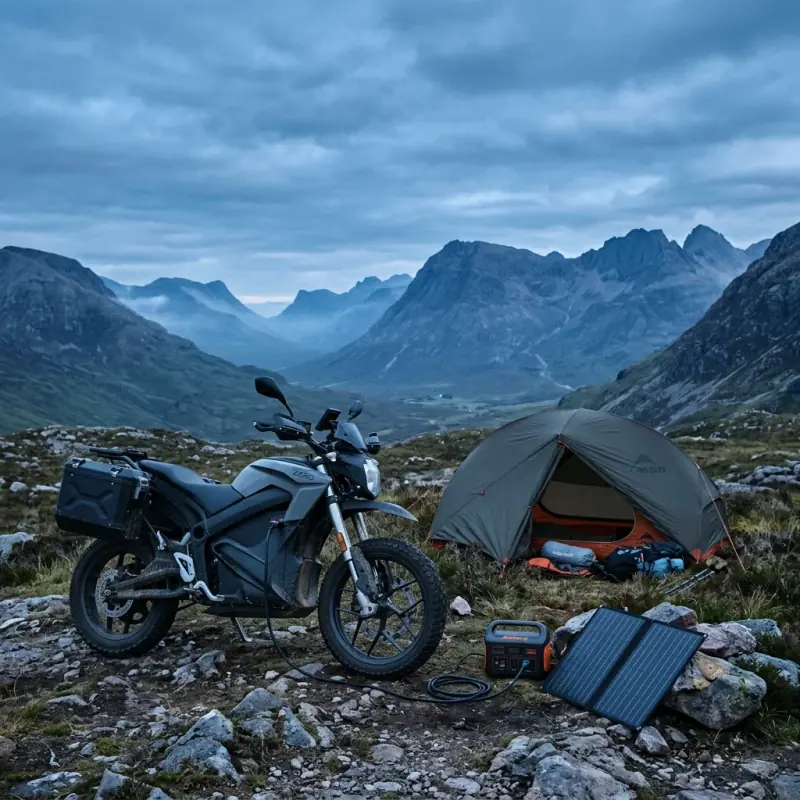
This site is about riding to places that don’t have chargers: remote Turkish bays, fjord pitches a long way from a town, mountain passes where the nearest fuel is an hour away. The whole point of an adventure bike, for that kind of riding, is that it carries its own range to the edge of the map and beyond. So the question of whether to buy an electric adventure motorcycle is really two completely different questions, because “is it a good bike?” and “is it a good bike for this?” now have very different answers.
The honest 2026 picture is that electric adventure motorcycles have finally become good machines — fast, capable, refined, a joy to ride. What hasn’t caught up is the thing that matters most for remote touring and wild camping: where, and how fast, you can put the energy back in. This is the reality check for riders who camp wild and ride far from infrastructure: the spec sheets read against the charging map.
The Contenders in 2026
Three bikes define where electric adventure and touring actually is right now.
Zero DSR/X. The real electric ADV
The Zero DSR/X is the most convincing electric adventure bike on sale: proper upright adventure ergonomics, around 100 hp, capable off-road manners, and roughly 290 km of city range from its big battery. Reviewers are consistent about how it rides: instant torque, no gears, and a quiet that changes how you experience a landscape. Its one serious flaw in 2026 is charging: it still doesn’t support DC fast charging, so away from home you’re stuck with the onboard AC charger and a multi-hour wait for a near-full battery. As a bike, it’s the class leader. As a tourer, that charging limitation is the catch.
Energica Experia. The electric tourer that works
The Energica Experia answers the touring question more convincingly. It carries one of the biggest batteries in the class, has the longest highway range here (around 200 km on the highway, more gently), and crucially it takes DC fast charging — roughly 40 minutes to 80%. That combination means it can genuinely replace a petrol touring bike for a rider sticking to roads and motorways with charging on the route. The trade-offs are weight (it’s heavy) and a road rather than off-road bias. It’s a tourer in adventure clothing more than a true dirt bike.
One thing to check before you fall for it: Energica went into judicial liquidation in October 2024. Singapore-based investors bought the business in 2025 and named the Experia among the models they plan to build again, but at the time of writing we couldn’t confirm that new bikes are being delivered. If you buy one, new old stock or used, ask the seller who is providing parts and warranty support where you live.
LiveWire S2 Del Mar — the city/canyon bike
The LiveWire S2 Del Mar is lighter, more agile and aimed at a younger urban rider — brilliant fun in the city and on canyon roads, but with modest range and a clear city-and-day-ride brief rather than touring ambitions. It’s a sign of where the technology is going more than a tool for long trips. Worth knowing about; not the bike for a camping tour.
The Two Questions That Decide Everything
Forget the spec sheets. For touring and camping, two practical questions settle whether an electric ADV works for you.
1. How far does it really go — loaded?
The headline range numbers are best-case. Load the bike with camping kit, ride two-up, sit at motorway speed, and range drops 30-50%. The Zero’s ~290 km city figure becomes far less at a sustained 110 km/h; even the class-leading Experia is realistically around 200 km on the highway. For day rides and pottering between towns that’s fine. For the way adventure bikes are actually used on a long trip — big distances, a fuel stop every 300+ km, no thinking about it. That range is the hard limit you plan your whole day around.
2. Where, and how fast, can you charge?
This is the one that matters most, and the one the niche misses. A petrol bike refuels in five minutes anywhere there’s a pump, and there’s a pump nearly everywhere. An electric bike needs a charger, and the good fast ones are concentrated in developed areas along main roads. Take the DSR/X, which has no fast charging at all, somewhere remote and a “refuel” is a two-hour wait — if you can find a socket. The Experia’s 40-minute fast charge is far better, but only where a fast charger exists, which is not on the dirt road to a remote bay.
Where It Works, and Where It Doesn’t
Put those two questions together and the verdict sorts itself by what kind of riding you do, not by which bike is best.
Where an electric ADV already works well in 2026:
- Day rides from a fixed base — ride out, ride back, charge overnight at home or your accommodation. The single best use case, and a brilliant one: the silence and torque make a day in the mountains genuinely better.
- Weekend and short trips in a country with good charging — Norway, the Alpine countries and much of western Europe now have the infrastructure to plan around.
- Commuting plus the occasional tour — where the bike spends most of its life on predictable daily runs with home charging, and the tour is the exception.
Where it doesn’t, yet:
- Remote, off-grid riding. The Turkish bays and back roads where there’s no charger for a hundred kilometres. This is exactly where a petrol middleweight or a long-distance tourer still wins outright.
- Long multi-day trips far from infrastructure — crossing the empty parts of the map, where refuelling has to be quick and possible anywhere.
- Wild camping itself; which brings us to the real sticking point.
The Wild Camping Problem
Here’s where it gets personal for this site. Wild camping means no infrastructure, that’s the whole definition. You ride to a quiet bay or a mountain pitch precisely because there’s nothing and no one there. And nothing and no one means no socket.
A petrol bike doesn’t care: it carries everything it needs and a jerry can covers the rest. An electric bike, parked at a perfect wild pitch a long way from anywhere, simply has no way to charge. You can top up at organised campsites with electrical hook-ups, or anywhere with a standard plug if you’ve got the hours, but the free, remote, off-grid camping that this whole site is built around is the one thing today’s electric bikes can’t support. You’d spend the trip routing not by where you want to sleep but by where you can plug in; which is the opposite of why we go.
Worth noting the small irony: managing power off-grid is a problem riders already think about for phones, cameras and devices on a camping trip. Doing it for the bike itself, at the scale a motorcycle battery needs, is a different order of problem entirely, and not one a tank bag of power banks solves.
Weight, Cost and the Other Trade-offs
A few more honest marks against, for now:
- Weight. Big batteries are heavy, and that weight sits in a bike you might want to pick up off a trail. The road-biased Experia especially is no lightweight.
- Price. Electric ADV bikes carry a premium over equivalent petrol machines up front, though running costs (home charging, fewer moving parts) claw some back over time.
- Security. A high-value electric bike at a remote camp is a worry like any expensive machine. The usual thinking about securing a bike at camp applies, with the added wrinkle that you can’t just ride away if the battery’s flat.
None of these are dealbreakers for the right rider. All of them matter more the further you get from a town.
The Verdict
Electric adventure motorcycles in 2026 are good bikes held back, for our kind of riding, by the charging map rather than by anything wrong with the machines. The Zero DSR/X is a wonderful thing to ride and the best electric ADV out there; the Energica Experia proves an electric bike can really tour, where the chargers are. If your riding is day loops, well-served weekends, or commuting with the odd tour, buy one and enjoy it. You’re not compromising much, and the experience is special.
But if your riding looks like this site — remote, coastal, off-grid, a tent by the water a long way from the nearest socket — then a petrol adventure bike is still the right tool, and will be until charging reaches the places we actually go. The technology is closing the gap fast, and I genuinely expect this verdict to change within a few years. For now, match the bike to your trips, be honest about where you really ride, and don’t let either the hype or the cynicism choose for you.
Related Guides
- For the petrol bikes that still own the remote middleweight space, see KTM 890 Adventure R vs Yamaha Ténéré 700.
- For long-haul road touring, the best motorcycles for long-distance touring and the BMW R 1300 GS Adventure review.
- Managing power off the grid for your devices (a different, smaller problem) — best power banks and charging for motorcycle camping.
- And the riding this verdict is measured against — bays in Turkey you can reach by motorcycle.
This guide is built from the manufacturers’ current 2026 specifications and published charging data; we have not ridden these bikes. Some links in this article are affiliate links — if you buy gear through them, we may earn a small commission at no extra cost to you.
Frequently Asked Questions
Can an electric motorcycle do long-distance touring in 2026?
On road-focused touring with charging infrastructure, yes — the Energica Experia, with real-world highway range around 200 km and proper DC fast charging that gets it to 80% in roughly 40 minutes, can genuinely replace a petrol tourer for someone riding between towns and motorways. The catch is that it only works where the chargers are. Plan a route around charging stops in a developed country and an electric tourer is now a real option; ride somewhere remote and spontaneous and it isn't, yet.
What's the best electric adventure motorcycle right now?
The Zero DSR/X is the most credible electric ADV bike — proper adventure ergonomics, around 100 hp, strong off-road manners and roughly 290 km of city range (much less on the highway). Its big limitation is that it still doesn't take DC fast charging in 2026, so away from home you're on a slow AC charge of around two hours. The Energica Experia is the better long-distance tourer thanks to fast charging and bigger range, but it's heavy and road-biased. For pure adventure use the DSR/X leads; for touring the Experia does.
Can you charge an electric motorcycle while wild camping?
Not really, and this is the heart of the problem for the kind of riding this site is about. Wild camping by definition means no infrastructure — no socket at a remote bay or a mountain pitch. You can top up at campsites that have hook-up points, or anywhere with a standard plug given enough hours, but you cannot charge in the wild. That makes today's electric bikes a poor match for off-grid, remote, multi-day camping trips, however good they are around a town with chargers.
How far can an electric adventure bike really go on a charge?
Less than the headline number, especially two-up and loaded on the highway, where range can drop 30-50% from the quoted figure. The Zero DSR/X's ~290 km city range becomes far less at sustained motorway speed; the Energica Experia is among the best and still realistically around 200 km on the highway. For day rides and developed-area touring that's workable; for the long, remote, fuel-stop-every-300-km riding adventure bikes are built for, it's the limiting factor.
Should I buy an electric adventure bike for camping trips?
Honestly, not yet if your trips are remote and off-grid — the lack of charging in the wild and the range hit when loaded make a petrol ADV the right tool for that job today. But if your 'adventure' riding is day loops from a fixed base, weekend trips in a country with good charging, or commuting plus the occasional tour, an electric ADV is already genuinely good and getting better fast. Match the bike to your riding, not to the hype.