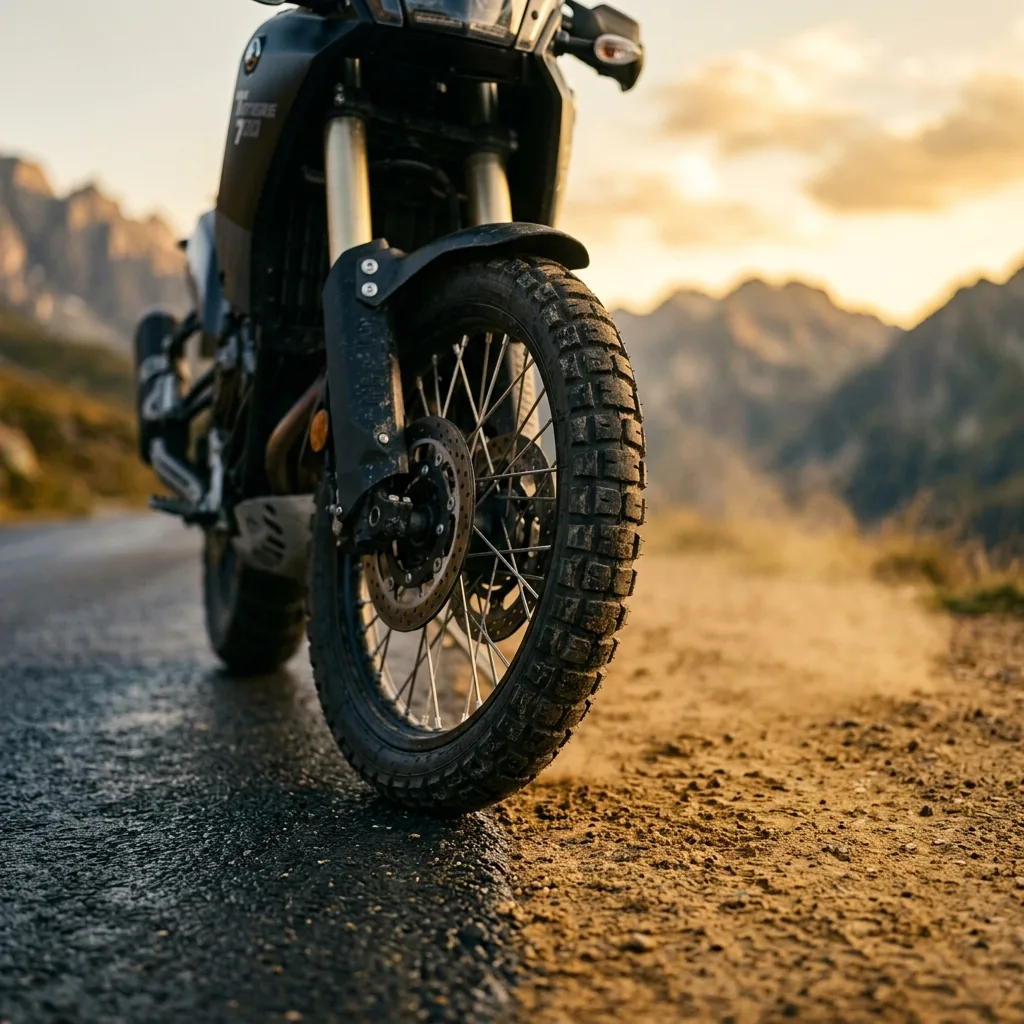
One tire cannot do everything. Pick a real off-road knobby and you will hear it humming on the motorway and replace it twice a year. Pick a road-biased ADV tire and you will slide it sideways the first time you hit wet clay. The right answer is matching the tire to the actual split of pavement and dirt you ride — not the trip you imagine taking next summer.

Updated for the 2025–2026 season. This best adventure motorcycle tires 2026 guide ranks seven tires by where they sit on that split, with honest weak points and the sizes most people actually run. Every recommendation here is tied to a real ASIN on Amazon so you can check what is actually in stock for your bike. No sponsored placements, no “industry favourites” we have never put on a wheel. The picks are the same whether you are restocking from a late-2025 set or planning fresh rubber for 2026.
Pick by the riding you do this year, not the riding you keep planning to do.
Quick Pick by Riding Style
A short summary for riders who do not want to scroll the whole guide:
- Mostly pavement, occasional gravel (90/10–80/20) — Michelin Anakee Adventure 2 for premium feel, Shinko 705 for budget.
- Balanced mixed-surface touring (50/50) — Dunlop Trailmax Mission for mileage, Mitas E-07+ for value, Heidenau K60 Scout for round-the-world durability.
- Dirt-first with road sections (40/60 and beyond) — Continental TKC80 for the classic aggressive look, Bridgestone Battlax AX41 for modern off-road bite.
Read past the table for the why behind each one.
At-a-Glance Comparison
| Tire | On/Off Split | Best For | Construction | Standout | Price |
|---|---|---|---|---|---|
| Michelin Anakee Adventure 2 | 80/20 | Road-biased ADV touring | Radial | Quiet, refined, OE on some GS models | Check price → |
| Continental TKC80 Twinduro | 40/60 | Aggressive classic 50/50 | Bias | Iconic block grip, OE on GS Adventure | — |
| Mitas E-07+ | 50/50 | Value 50/50 with long life | Bias | Reinforced ”+” carcass, Dakar option | Check price → |
| Heidenau K60 Scout | 50/50 | Round-the-world mileage | Bias | Legendary durability, M+S rated | Check price → |
| Shinko 705 | 80/20 | Budget all-rounder | Bias 4-ply | Amazon best-seller, real value | Check price → |
| Bridgestone Battlax AX41 | 40/60 | Serious off-road bite | Bias | ~30% larger block face, Even-Wear | — |
| Dunlop Trailmax Mission | 50/50 | Mileage-leading 50/50 | Bias | Class-leading life claim, wide fitment | Check price → |
Price bands move week to week on Amazon, especially across sizes — check the current price for your specific size before ordering.
The Seven Adventure Tires Worth Buying in 2026
Sizes below cover what most adventure riders are actually mounting — 19” front + 17” rear sport-touring ADVs (R 1250 GS, Africa Twin), 21” front + 18” rear dirt-leaning ADVs (KTM 890 R, Husqvarna 701), and the Ténéré 700 sizing that has become almost its own category. Always confirm the size against your own bike before buying — every size is a different ASIN.
1. Michelin Anakee Adventure 2 — Best Road-Biased All-Rounder (80/20)
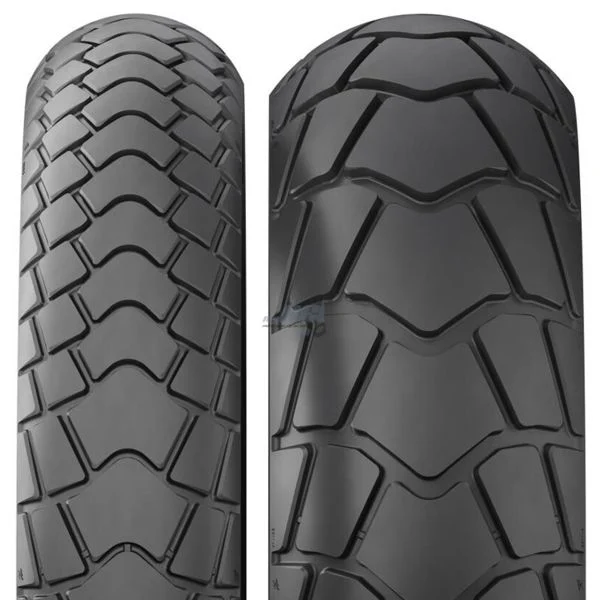
The Anakee Adventure 2 is Michelin’s answer to “I want to act like I might ride dirt, but I won’t.” It is an 80/20 with a silica-based compound, Michelin’s 2CT dual layer, and the Reinforced Radial-X EVO carcass. Versus the original Anakee Adventure it runs noticeably quieter, holds wet pavement better, and reportedly lasts longer in the rear. It is OE on several BMW GS variants, which tells you which end of the dirt/road spectrum it is tuned for.
In practice it is the tire most ADV riders should be running. The on-center feel is precise, it warms up quickly, and it handles light gravel and hardpack without fuss. Take it into wet clay or mud and you will know immediately why “Adventure 2” is not called “Wild.”
Best for: Riders spending most of their miles on tarmac and dipping into easy forest roads on weekends. Weak point: Not enough block for serious off-road. If your weekends are deep dirt, look further down this list.
Shop Anakee Adventure 2 front (120/70R-19) on Amazon →
For 21” / 18” / 17” rims and other common sizes:
Shop Anakee Adventure front 90/90-21 → Shop Anakee Adventure front 110/80-18 → Shop Anakee Adventure rear 140/80-17 (T7) → Shop Anakee Adventure rear 150/70-18 (R1250GS) → Shop Anakee Adventure rear 170/60-17 →
Pick the size that matches your own wheels — the Anakee 2 specifically is the new front 120/70R-19, the rest of the range is still the well-stocked previous generation.
2. Continental TKC80 Twinduro — Best Aggressive Classic (40/60)
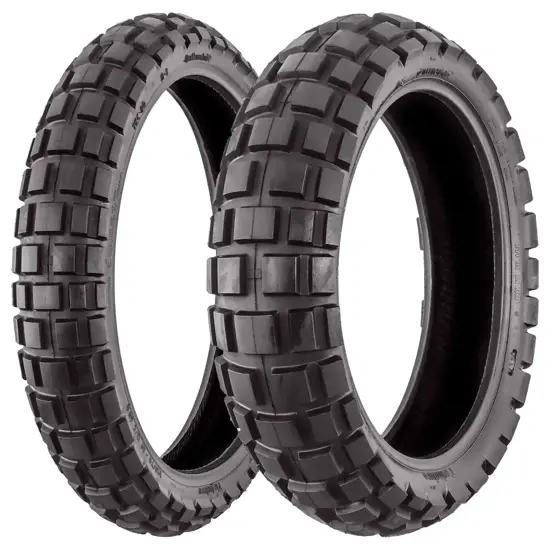
The TKC80 has the look every adventure rider thinks they want. Deep, widely spaced blocks; an M+S rating; OE fitment on BMW GS Adventures, big KTMs, and the Husqvarna 701 Enduro. On dirt and gravel it is genuinely excellent. The grip on hardpack and damp earth is the kind that makes you trust the front more than you should, and the tread pattern self-cleans well in mud.
The catch is wear. Heavy bikes on hot tarmac eat TKC80 rears for breakfast — owners on big GSs and Africa Twins routinely report 4,000-5,000 miles before the rear is finished. On the road it tracks better than its appearance suggests, with a noticeable hum on the motorway that some riders enjoy and others learn to hate.
Best for: Dirt-first ADV riders who want classic knobby tutuş and accept the wear penalty. Weak point: Short rear life on heavy bikes, motorway noise, wet-tarmac edge grip is honest at best.
Shop TKC80 front + rear set (120/70-19 + 140/80-18) → Shop TKC80 rear 140/80-17 (T7) → Shop TKC80 rear 150/70B-17 → Browse other TKC80 sizes on Amazon →
If your bike runs a less common size, hit the multi-size listing — TKC80 is made in almost every ADV fitment that exists.
3. Mitas E-07+ (Enduro Trail+) — Best Value 50/50

Mitas is the quietly competent value brand in the ADV tire market. The E-07+ is a true 50/50 with a reinforced ”+” carcass over the original E-07, and the Dakar variants step that up again for heavily loaded bikes. The compound is harder than premium European rivals, which is exactly why it lasts — the trade is a slightly less plush ride on cold mornings and a bit more noise during the first few hundred miles.
What you get for the money is honest. The block pattern works well in dry dirt and light mud, the on-road manners are stable and predictable, and the rear runs long enough to make the price-per-mile genuinely good. It does not have the wet-asphalt refinement of a Michelin or the high-end feel of a Metzeler, but those are not what people buy a Mitas for.
Best for: Riders who want a 50/50 that does not feel cheap but does not cost premium money either. Weak point: Wet tarmac grip is good, not excellent. Cold start noise is real.
Shop Mitas E-07+ front 120/70B19 → Shop Mitas E-07+ rear 130/80B17 → Shop Mitas E-07+ rear 150/70B17 → Shop Mitas E-07 Dakar front 110/80B19 →
Two-up tourers and riders carrying full panniers should look hard at the Dakar version — the carcass handles the extra load with less squirm.
4. Heidenau K60 Scout — Best for Longevity / Round-the-World (True 50/50)
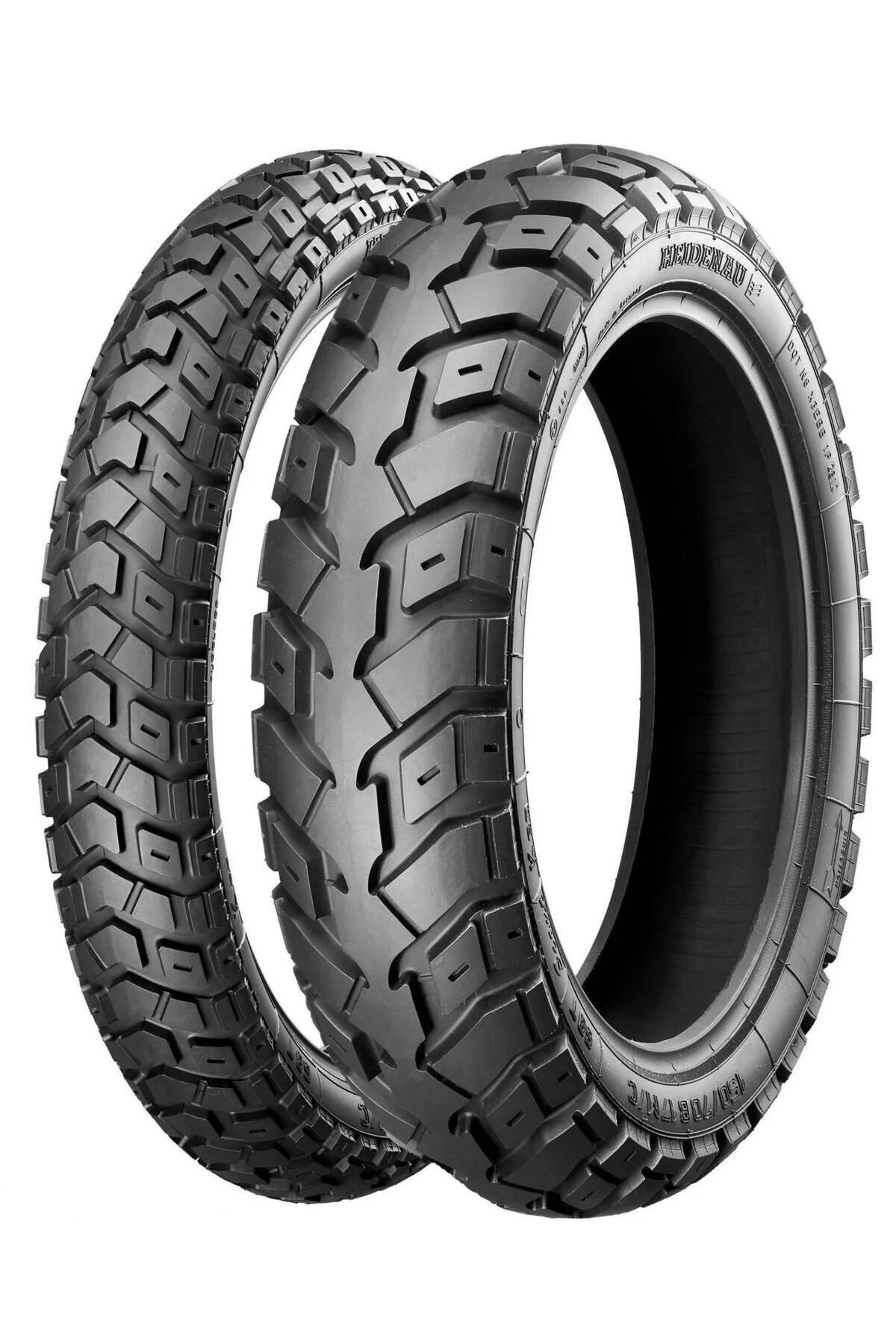
There is a reason the K60 Scout shows up under almost every long-distance overlander’s bike. German-built, M+S rated, high natural rubber content, and a block pattern that lasts in a way that nothing else in this list matches. Rental outfits that have published their fleet data show K60s racking up serious numbers across hundreds of bikes, with mileage figures that are uncomfortable for the rest of the market.
The character is unmistakable. New tires feel firm, almost stiff, and there is a mid-frequency hum at certain speeds that takes some getting used to. After a few hundred miles the ride settles and the K60 simply keeps going — through wet roads, gravel, hardpack, and the occasional muddy crossing. It is not the most aggressive 50/50 in the dirt, but it is the one you will still be running when the next tire change would have come and gone.
Best for: Long-distance touring, round-the-world planning, T7 owners who want to stop thinking about tire changes. Weak point: Initial harshness, noise, not the bite of a TKC80 in soft ground.
Shop Heidenau K60 Scout front 110/80-19 → Browse all K60 Scout sizes on Amazon →
Other K60 sizes are stocked across multiple sellers — confirm your specific size matches your rim before ordering, especially on older European bikes with metric sizes that overlap.
5. Shinko 705 — Best Budget / Best-Seller (80/20)
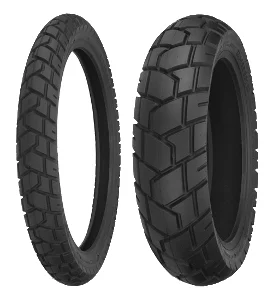
The Shinko 705 is the tire that punches well above its price. It is a bias 4-ply 80/20 that genuinely grips dry and wet asphalt, handles fire roads without complaint, and lasts longer than its sticker suggests. It is also, by some distance, the best-selling adventure tire on Amazon — not because it is the best tire on this list, but because it does what it claims for half the money.
The feel is firmer and less nuanced than a premium radial. You can sense the bias carcass on the freeway in a way you would not on the Anakee 2. The trade is that you can change tires twice as often for the same total spend, which for plenty of riders is a better answer than chasing the last percentage of refinement.
Best for: New ADV riders, first sets after the OE tires square off, anyone who wants real grip without spending real money. Weak point: Not for serious off-road. Bias feel is honest, not premium.
Shop Shinko 705 130/80-17 TL → Shop Shinko 705 120/80-18 → Shop Shinko 705 front 120/70R19 radial →
There is a radial 705 for some 19” front fitments and the rest are bias — match construction front and rear unless you have a specific reason not to.
6. Bridgestone Battlax AdventureCross AX41 — Best True Off-Road (40/60)
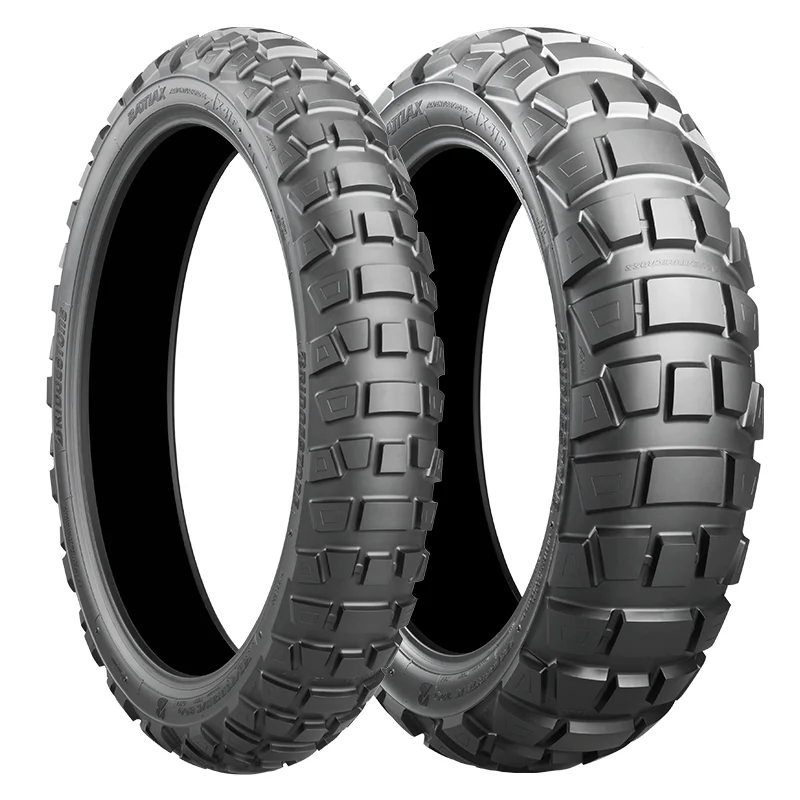
The AX41 is what the TKC80 looks like if you redesign it for 2026. Bridgestone increased the block face area by about 30% over the previous generation, and the Even-Wear pattern keeps the contact patch consistent as the tire ages instead of squaring off into a slick rear. In mud and loose dirt it bites harder than the TKC80, and on hardpack the larger blocks actually feel more stable than the deeper, narrower TKC pattern.
On the road it is what you would expect from a 40/60. The bike feels lively at low speed, the rear gives a faint sense of moving under throttle, and the freeway will produce a low drone. It is not unpleasant, but you will not forget what tire you are on. There is a Tourer-flavoured AX41T variant with slightly closer block spacing for riders who want a little more pavement composure without losing the dirt focus.
Best for: Riders who are honest about doing more dirt than road and want modern off-road performance. Weak point: Road life is short if you sit on the motorway in cruise control all day.
Shop AX41 front 110/80-19 → Shop AX41 rear 150/70-17 → Shop AX41 rear 170/60-17 → Shop AX41T Tourer front 90/90-21 →
The 21” Tourer front is the right answer for KTM 890 R / 790 R / Husqvarna 701 riders who want the AX41 family without the harshest road behaviour.
7. Dunlop Trailmax Mission — Best Balanced Mileage (50/50)

Dunlop’s pitch for the Trailmax Mission is class-leading mileage in a real 50/50, and on owner forums that claim has held up better than it had any right to. The tread looks aggressive — Staggered Step blocks with wrap-around edge lugs — but the compound is harder than the appearance suggests, and the rear simply runs and runs. People who burned through TKC80s in a season tend to move here.
It is not the most aggressive mud tire and it is not the quietest road tire. What it is, is the most balanced of the 50/50 options for riders who want one tire to do the Tenere fire road on Saturday, the Africa Twin highway tour next week, and the V-Strom commute every morning. Fitment coverage is huge — Africa Twin, V-Strom, GS, KTM 790/890/1290, Tenere 700, Triumph 800/1200 all have specific sizes listed.
Best for: “Tek lastikle her şeyi yap” riders who want mileage without giving up off-road competence. Weak point: Not the bite of an AX41 or TKC80 in deep mud, not the refinement of a road-focused 80/20.
Shop Trailmax Mission front 90/90-21 → Shop Trailmax Mission front 110/80-19 → Shop Trailmax Mission front 120/70B-19 → Shop Trailmax Mission rear 150/70-17 → Shop Trailmax Mission rear 150/70-18 →
If you cannot decide between the AX41 and the K60 Scout, the Trailmax Mission is the answer that splits the difference cleanly.
Buyer’s Guide: How to Actually Pick
On/Off Split Is the First Decision
Everything else flows from it. Manufacturers state the split as a percentage that approximates how the tire is biased:
- 90/10 – 80/20: Road-biased. Light gravel, dry hardpack, anything firm. Think Anakee Adventure 2, Shinko 705.
- 50/50: Balanced. Real dirt and real road, neither perfect, both genuinely usable. Trailmax Mission, K60 Scout, E-07+.
- 40/60 – 20/80: Dirt-biased. Soft ground, mud, technical off-road. Road-legal, road-rideable, but you will pay in wear. TKC80, AX41.
Be honest about what you actually ride, not what you want to be the kind of rider who rides.
Radial vs Bias-Ply
Radials handle heat and high speed better and tend to give a more refined feel on heavier ADVs. They cost more and are dominant on premium tires. Bias-ply tires have stiffer sidewalls, take loads well, and are more common on lighter bikes and budget options. Many adventure tires exist in both — match what came on the bike unless you have a reason to change.
Tubeless vs Tube — the Rim Decides
Cast aluminum rims and properly sealed cross-spoke rims (BMW GS Adventure, KTM 1290 SAR) run tubeless. Standard wire-spoke rims (Ténéré 700, most KTM Rs, most older GSs) need a tube even if the tire itself is marked TL. The carcass is usually the same — it is the rim that defines whether the tire holds air. Carry the right repair kit for what your bike actually runs: tubeless plugs for tubeless, spare tube and irons for tubed.
When to Replace
Three signs to retire a tire:
- Wear bars — molded into the tread grooves. When they sit flush with the surface, time to change.
- Square rear — once the contact patch in the middle flattens, the bike starts falling into corners. Common at 70-80% wear on heavy ADVs.
- Knob damage — torn or missing blocks on aggressive tires, sidewall cracks on older tires. The DOT date code (a four-digit number, week+year) tells you the manufacturing date. Six years is the outer limit regardless of mileage.
Rules That Apply to Every Set
- Match front and rear category whenever possible — both 50/50, both 80/20, etc.
- Ride the first ~100 miles gently on new tires. The factory mold release sits on the surface and needs to wear off before the tire grips properly.
- Adjust pressure for load. Two-up or fully loaded with panniers, follow the manufacturer’s higher-load figures, not the solo numbers in the owner’s manual.
- Check pressures cold, every ride if you can, every fuel stop on long trips at minimum.
What Bike You Ride Changes the Answer
A lot of the tire question is bike-specific. The Ténéré 700 has a different ideal tire than an Africa Twin — the T7 leans hard into 50/50 territory, where the AT can carry an 80/20 well. The KTM 890 Adventure R wants something with real off-road bite to match the chassis. The Royal Enfield Himalayan 450 suits the Shinko 705 or a similar budget all-rounder more than a premium tire that costs a third of the bike.
If you are still picking your first adventure bike, the best motorcycles for beginners 2026 guide covers what to ride before you start worrying about what to put on it.
Related Riding and Trip Guides
Tires are only as good as the riding you do with them. The off-road riding tips for loaded adventure bikes piece covers the techniques that make 50/50s feel like 60/40s, and how to pack a motorcycle for a 2-week camping trip is the load setup that drives the pressure adjustments above. For real-world dirt to test a new set on, the Turkey TET route guide and the Trans Euro Trail for beginners write-ups show what the tires in this list actually have to deal with.
The Short Version
If you only need one sentence: ride pavement, run an Anakee Adventure 2 or a Shinko 705; ride mixed, run a Trailmax Mission, an E-07+, or a K60 Scout; ride dirt, run a TKC80 or an AX41. The wrong tire on the right bike will ruin a trip. The right tire on a modest bike will save it.
Disclosure: Some of the links in this article are affiliate links. If you buy tires through them, we may earn a small commission at no extra cost to you. It helps fund the road trips that make these independent gear comparisons possible — every tire in this guide was selected against real owner feedback, published manufacturer specs, and verified Amazon availability.
Frequently Asked Questions
How long do adventure motorcycle tires actually last?
It depends on the compound and the on/off split. A road-biased 80/20 tire like the Michelin Anakee Adventure 2 or Shinko 705 commonly reaches 8,000-12,000 miles on the rear of a mid-size ADV. A 50/50 like the Heidenau K60 Scout or Dunlop Trailmax Mission can stretch past 10,000 miles on the road, often more on the front. Aggressive 40/60 knobbies like the TKC80 and Bridgestone AX41 are typically gone by 4,000-5,000 miles on a heavy bike, sometimes faster if you ride them hard on pavement. Rear tires always wear out before fronts.
Are 50/50 adventure tires actually good on the highway?
Yes, but they are not road tires. A modern 50/50 like the Trailmax Mission, Mitas E-07+ or Heidenau K60 Scout will run all day on the motorway without drama, hold a line in the rain, and behave predictably above 130 km/h. They are louder than road tires, the on-center feel is slightly less precise, and edge grip is lower than a Pilot Road. For mixed adventure use the trade is worth it. For pure motorway commuting it is not, get an 80/20 instead.
Tubeless vs tube ADV tires — which do I need?
It is the rim that decides, not the tire. Cast aluminum or sealed spoked rims with a center channel run tubeless. Standard cross-spoke wire wheels, which is most older adventure bikes and the Ténéré 700, need a tube. Many tires are made in both versions and the carcass is the same, so match the rim, not your preference. Tubeless is easier to plug on the trail, tubes are easier to swap completely when something blows out. Carry the right repair kit for what your bike actually runs.
What is the best tire for the Yamaha Ténéré 700?
The T7 community is split three ways. The Heidenau K60 Scout (110/80-19 front, 150/70-17 rear) is the long-trip favourite for mileage. The Mitas E-07+ in the same sizes is the value pick that still goes off-road well. The Continental TKC80 is the right answer if you are doing serious dirt and accepting the wear penalty. All three fit the bike, all three work, and all three reflect different priorities more than they reflect any difference in the tires themselves.
Can I mix front and rear tire brands on an adventure bike?
You can, and people do, but it is a compromise. Manufacturers tune fronts and rears together for a specific feel and slip behaviour. Mixing across brands is usually fine when the on/off split is the same and the construction is similar — a Michelin front with a Heidenau rear works for plenty of riders. Mixing aggressive knobby front with a road rear, or radial with bias, produces unpredictable handling at the limit. If you do mix, keep the categories close and run a familiar route first before any committing pace.
When should I replace adventure motorcycle tires?
Three triggers. First, when you reach the wear indicators in the tread grooves. Second, when the rear has squared off so badly that the bike falls into corners. Third, when knobs start tearing or breaking off, especially with aggressive off-road tires. Age also matters: any tire older than five or six years should be replaced even if it looks fine. The date code is stamped on the sidewall as a four-digit number — week and year.