The Royal Enfield Himalayan 450 costs $5,999. That’s not a typo and it’s not a stripped-down trim. That’s the standard, ready-to-ride price for what is, by 2026 standards, a legitimately capable adventure motorcycle.
For context: a Yamaha Tenere 700 starts at $10,499. A KTM 890 Adventure R starts at $13,999. A BMW R 1300 GS Adventure starts well over $20,000. The Himalayan undercuts all of them by such a margin that the obvious question is: what’s the catch?
After looking at the specs, the reviews, and how the bike actually performs in the conditions it claims to handle, the short answer is: there isn’t one. Not really. This royal enfield himalayan 450 review explains what you actually get for the money, who should buy it, and who should walk past it.
Introduction: Under $6,000 for a Legitimate ADV Bike
The Himalayan 450 isn’t a copy of an established bike. It’s Royal Enfield’s first ground-up attempt at a modern adventure motorcycle, launched at the end of 2024 after about five years of development with a UK-based engineering team.
The brief was clear: take what worked about the original Himalayan 411 (low seat, manageable weight, real off-road geometry) and fix everything that didn’t (underpowered air-cooled engine, dated chassis, no electronics). The result is a bike that’s recognizable as a Himalayan, but mechanically almost nothing like its predecessor.
ADVMoto called it “a legitimate adventure motorcycle with an extraordinarily affordable price tag.” GearJunkie said “it clearly outperforms other bikes in its price range.” Both reviews held the price tag against the spec sheet and concluded that Royal Enfield wasn’t asking riders to compromise — at least not in the ways the budget category usually requires.
What’s New: How Different Is the 450 from the 411?
Almost completely. The old Himalayan 411 was a 24 hp air-cooled single on a basic frame with budget suspension. The 450 is a 40 hp liquid-cooled single on a tubular steel chassis with proper inverted Showa forks.
The new engine, internally designated Sherpa 450, is a 452cc DOHC single with fuel injection and a six-speed gearbox. The frame is new. The suspension is new. The dash is new. About the only thing that carries over is the “approachable beginner ADV” philosophy.
If you remember the 411 as charming but limited, the 450 will surprise you. If you’ve never ridden a Royal Enfield, the 450 is a fair starting point. This is not the old company.
Engine and Performance: Single Cylinder in 2026
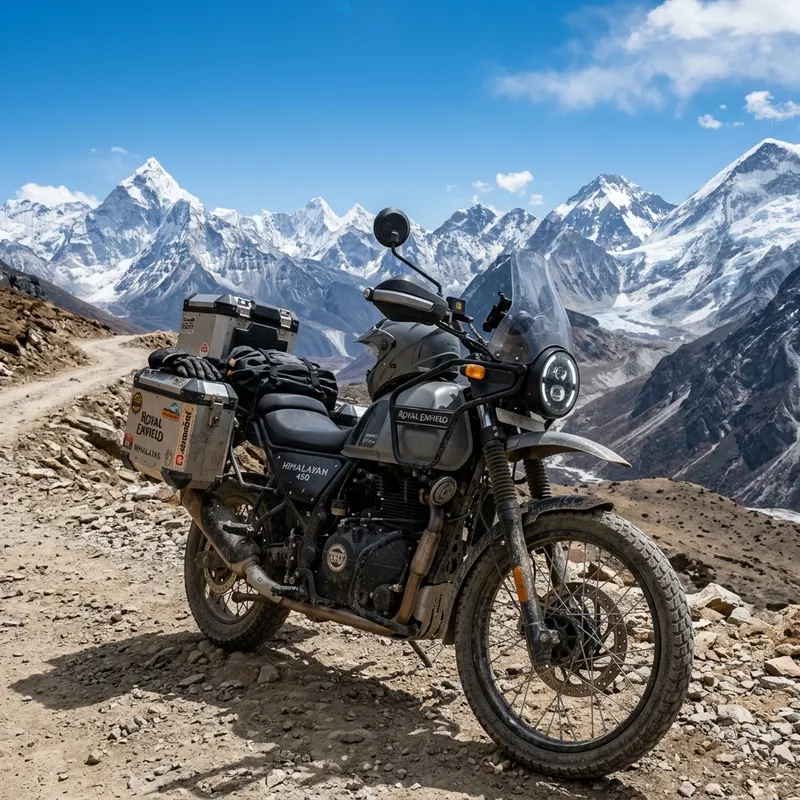
40 hp doesn’t sound like much in a world where the Africa Twin makes 102. But the Himalayan weighs 399 lbs dry, which means the power-to-weight ratio is in a perfectly reasonable adventure-touring window. The bike is not slow.
The engine is liquid-cooled with a counterbalancer to reduce vibration. It’s not Yamaha-CP2 smooth, but it’s a long way from the rattly air-cooled single it replaces. Cruising at 70-75 mph is comfortable. Sustained 80+ mph riding is where the single cylinder starts to remind you it’s a single cylinder — vibration through the bars and pegs creeps in.
Off-road, the engine character is excellent for the price bracket. Tractable at low rpm, willing to lug, easy to manage on loose surfaces. A common observation: the Himalayan 450 makes you a better off-road rider faster than a more powerful bike would, because nothing happens too quickly.
Suspension and Chassis
The front suspension is Showa Big Piston inverted cartridge forks. The rear is a Showa shock with linkage. Travel is 200mm front, 200mm rear — proper adventure-bike numbers, not posing.
This is the most surprising part of the spec sheet. Showa cartridge forks on a $5,999 motorcycle is unusual. They’re not the WP XPLOR setup you’d find on a 890 Adventure R, but they’re a real, capable suspension system. The bike absorbs rough surfaces without crashing through to the bumpstops.
The chassis is a tubular steel frame designed by Royal Enfield’s UK team. The geometry is mild enough to be friendly to new riders but steep enough to actually turn into a corner. The 21-inch front and 17-inch rear wheel combo is a slight compromise — a pure off-road bike would have a 18-inch rear — but it improves road manners.
Features Punching Above Their Weight
The TFT dashboard is the headline feature. It’s a round circular display with Google Maps integration via Bluetooth to a phone. You get turn-by-turn navigation built in, on a $5,999 motorcycle, in 2026. KTM doesn’t offer this. Honda doesn’t offer this on the Africa Twin. The Himalayan does.
Switchable ABS at the rear, LED lighting throughout, USB-C charging port. None of this is cutting edge, but all of it is present at a price where most of it isn’t.
Real-World Range and Fuel Economy
The Himalayan returned 51.9 mpg in independent testing, which works out to roughly 230-240 miles per tank from the 17-litre fuel cell.
That’s a usable range for back-road touring. For long-distance highway days, it’s tighter than a Tenere 700 or Africa Twin, but not problematic. The smaller engine and lower cruising speeds mean fuel stops integrate naturally with rest stops.
Himalayan 450 Spec Sheet
The numbers that matter, on one screen.
- Engine: 452cc liquid-cooled DOHC single, fuel-injected (0 g — specification)
- Power: 40 hp at 8,000 rpm (0 g — specification)
- Torque: 40 Nm at 5,500 rpm (0 g — specification)
- Dry weight: 399 lbs / 181 kg (181 kg)
- Seat height: 31.7 inches / 805mm (0 g — specification)
- Front suspension: Showa Big Piston inverted forks, 200mm travel (0 g — specification)
- Rear suspension: Showa monoshock with linkage, 200mm travel (0 g — specification)
- Fuel tank: 17 L / 4.5 US gallons (17 kg full)
- Fuel range: ~230-240 miles per tank (0 g — specification)
- Wheels: 21-inch front, 17-inch rear (0 g — specification)
- MSRP: $5,999 USD (0 g — specification)
Shop Himalayan 450 Accessories on Amazon →
Shop Budget ADV Luggage on Amazon →
Who Is This Bike For?
You’re new to adventure motorcycling and you want to learn without putting $14,000 at risk on the first low-side. You’re a shorter rider (5’6” to 5’9”) who’s been pushed out of the segment by 33-inch-plus seat heights (check out our guide on the best ADV bikes for short riders). You’re a downsizer coming off a heavy BMW or Africa Twin and you want a bike you can actually ride off-road without an anxiety attack.
You ride mostly back roads, gravel, fire roads, and mild single-track. You don’t need to cross continents at 85 mph. You’d rather spend $5,999 on the bike and put the rest of your budget into the trip itself.
Who Should Look Elsewhere?
You commute 100 miles a day on interstates at 80 mph. The single cylinder will wear you out. You’re a tall rider (6’2”+) — the ergonomics will feel cramped over long days. You want big electronics, multiple ride modes, IMU traction control. You’ll be disappointed.
You’re chasing serious off-road performance at speed — the Himalayan isn’t slow, but it isn’t a KTM 890R either, and pretending otherwise sets you up for a bad afternoon.
Himalayan 450 vs Tenere 700: Is the $5,000 Gap Worth It?
The Tenere 700 has 32 more horsepower, 28 Nm more torque, and is unambiguously the better long-distance and off-road performer. It’s also $4,500 more expensive.
For a rider doing 5,000+ kilometers a year of mixed touring, the T7 is the better bike. For a rider doing 2,000 km of weekend riding on back roads and gravel, the Himalayan covers the ground perfectly well, and the $4,500 saved buys a serious tyre, luggage, and trip budget.
The question isn’t which is the better motorcycle. It’s whether the extra capability is capability you’ll actually use.
Verdict
The Royal Enfield Himalayan 450 is the most honest budget adventure bike on the market in 2026. It’s not pretending to be something it isn’t. It’s not a marketing exercise. The engineering matches the price, and the price matches what the bike does.
For a beginner, a budget tourer, or a shorter rider who’s been ignored by the rest of the ADV market, this is the right bike. For an experienced rider with a real budget for an adventure bike, it’s not — and that’s fine. The Himalayan was never built for that buyer.
FAQ
For more context on what to look at across the segment, see our best motorcycles for women guide, the best ADV bikes for short riders fit analysis, our complete women’s ADV gear guide, Tenere 700 vs Africa Twin comparison, off-road riding tips for loaded adventure bikes, and best compact sleeping pads for motorcycle camping.
Disclosure: Some of the links in this article are affiliate links. If you buy gear through them, we may earn a small commission at no extra cost to you. It helps fund the road trips that make these independent reviews possible.
Frequently Asked Questions
Is the Royal Enfield Himalayan 450 a good adventure bike for beginners?
Yes — for entry-level adventure riders, it's the most accessible real ADV bike on the market in 2026. The 31.7-inch seat height suits shorter riders, the 40 hp engine is friendly, the 399-lb dry weight is genuinely manageable, and the $5,999 price tag means you can drop it learning without dropping a $14,000 investment (read more in our guide to the [best motorcycles for women](/blog/best-motorcycles-for-women-2026)). Reviewers at ADVMoto and GearJunkie both call it a legitimate adventure motorcycle, not just a styling exercise.
How much does the Royal Enfield Himalayan 450 cost in 2026?
MSRP is $5,999 USD in the United States. UK pricing sits around £5,999. That's roughly half the price of a Yamaha Tenere 700 and a quarter of the price of a BMW R 1300 GS Adventure. The price-to-capability ratio is the strongest of any ADV bike currently sold.
What is the seat height of the Himalayan 450?
31.7 inches (805mm) in standard trim. That's notably lower than the Tenere 700 (34.4 inches) and the Africa Twin (33.7 inches). For shorter riders or first-time ADV buyers, the lower seat is a significant practical advantage — flat-footing at stops on rough surfaces is easier and confidence comes faster.
How is the Himalayan 450 on the highway?
Adequate but not effortless. 40 hp from a single cylinder means it'll cruise at 70-75 mph comfortably, but sustained 80+ mph riding leaves nothing in reserve for overtakes. For a rider mostly doing back roads, gravel, and mixed surfaces at 50-65 mph, it's well-matched. For a highway commuter or trans-continental tourer who wants to hold 85 mph for 600 km a day, look at a bigger twin.
Is the Royal Enfield Himalayan 450 reliable?
Early reviews and owner reports are positive, but the platform is new — production began in late 2024. The earlier Himalayan 411 had a mixed reliability record, and Royal Enfield has clearly engineered the 450 as a major step up. Indian-market owners are already covering high mileage with no major issues reported. Long-term reliability data will be clearer by 2027.