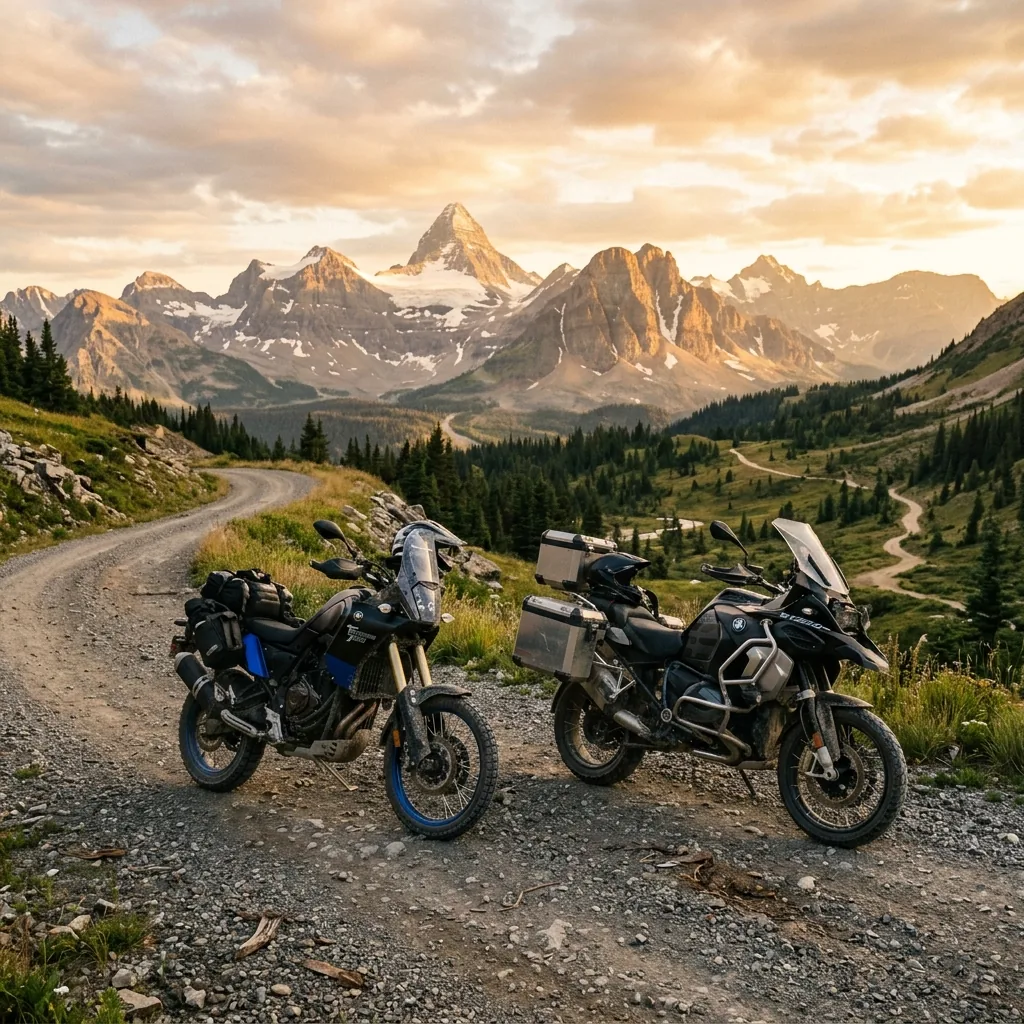
The Yamaha Tenere 700 costs $10,499. The Honda Africa Twin starts at $14,499. That’s a $4,000 gap between two bikes marketed for the same job. Anyone shopping middleweight ADV in 2026 has to deal with this question before anything else.
This tenere 700 vs africa twin comparison won’t sit on the fence. After looking at the specs, the rider feedback, and how each bike behaves in the conditions it claims to be built for, one bike wins on dirt and the other wins on tarmac. The hard part is knowing which one you actually are.
Introduction: $4,000 Is a Lot of Money
You can’t talk honestly about these bikes without naming the price gap first. Four thousand dollars buys a lot of things. It’s a full set of premium soft luggage plus a Rally Raid suspension kit. It’s two months of overlanding through Morocco. It’s a backup bike for the days the main one is in the shop.
So the Africa Twin doesn’t just need to be better. It needs to be $4,000 better — and to a specific type of rider. Honda knows this. The Africa Twin is sold as the more grown-up bike: more power, more tech, more comfort. The Tenere 700 is sold as the bike that does less, on purpose, and costs less because of it.
Both bikes are good. Neither bike is a mistake. The question is which one is the right tool for the riding you actually do, not the riding you imagine you’ll do.
The Core Difference: Philosophy, Not Just Specs
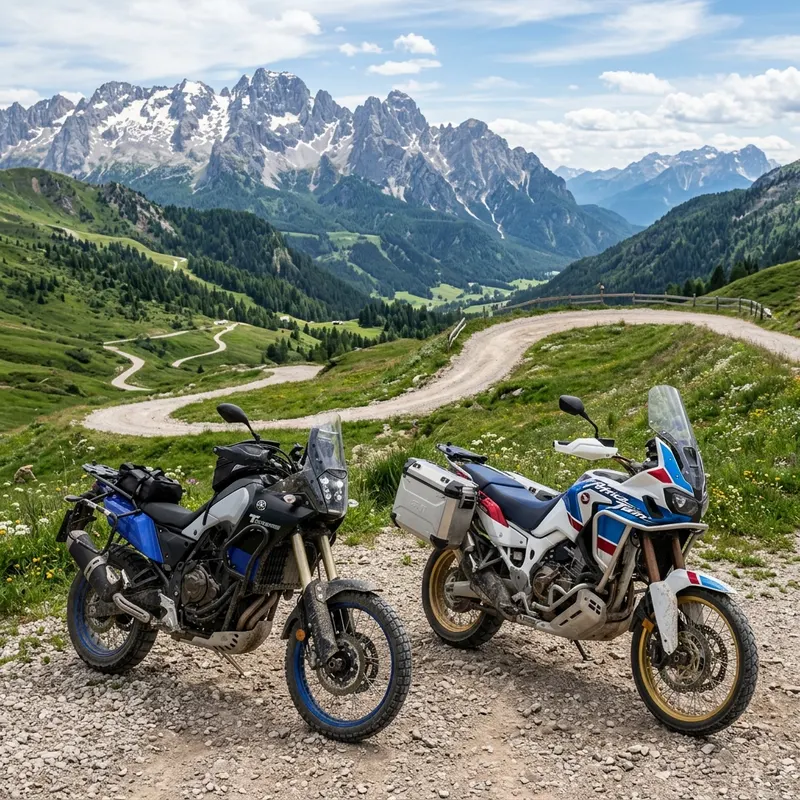
The Tenere 700 is a deliberately simple motorcycle. Cable throttle. No traction control. No ride modes. No cruise control. A small LCD dash. Yamaha’s bet was that adventure riders want the bike to disappear underneath them, not present a settings menu every time the surface changes.
The Africa Twin takes the opposite position. Ride-by-wire throttle, four user-configurable ride modes, cornering ABS, six-axis IMU, cruise control, optional DCT, large color TFT with Apple CarPlay. The bike is engineered to make highway miles painless and to give intermediate riders a safety net off-road.
These aren’t minor trim differences. They’re two different ideas about what a 2026 adventure bike should be. Owners on ADVRider.com talk about this constantly — one camp says the T7 is the last “honest” ADV bike; the other says the Africa Twin is what 2026 should look like.
Engine and Performance
The Tenere 700 uses Yamaha’s CP2 parallel twin — 689cc, 270-degree crank, about 72 hp at 9,000 rpm and 68 Nm at 6,500. It’s the same engine family that lives in the MT-07 and the XSR700. Punchy, linear, no surprises.
The Africa Twin uses a 1084cc parallel twin, also 270-degree crank, making about 102 hp at 7,500 rpm and 105 Nm at 6,250. On paper, the AT has roughly 40% more power and 50% more torque.
That gap is genuinely felt on the highway. Overtaking a truck on a Romanian two-lane, the T7 needs a downshift; the Africa Twin pulls cleanly in the same gear. With a pillion and full luggage, the AT still feels relaxed at 130 km/h. The T7 doesn’t run out of breath, but it works harder.
Off-road, the equation flips. The T7’s 72 hp is plenty for any single-track that a 200 kg bike has any business being on. The Africa Twin’s extra power becomes a liability the moment the surface gets loose — more torque to manage, more weight behind every twist of the throttle.
Weight and Off-Road Capability
The Tenere 700 weighs about 204 kg wet. The standard Africa Twin weighs 226 kg. The DCT version pushes 240 kg.
Twenty-two kilos doesn’t sound like much. Then you tip the bike over in deep sand at the end of a long day, and it sounds like a lot. Picking a 240 kg DCT Africa Twin off its side, on a slope, in 35°C heat, is a workout that the T7 owner is not having.
Both bikes wear 21-inch front and 18-inch rear wheels — the off-road standard. Both have meaningful suspension travel. On paper, both are off-road capable. In practice, the T7 lets the average rider attempt a third more terrain before fatigue takes over.
A common comment on Reddit’s r/motorcycles when this comparison comes up: the T7 makes you a better off-road rider faster, because it stops punishing you for small mistakes.
Technology: Minimalist vs Maximum
Here’s where the cost gap shows up most clearly on the spec sheet.
The Tenere 700 has rear ABS that you can switch off. That’s it. No traction control. No ride modes. No cornering enhancements. No cruise control. The cable throttle is purely mechanical.
The Africa Twin has a six-axis IMU feeding cornering ABS, cornering traction control, wheelie control, and rear-lift control. Four ride modes plus two user-defined slots. Cruise control. Optional DCT. Heated grips standard on most trims. Apple CarPlay and Android Auto on the TFT.
For a touring-focused rider doing 600 km days on motorways, this stuff matters. Cruise control alone saves your right wrist on long highway stretches. For an off-road-focused rider, most of it gets switched off on day one anyway.
Comfort on Long Days
The Africa Twin is the more comfortable long-distance bike. Period.
It has a taller windscreen, a larger fuel tank (24.8 L vs 16 L on the T7), a more accommodating seat, more leg room, and a smoother power delivery at sustained highway speeds. Owners doing trans-continental rides consistently report less fatigue on the AT.
The T7 isn’t uncomfortable — Yamaha did fine work on the ergonomics. But the smaller tank means more fuel stops on long days. The narrower seat starts to feel thin around hour six. The lack of cruise control means your throttle hand never gets a break.
If your typical trip is two riders, panniers full, 500 km a day for two weeks, the Africa Twin earns its premium. If your typical trip is solo, lighter loaded, mixed surfaces, three to five hours of riding a day, the T7’s compromises stop mattering.
Pricing: What You Actually Get for the Money
Tenere 700: $10,499-$10,999 depending on trim and color year.
Africa Twin CRF1100L: $14,499 standard, $14,799 for the Adventure Sports, more again for the DCT options.
That $4,000 buys: roughly 30 hp, 22 kg of weight, an IMU, cruise control, a bigger tank, a taller screen, a TFT display, and four ride modes.
It does not buy: a better engine for off-road, lighter handling on dirt, easier pickup after a fall, or a more reliable powerplant. Both engines are bulletproof; the CP2 has a longer track record and a stronger reputation for trouble-free high mileage.
ADV Bike Comparison Specs List 2026
The honest spec comparison, side by side, no marketing.
- Tenere 700 engine: 689cc CP2 parallel twin, 72 hp, 68 Nm (0 g — specification)
- Africa Twin engine: 1084cc parallel twin, 102 hp, 105 Nm (0 g — specification)
- Tenere 700 wet weight: 204 kg / 450 lbs (204 kg)
- Africa Twin standard wet weight: 226 kg / 498 lbs (226 kg)
- Africa Twin DCT wet weight: 240 kg / 529 lbs (240 kg)
- Tenere 700 fuel tank: 16 L (16 kg full)
- Africa Twin fuel tank: 24.8 L (24.8 kg full)
- Tenere 700 wheels: 21-inch front, 18-inch rear (0 g — specification)
- Africa Twin wheels: 21-inch front, 18-inch rear (0 g — specification)
- Tenere 700 electronics: switchable rear ABS only (0 g — specification)
- Africa Twin electronics: 6-axis IMU, 4 ride modes, cruise control (0 g — specification)
- Tenere 700 MSRP: $10,499 USD (0 g — specification)
- Africa Twin MSRP: $14,499 USD (0 g — specification)
Shop Tenere 700 Accessories on Amazon →
Shop Africa Twin Accessories on Amazon →
Who Should Buy the Tenere 700?
You ride dirt regularly — at least every other weekend. You value mechanical simplicity over electronics. You travel solo or with a light passenger occasionally. You’d rather spend the $4,000 you saved on suspension upgrades, tyres, and fuel for the trip. You don’t need cruise control because your highway days are short. You know the T7 will probably outlast you with a chain and oil schedule.
A common observation on ADVRider.com about long-term T7 ownership: the people who buy it almost never sell it.
Who Should Buy the Africa Twin?
You ride mostly pavement on long trips. You carry a pillion regularly. Highway days of 600 km are standard for you. You want cruise control, heated grips, and modern electronics as standard, not as aftermarket add-ons. You’re an intermediate off-road rider who values the safety net of cornering ABS and traction control. You like the idea of DCT for stop-and-go traffic or technical low-speed work.
The Africa Twin isn’t a worse bike than the T7. It’s a different bike, sold to a different rider.
Verdict
The Tenere 700 wins on off-road, weight, simplicity, reliability reputation, and outright value. For 80% of riders shopping middleweight ADV in 2026, the T7 is the bike. It’s the better tool for the riding most ADV buyers actually do — mixed surfaces, solo or two-up occasionally, weekend or two-week trips.
The Africa Twin wins for the rider who lives on the highway and wants tech as standard. For a long-distance pavement tourer who happens to take occasional dirt detours, the AT is a more refined, more comfortable, and more capable companion. It costs more because it does more — for that specific rider.
The wrong question is “which bike is better.” The right question is “which rider am I.” Answer that honestly and the bike picks itself.
FAQ
For more on the riding both bikes are built for, see our off-road riding tips for loaded adventure bikes, pannier choices for ADV bikes, and the Trans Euro Trail starter guide.
Disclosure: Some of the links in this article are affiliate links. If you buy gear through them, we may earn a small commission at no extra cost to you. It helps fund the road trips that make these independent comparisons possible.
Frequently Asked Questions
Which is better, the Yamaha Tenere 700 or Honda Africa Twin?
Neither is universally better. The Tenere 700 wins on off-road capability, lighter weight, mechanical simplicity, and pure value — it costs about $4,000 less than the Africa Twin. The Africa Twin wins on long-distance touring comfort, electronics, optional DCT, and outright power. If you ride dirt 50% of the time or more, the T7 is the bike. If you ride 80% pavement on long trips with a pillion, the Africa Twin earns its premium.
How much horsepower does the Tenere 700 have vs the Africa Twin?
The Tenere 700 produces about 72 hp and 68 Nm of torque from its 689cc CP2 parallel twin. The Honda Africa Twin CRF1100L produces about 102 hp and 105 Nm from its 1084cc parallel twin. The Africa Twin has roughly 40% more power and 50% more torque, which shows up clearly on highway overtakes and when loaded with a pillion and luggage.
Is the Tenere 700 easier to ride off-road than the Africa Twin?
Yes, meaningfully so. The T7 weighs about 204 kg wet versus 226 kg for the standard Africa Twin (and 240 kg for the DCT). Picking up a tipped-over bike on a steep gravel track or grinding through deep sand for an hour shows the difference fast. The T7 also has a simpler chassis with no ride modes to fumble through when conditions change.
Does the Africa Twin DCT make sense for adventure riding?
It depends on the rider. The DCT gearbox adds about 14 kg over the manual and removes the clutch lever, which divides riders sharply. Owners on ADVRider.com who tour heavily often love it; off-road purists usually don't. For technical single-track the manual is preferable. For long-distance interstate touring with a pillion, the DCT is genuinely relaxing.
Is the $4,000 price gap between the Tenere 700 and Africa Twin worth it?
Only for riders who actually use what the Africa Twin offers — its IMU-based electronics, cruise control, larger fuel tank, comfort over 500 km days, and the option of DCT. For a rider who'd switch off traction control and ride mostly dirt anyway, that $4,000 is better spent on a Rally Raid suspension upgrade for the T7 and a serious tyre budget. The T7 plus mods still comes out cheaper than a stock Africa Twin.