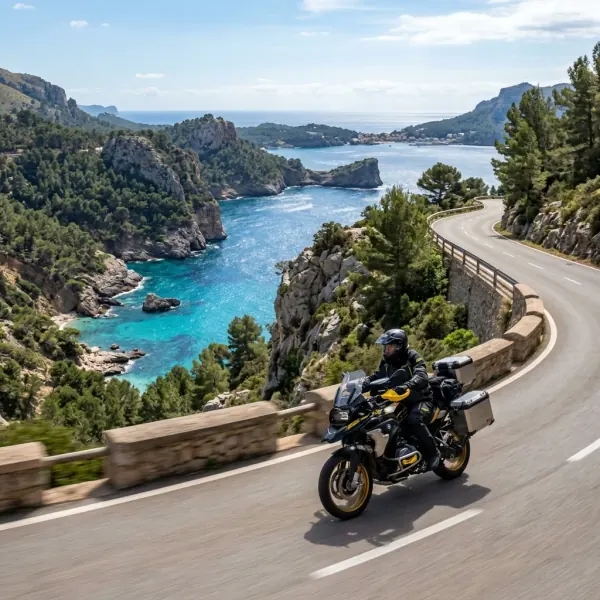
The first time I rode the Amalfi Coast it was a Tuesday in October and there were six cars on the entire 50 km stretch from Vietri to Positano. The second time I rode it was a Sunday in July and the same road had a tourist bus stuck at every hairpin. Both rides were the same road. Neither was the same experience.
Mediterranean coastal motorcycle riding is fundamentally about timing. The roads themselves are world-class. The difference between memorable and miserable is the month, the day of the week, and the hour of the morning. Get those right and the Mediterranean offers the best concentration of coastal motorcycle roads anywhere on earth. Get them wrong and you’re stuck behind a Hymer doing 30 km/h on a road designed for 80.
This guide ranks the seven coastal motorcycle routes that earn their reputation. Best coastal motorcycle routes Mediterranean — the working version, with timing, road realism, and the trade-offs that determine whether a route works for your specific bike and style.
Italy: The Amalfi Coast — SS163 Amalfitana
Length: 50 km, Vietri sul Mare to Positano via Amalfi town.
What it’s like to ride: The most dramatic single piece of coastal motorcycle road in Europe. The SS163 was carved into the cliff face above the Tyrrhenian Sea in the 1850s and hasn’t been widened since. Two lanes wide where two lanes fit, less where they don’t. Continuous tight hairpins, cliff drops, and views directly down to fishing villages 200 meters below.
The motorcycle advantage: Cars face alternating-plate restrictions in summer that don’t apply to motorcycles. Tourist buses and motorhomes face length restrictions. Bikes ride the road essentially unrestricted while cars and buses queue or are turned away. This is the single biggest reason to ride Amalfi on two wheels rather than four.
Timing: Ride before 10:00 or after 18:00 in summer. Weekday Tuesday or Wednesday for minimum buses. Off-season (April-May, October) for fewer crowds.
The catch: The road is short. Most riders combine Amalfi with the Sorrento Peninsula, Capri ferry, and inland Campania to make a multi-day trip. As a standalone day ride from a Salerno or Sorrento base, it’s a half-day at most.
For deeper coverage including ZTL zones and alternative mountain roads, see the dedicated Amalfi Coast motorcycle touring rules guide.
Turkey: The Lycian Coast — Fethiye to Antalya
Length: 475 km, Fethiye east to Antalya.
What it’s like to ride: Sustained engagement with one of the great coastal touring roads of Europe. The D-400 hugs the southern Turkish coast, climbing 200-400 meters above the Mediterranean and descending into fishing villages every 20-30 km. The 35 km section between Kalkan and Kaş is genuinely world-class — sweeping mid-speed cliff corners with the Kaputaş gorge midway.
The advantages: Lowest cost in the Mediterranean (€40-60/day for moderate riding), least traffic outside July-August, longest sustained quality coast road, tolerant wild camping culture. Excellent road surface throughout.
Timing: Late April through mid-June, or September through October. Mediterranean climate, sea temperatures suitable for swimming.
The catch: Distance from northern Europe — typically 2,000+ km of riding through Balkans or Eastern Europe to reach. Most riders fly to Istanbul or Antalya and rent locally for a focused trip.
For full day-by-day route detail, see the Lycian Way motorcycle route guide.
Croatia: The Dalmatian Coast Highway
Length: 600 km, Pula in the north to Dubrovnik in the south, via D8 Adriatic Highway and parallel coastal roads.
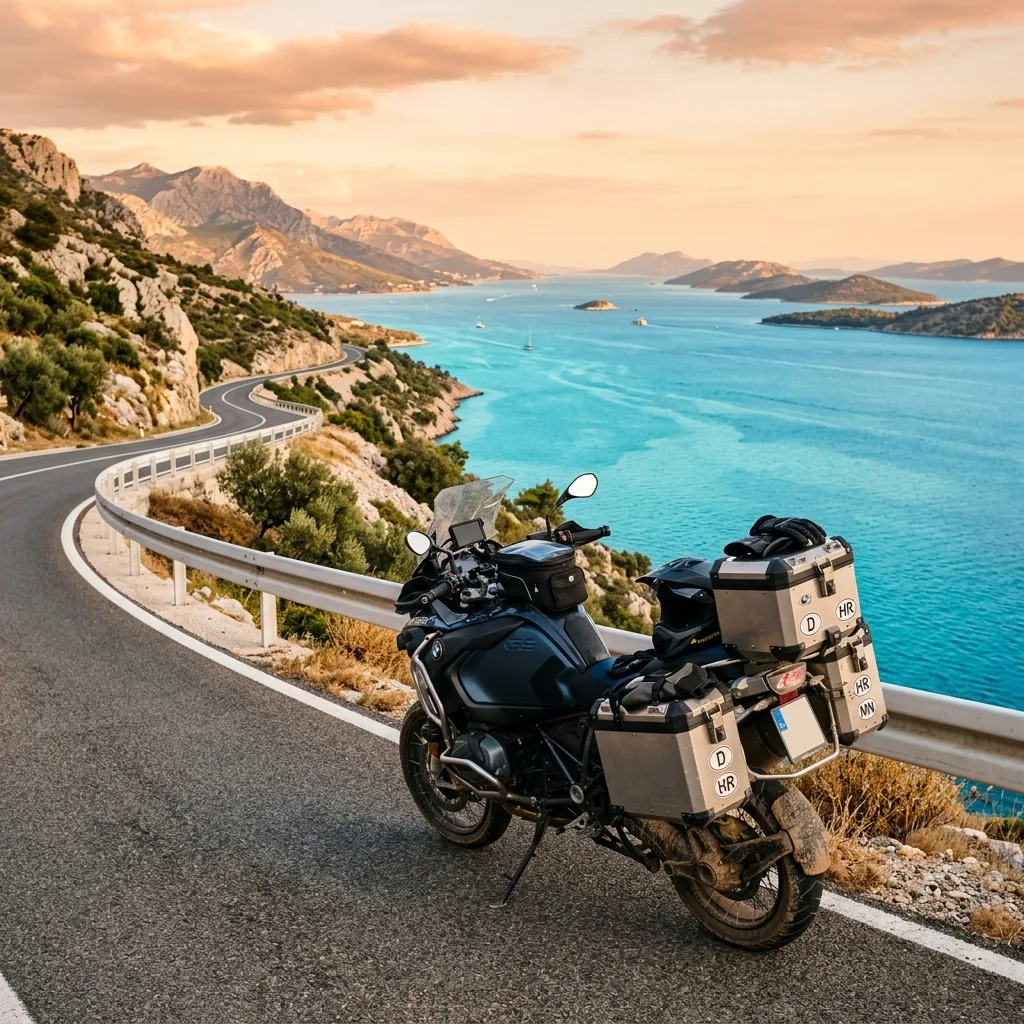
What it’s like to ride: One of the longest world-class coastal touring routes in Europe. The D8 climbs and descends the Adriatic cliffs from Istria through Split to Dubrovnik, with the islands visible offshore and UNESCO-listed old towns at every major stop. The road quality is excellent — recent EU investment has rebuilt most sections to modern standards.
Highlights: Plitvice Lakes National Park (inland detour from D8 in the north). Split (Diocletian’s Palace, old town, Adriatic ferry hub). Hvar and Brač island ferries (motorcycles welcomed, day trips possible). Dubrovnik old town (the route’s southern anchor).
Timing: May-June and September. July-August is dense with Adriatic cruise tourism. Avoid the Croatian coast in peak summer.
The catch: Cost has risen sharply since Croatia’s 2023 euro adoption. Accommodation prices in summer 2026 are 40-60% higher than equivalent quality in Greece or Turkey. The road through Neum (Bosnian coastal corridor) requires brief border crossings in both directions — typically routine but adds time in summer.
Montenegro: Bar to Kotor Bay
Length: 60 km, Bar north to Kotor via the coastal road.
What it’s like to ride: Limestone cliffs rising 1,000+ meters directly from the Adriatic, the medieval town of Budva midway, and the dramatic finale of Kotor Bay — a deep fjord-like inlet ringed by mountains. The town of Kotor at the head of the bay is UNESCO-listed and walkable; park the bike and explore on foot.
Why it’s underrated: Tucked between famous Croatia to the north and developing Albania to the south, Montenegro often becomes a transit country rather than a destination. The Bar-to-Kotor stretch deserves at least two days — one for the coastal road, one to ride up the Lovćen Mountain road that climbs from Kotor to the historic capital Cetinje (one of the great mountain motorcycle roads in Europe).
Timing: May-June and September best. July-August manageable but coastal traffic builds.
The catch: Short route. Most riders combine with Albania to the south and Croatia/Bosnia to the north for a 7-10 day Balkan loop.
For deeper Balkan touring planning, see riding motorcycle Balkans guide.
France: The Côte d’Azur and Corsica
Côte d’Azur length: 100 km, Cannes east to Menton via Nice and Monaco.
What it’s like to ride: The Mediterranean’s most famous and most crowded coastal route. Three Corniche roads parallel the coast at different elevations — Basse Corniche (D6098, sea level, busiest), Moyenne Corniche (D6007, mid-height, balanced), Grande Corniche (D2564, highest, quietest and most scenic). For motorcycles, the Moyenne and Grande Corniches are the right routes.
Highlights: Èze village (perched above the sea, accessible by motorcycle via the Moyenne Corniche). Monaco for the Grand Prix circuit ride-through. Menton and the Italian border. Cap Ferrat peninsula side roads.
Timing: Difficult. The Côte d’Azur is busy year-round. Best windows are March-April and October-November when the climate is still pleasant but tourist density drops.
Corsica length: 500 km coastal circuit of the island.
What it’s like to ride: Wild French island in the Mediterranean. Coastal roads, the Col de Bavella mountain pass inland, granite headlands, turquoise water. Less crowded than the Côte d’Azur. Requires ferry from Nice or Toulon.
Timing: April-June and September. Peak summer (August) is mass French holiday with traffic.
Spain: Costa Brava
Length: 200 km, Cap de Creus in the far northeast east to Barcelona via Cadaqués and Tossa de Mar.
What it’s like to ride: Dramatic granite headlands, hidden coves between rocky promontories, and small whitewashed fishing villages. The road from Cap de Creus south to Roses runs through the Cap de Creus Natural Park — protected coastline with minimal development. Cadaqués (the Salvador Dalí town) is the architectural and cultural highlight.
Highlights: Cap de Creus lighthouse at the easternmost point of mainland Spain. Cadaqués. Sant Pere de Rodes monastery (high in the hills, road accessible). The GI-682 coastal road from Tossa de Mar to Sant Feliu de Guíxols — 25 km of switchback coast riding.
Timing: May-June and September best. July-August is Spanish summer holiday, busy but manageable on weekdays.
The advantage: Less crowded than the Côte d’Azur, cheaper than Italy or France, with comparable road quality and dramatic coastline. Underrated as a Mediterranean coastal destination.
Greece: The Mani Peninsula
Length: 150 km, Gythio south to Cape Tainaron (mainland Europe’s southernmost point) and back.
What it’s like to ride: Stark, rocky, almost lunar in places. The Mani is the southernmost finger of the Peloponnese, historically remote and culturally distinct from the rest of Greece. Tower houses dot the landscape — defensive stone structures built by feuding clans. The coastal road is dramatic, the inland tracks are minimal, and the entire peninsula feels half a century behind the rest of Europe.
Highlights: Areopolis (former capital, well-preserved). Vathia (cliff-edge village of tower houses). Limeni harbor (best seafood lunch in the region). Cape Tainaron lighthouse at Europe’s southern tip.
Timing: April-June and September-October. July-August is hot and dry; the rocky terrain reflects heat.
The catch: Distance from main motorcycle entry points — from Patras you ride 250 km south through the Peloponnese to reach Mani. Worth combining with other Peloponnese highlights (Nafplio, Olympia, Monemvasia) for a 7-10 day trip.
For Greek camping options that link with this route, see top seaside campgrounds in Greece for motorcycle travelers.
Mediterranean Route Planning Checklist
What you actually carry beyond standard touring gear for any Mediterranean coastal trip:
- Downloaded offline maps for each country segment (0 g)
- Insurance Green Card covering all visited countries (minimal)
- Summer riding gear — mesh jacket for 35°C+ temperatures (0 g, worn)
- Tyre plugs — coastal gravel sections in Turkey and Greece (180 g)
- Cash in local currency — rural Croatia and Greece still cash-heavy (minimal)
- Swim gear — every route has unmissable bay stops (200 g)
The mesh jacket point matters more than people think. Mediterranean summer riding in a textile touring jacket is genuinely dangerous — at 35°C with full sun, an unvented jacket builds internal temperatures that lead to heat exhaustion. A proper vented mesh jacket with armor (Klim Marrakesh, Rev’It Tornado, Held Toledo) is the right kit for May-September Mediterranean riding.
Check Summer Mesh Jackets on Amazon →
Check Quick-Dry Travel Shorts on Amazon →
Best Time to Ride the Mediterranean
Late April to mid-June: Best overall window. Daytime 20-28°C in most regions, sea temperatures rising past 20°C by June, wildflowers, low tourist density.
Mid-September to mid-October: Second-best window. Stable warm weather, sea still 22-24°C from summer warmth, harvest season (best food year-round), low traffic.
July-August: Avoid across the board. Heat (35-40°C inland), traffic peak, accommodation prices double, restaurants overrun. Possible only if you ride dawn-and-dusk and beach in the afternoon.
November-March: Mixed. Italy and Spain still rideable in mild winters. Turkey and Greece coastal roads stay open. Mountain roads close. Many businesses shut. A different kind of trip — quieter, cheaper, less reliable weather.
Internal Connections
This guide is the umbrella for several country-specific deep dives:
- Lycian Way motorcycle route guide — Turkey deep dive
- Amalfi Coast motorcycle touring rules — Italy deep dive
- Remote Turkish bays only an adventure motorcycle can reach — Turkish bay-focused content
- Riding motorcycle Balkans guide — Croatia, Montenegro, Albania context
- Europe motorcycle border crossing documentation — documentation for crossings between these countries
FAQ
Five common questions are answered at the top of this page. The short version: Turkey is the best overall, Amalfi is the most dramatic, the timing window is May-June or September, and avoid July-August everywhere.
Whatever your version of the best coastal motorcycle routes Mediterranean trip looks like, the principle is the same — ride short days, time the route for shoulder season, and pace it so you have time to swim, eat, and explore the small towns these roads connect. The Mediterranean rewards riders who treat it as a place to be, not a place to ride past.
Disclosure: Some links in this article are affiliate links. If you buy gear through them, we may earn a small commission at no extra cost to you.
Frequently Asked Questions
Which Mediterranean coast is the best for motorcycles overall?
Turkey's Lycian coast (Fethiye to Antalya) is the best balance of road quality, scenery, low traffic, and tolerance for wild camping at a price point lower than anywhere in Western Europe. Italy's Amalfi is more dramatic per kilometer but shorter and more crowded. Croatia's Dalmatian coast is closest to Turkey in length and quality but more expensive and more touristed. For a first Mediterranean coastal trip, Turkey is the right answer.
When should I avoid Mediterranean coastal riding?
July and August across the entire Mediterranean. Temperatures hit 35-40°C, coastal traffic peaks with summer holidaymakers, accommodation prices double, and famous routes (Amalfi SS163, Côte d'Azur Corniche, Big Sur in California) become parking lots with views. The Mediterranean is a fall/spring destination for motorcycles. May-June and September-early October are the right windows.
Can I do all seven routes in one trip?
Yes, but only if you have 6-8 weeks. The full Mediterranean coastline loop runs roughly 5,500 km from Spain through France, Italy, Croatia, Montenegro, Albania, Greece, and Turkey. Most riders do regional sections — Italian Amalfi plus Sardinia in 2 weeks, Croatia plus Montenegro plus Albania in 3 weeks, the full Turkish coast in 2-3 weeks. The whole-Mediterranean trip exists but it's a serious expedition, not a vacation.
How much does a 2-week Mediterranean coastal trip cost?
Variable by country. Turkey: €50-80/day all-in (lowest). Greece, Spain, Croatia: €70-110/day. Italy, France: €100-160/day (highest). Wild camping and self-cooking can drop these by 30-40%. Hotel-and-restaurant comfort raises them by 50-100%. A 2-week trip in mid-tier accommodation across multiple countries lands around €1,500-2,500 per person excluding fuel to and from your home country.
What's the most underrated Mediterranean route?
Montenegro's Bar to Kotor coastal road. 60 km of road that combines limestone mountains rising directly from the Adriatic, Kotor Bay (a deep fjord-like inlet that's been called Europe's southernmost fjord), and the medieval town of Kotor at the head of the bay. Less famous than Amalfi, less crowded than Dalmatian Croatia, and just as dramatic. Most riders pass through on the way to Albania without realizing what they're missing. Spend two days here.