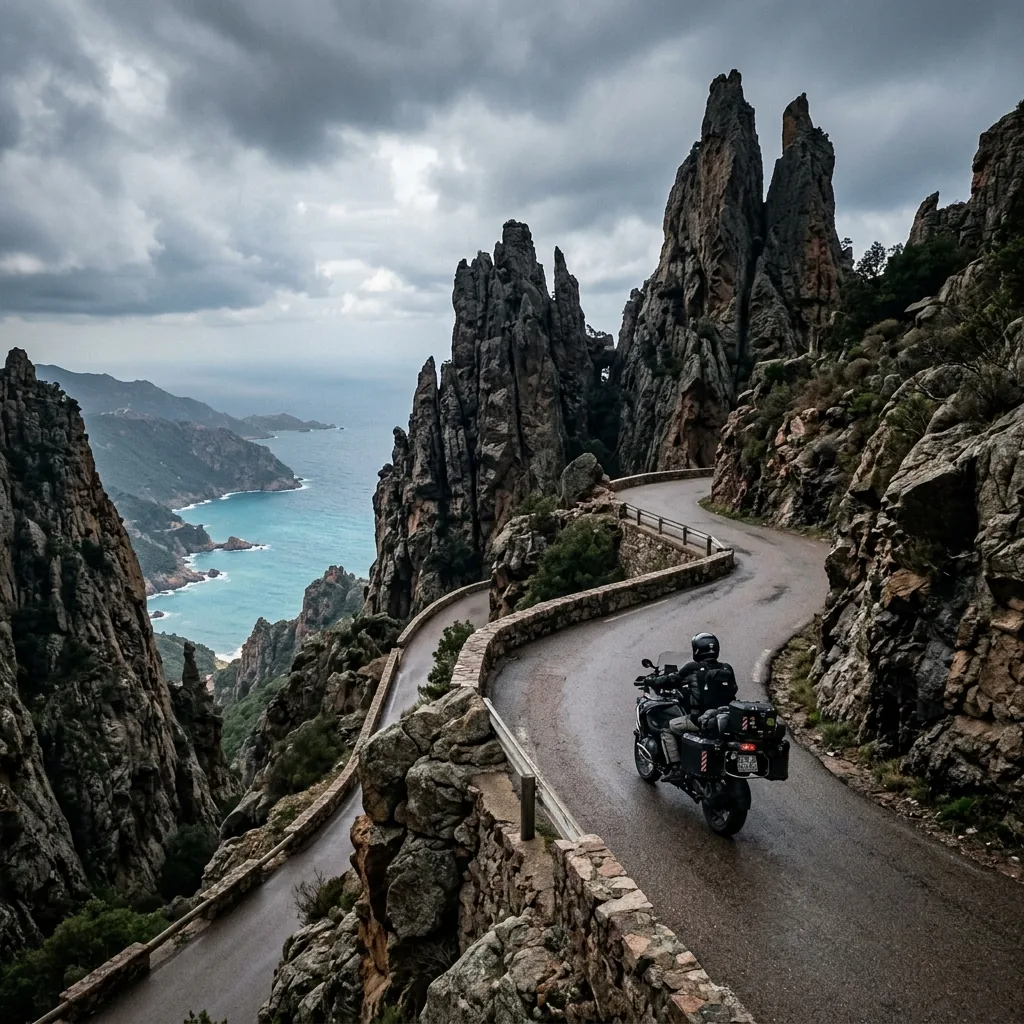
Corsica is 8,680 square kilometres of granite mountains in the middle of the Mediterranean, with a coastline that drops vertically into turquoise water and a road network that contains some of the best motorcycle riding in Europe. Most tourists never see it. They go to Nice. They go to Sardinia. They miss the island that French motorcyclists have quietly known about for forty years.
This corsica motorcycle tour guide covers the routes that matter, the ferry logistics, the wild camping reality, and the seven-day itinerary that gets you onto the right roads at the right times.
Introduction: The Island That Rewards Slow Riders
Corsica isn’t a touring island in the German sense. You’re not covering 400 km a day. You’re covering 150 km a day and spending six hours doing it, because every kilometre has a corner and most of them have a view.
The island has the highest road density of any French region. Constantly discovering new routes is part of the experience — pull out a map at the campsite and find three roads you didn’t know about, all leading to places worth seeing.
There are no motorways. Every kilometre is on real roads, which is exactly what you want when you’ve come this far.
Getting There: Ferries and Logistics
The ferry is the experience that starts the trip. Two French ports run most departures:
Nice to Bastia: about 12 hours overnight on Corsica Linea. The classic option, dinner on board, wake up in Corsica.
Marseille to Bastia or Ajaccio: 10-12 hours, also typically overnight. La Méridionale alongside Corsica Linea.
Toulon to Bastia or Ajaccio: similar duration to Marseille routes.
Daytime fast ferries also run in season but cost more. Bikes have limited spots on every crossing — book three months ahead for July-August departures, six weeks ahead for shoulder season. Cabins are worth it on overnight crossings if you want to ride properly the next morning.
Sardinia connects via a short ferry from Santa Teresa Gallura to Bonifacio — useful for riders combining both islands.
Col de Bavella: The Road That Makes the Trip
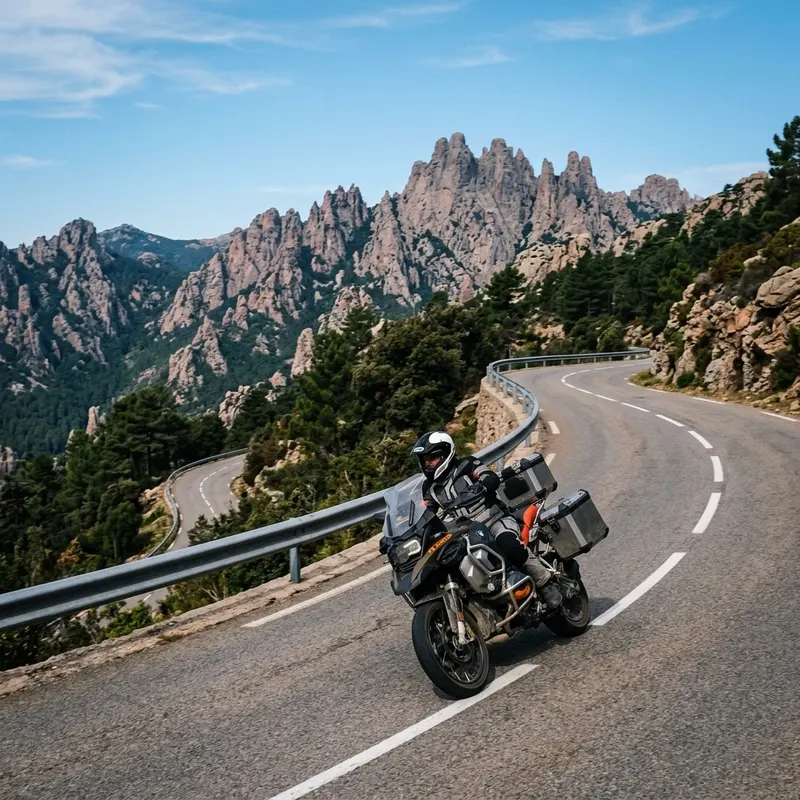
Col de Bavella sits at 1,218 metres in the south of the island, on the D268 between Solenzara and Zonza. The pass is dominated by the Aiguilles de Bavella — needle-shaped granite spires that rise straight out of the surrounding pine forest.
The road approaches from both sides through tight switchbacks. The east side from Solenzara is the more dramatic ride, climbing through dense forest with the spires appearing suddenly above the canopy. The west side from Zonza is slightly faster, more open, more visible.
Riders who’ve done both Stelvio and Bavella usually rate Bavella above for scenery and below for outright drama. It’s a road you ride twice — once each direction — because the views are completely different.
A common rider complaint on forums is that Bavella gets crowded with car traffic in July-August. Ride it in May or September and it’s nearly empty.
The West Coast: D81 and the Porto Calanques
The D81 runs the entire west coast of Corsica, and the section between Calvi and Ajaccio is one of the great coastal roads of Europe.
The peak section is the Calanques de Piana — red granite gorges that drop into the sea, with the road threading through them at car-width. UNESCO World Heritage. The road was carved out of the rock and the engineering hasn’t been updated since because there’s no room to widen it.
Time this section for early morning or late afternoon. The light on the red granite is the photograph everyone tries to take. Midday flattens it.
Allow a full day for the Calvi-to-Ajaccio stretch. It’s 160 km that takes six hours to ride properly, with frequent stops for villages and viewpoints.
The Interior: Mountain Roads Nobody Uses
The coastal roads get all the attention. The interior roads get all the riding.
Routes like the D84 through the Niolo valley, the D69 over Col de Vergio (1,477m, the highest road pass in Corsica), and the back roads through the Restonica and Tavignano valleys offer the kind of mountain riding that compares with the Alps — but with one-tenth the traffic.
The Castagniccia chestnut forests in the northeast are an underrated area. Tight, twisty roads through ancient villages where time has visibly stopped. Riders who’ve explored Corsica thoroughly often rate Castagniccia as their favourite, despite it never appearing on a tourist itinerary.
Corsica Rider Checklist
The non-obvious items that make the trip work.
- Ferry booking confirmed — book 3+ months ahead in summer (0 g)
- Downloaded offline maps Corsica — OsmAnd or Maps.me (0 g)
- Tyres checked — excellent roads, no knobbies needed (0 g)
- Cash in euros — rural villages cash preferred (minimal)
- Swim gear — every coastal route ends at a bay (200 g)
- Quick-dry travel towel (180 g)
- Sunscreen SPF50+ — Mediterranean sun (100 g)
- Mosquito repellent for interior evenings (80 g)
- French phrasebook or translation app offline (0 g)
Shop Quick-Dry Travel Gear on Amazon →
Shop Kriega Dry Bags on Amazon →
Wild Camping in Corsica
The legal situation: wild camping is officially restricted across most of Corsica, particularly within the regional park (Parc Naturel Régional de Corse) and along the coast.
The practical situation: discreet camping inland and at remote bays is broadly tolerated outside the peak July-August window. Arrive late, leave early, leave no trace, and you’ll be fine.
What’s not fine: fires. Corsica burns hard in summer. The 2017 fires destroyed huge swaths of maquis. Stove use is restricted during fire-warning days, and a casual disregard for the rules gets you in serious trouble with local authorities. Take this seriously.
Best Time to Visit
May to mid-June: ideal. Warm days, cool evenings, mountain roads fully open, wildflower-covered maquis, empty roads.
Mid-September to October: also ideal. Sea is still warm, light is golden, summer crowds gone, mountain passes still open.
July to August: avoid if you can. Ferries double in price. Roads fill with cars. Beaches fill with sunbathers. Heat in the interior hits 35°C+.
November to April: workable in the south but mountain passes close above 1,000m and the high routes become impassable.
7-Day Corsica Motorcycle Itinerary
A balanced loop hitting the highlights without rushing.
Day 1: Arrive Bastia, ride north through Cap Corse (the finger of land at the top of the island). Overnight Saint-Florent.
Day 2: South to Calvi via L’Île-Rousse on the Balagne coastal road. Overnight Calvi.
Day 3: Calvi to Ajaccio on the D81 via the Calanques de Piana. Long, scenic day. Overnight Ajaccio.
Day 4: Ajaccio to Zonza via the interior. Overnight Zonza, base for Col de Bavella.
Day 5: Col de Bavella both directions. Overnight Solenzara on the east coast.
Day 6: North through the Castagniccia. Overnight Corte (the medieval interior capital).
Day 7: Restonica valley ride, return to Bastia for evening ferry.
FAQ
For more Mediterranean motorcycle routes, see our best coastal motorcycle routes in the Mediterranean, Amalfi Coast motorcycle touring rules, and best wild camping bays in the Mediterranean.
Disclosure: Some of the links in this article are affiliate links. If you buy gear through them, we may earn a small commission at no extra cost to you. It helps fund the road trips that make these independent route guides possible.
Frequently Asked Questions
When is the best time to ride a motorcycle in Corsica?
May-June and September-October. July and August double ferry prices, fill the roads with rental cars, and push interior temperatures into the mid-30s. May to early June gives you warm days, empty roads, and wildflower-covered maquis. September brings warm sea, quiet beaches, and cooler riding in the mountains. Avoid winter — many mountain roads close above 1,000m.
How do I get to Corsica with a motorcycle?
Ferry from mainland France: Nice, Marseille, or Toulon to Bastia (north) or Ajaccio (west). Crossings run 5-12 hours depending on speed and route. Corsica Linea and La Méridionale operate most departures. Book three months ahead in summer — bikes have limited deck space. Sardinia-Corsica ferries also run year-round from Santa Teresa to Bonifacio if you're combining both islands.
Do I need an international driving permit for Corsica?
No, if you have a standard EU, UK, or US driving licence with a motorcycle category. Corsica is fully part of France, so French rules apply — and France accepts most foreign licences for tourist use up to 12 months. Carry your home licence, registration, and proof of insurance. The European Health Insurance Card works for medical emergencies for EU riders.
Is wild camping allowed in Corsica?
Officially restricted; in practice broadly tolerated outside designated tourist zones, fire-risk areas, and protected reserves. Discreet camping inland or at remote bays generally goes unbothered if you arrive late and leave early. Avoid pitching near tourist beaches in July-August. Forest fires are a real risk in summer — no campfires, no stoves outside designated areas during fire-warning days.
How long do I need for a Corsica motorcycle tour?
Five to seven days is the right window. The island is 183 km north to south but the roads are slow — average speeds of 40-50 km/h are normal because of switchbacks and tight valleys. Three days is enough to ride the highlights badly. Seven days lets you ride them properly, with rest days at coastal villages. Two weeks is too much unless you're combining with Sardinia.