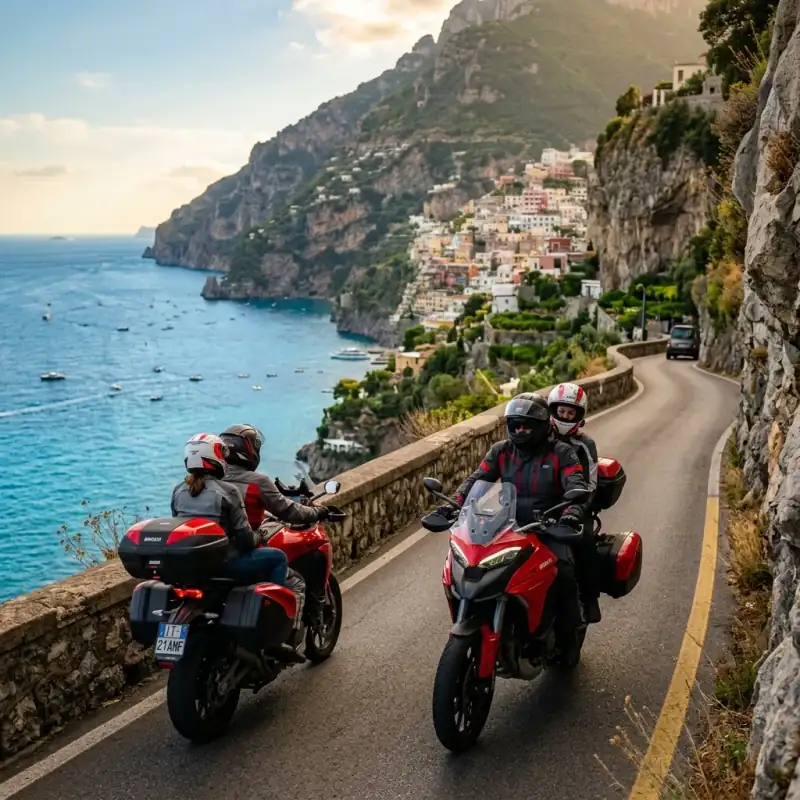
Behind a lot of great motorbike trips to Italy there’s some quiet planning going on — often by the person who isn’t the die-hard rider. Maybe it’s a milestone birthday, maybe it’s a surprise, and the brief goes something like: three or four days, the Amalfi Coast, a proper guided experience, his choice of bike, and — because he rides a Ducati at home — could we squeeze in the Ducati Museum too?
It’s a lovely idea, and most of it is very doable. But two things trip people up. The Amalfi Coast is a more serious road than the postcards suggest, especially two-up. And the Ducati Museum is nowhere near it.
This guide is about planning that short, guided Amalfi trip properly: how to arrange it when you don’t want a full week away, what a realistic few days actually looks like, how to make riding on the back genuinely enjoyable rather than nerve-wracking, and the honest answer to the Bologna question.
First, an honest reality check on time
Search for “Amalfi Coast motorcycle tour” and you’ll find plenty of polished packages — but look closely and almost all of them run seven to nine days. Italy Moto Tours’ Amalfi Dream Ride, for example, is an eight-day, seven-night loop out of Rome. These are wonderful, but they’re not a long weekend.
For a three-night trip you have two realistic options:
- Ask for a private or bespoke short tour. Most good operators will build a shorter, tailored itinerary for a couple even if it isn’t advertised on the website. You email them your dates and wishlist, and they come back with a custom quote and route. This is the path most people in your situation actually take.
- Rent the bike and self-guide, using a route plan rather than a guide. Cheaper and more flexible, but it puts all the navigation and traffic-reading on the rider — less ideal if the passenger is nervous and the whole point was to relax. If you lean this way, our companion guide to the Amalfi Coast rules, ZTL zones and best roads is the self-ride playbook.
The takeaway: for a short guided trip, don’t hunt for an off-the-shelf “3-day package” — there aren’t many. Decide what you want, then ask two or three operators to build it. There’s a ready-to-send brief for exactly that further down.
A rough idea of the budget
Bespoke pricing is genuinely hard to pin down — a private, dedicated-guide trip is always quoted case by case — but you shouldn’t have to plan blind, so here are honest anchors to frame the conversation:
- Renting the Ducati yourself: a Multistrada-class bike rents for roughly €60–100 a day in Italy, usually with a helmet included (watch for mileage caps and the security deposit). Add hotels, fuel and transfers, and a self-guided three nights for two comes together for well under the cost of a packaged tour.
- Guided, bundled tours: once a guide, hotels and the bike are wrapped together, group tours commonly work out around €300–500 per person per day. A fully-loaded reference point: Italy Moto Tours’ eight-day Amalfi Dream Ride runs about $10,000 for a couple, everything included.
- A private three-night tour for just the two of you sits above group per-day rates — you’re paying for a guide dedicated to one couple. Budget in the low-to-mid four figures per person as a planning figure, then get a firm quote, because it really does vary.
Whatever the number lands at, decide early whether the guided experience is worth the premium over renting and self-navigating. For a nervous first-time pillion on a road like this, plenty of people happily pay it: the guide is buying you calm.
Why guided makes sense for a first-timer on the back
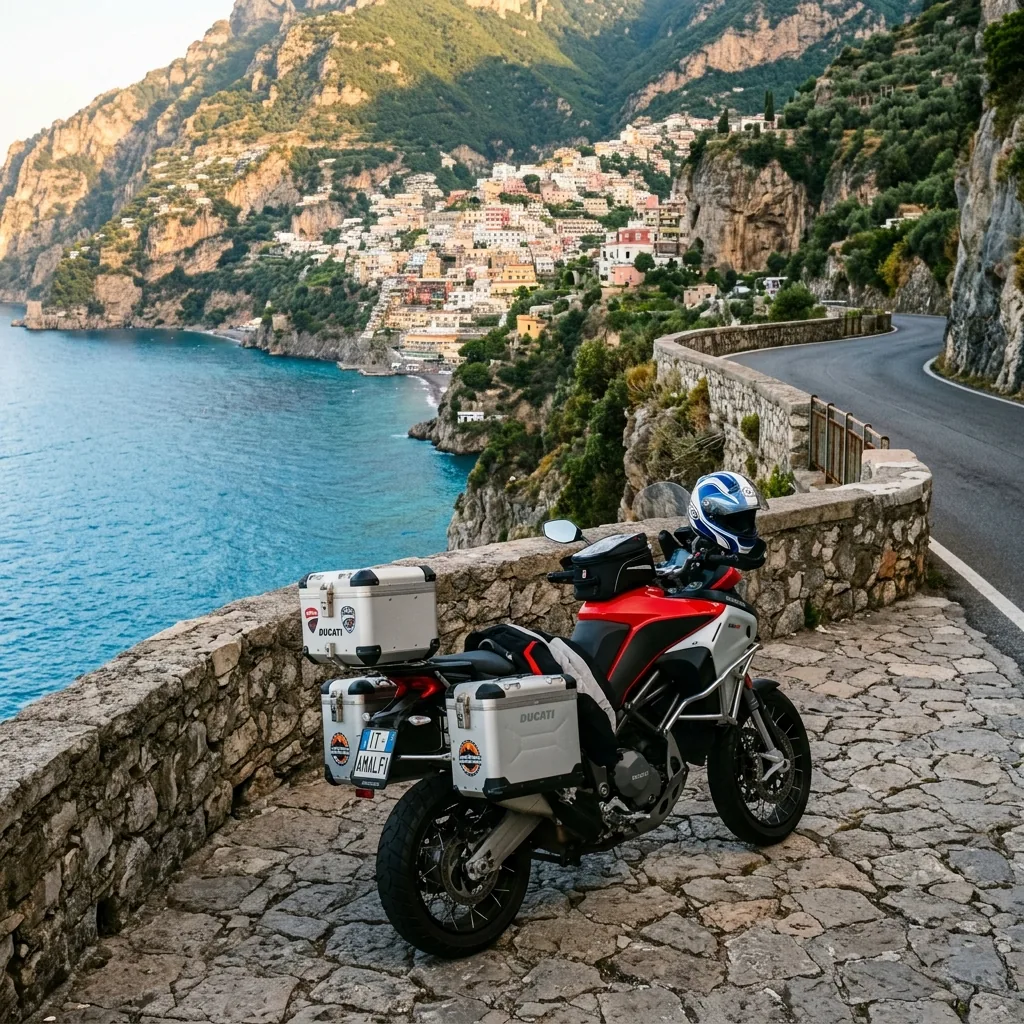
If one of you is an experienced rider and the other has barely been on the back of a bike, the Amalfi Coast is a big first date with pillion life. The SS163 is narrow, carved into the cliff, and shared with full-size coaches that meet on blind hairpins. It’s spectacular — genuinely one of the best coastal roads in Europe — but it rewards a rider who knows it and unsettles one who’s map-reading on the fly.
If this is the trip that turns into a habit, our guide to riding two-up covers the setup and briefing that make a passenger comfortable rather than merely willing — preload, tyre pressures, the mounting protocol, and what to tell them about corners.
That’s the case for going guided. A local guide:
- Leads the pace and the line, so the rider can relax and the passenger isn’t feeling every hesitation.
- Knows the road, including where to slow for the views and where the coaches bunch up.
- Handles the logistics — parking (a real headache in Positano and Amalfi), lunch stops, and the history and culture along the way.
- Usually brings a support van that carries the luggage hotel to hotel. That’s what lets you travel light with just a day bag on the bike — and it doubles as a comfort blanket, because a nervous passenger can ride in the van for any stretch that feels like too much.
One detail worth confirming when you book: some operators only run the support van above a minimum number of riders (Italy Moto Tours, for instance, notes a four-rider minimum for luggage transport). On a private two-person tour, ask specifically how luggage and transfers are handled — it’s the kind of thing that’s easy to sort in advance and annoying to discover on day one.
Two more things genuinely help a first-time passenger, and neither costs a thing. Do a short shakedown ride at home together before you fly — even an hour — so the first time on the back isn’t also the first time on a cliff road. And know that hours of constant switchbacks can bring on motion sickness in anyone prone to it: eat lightly beforehand, look up and out over the rider’s shoulder toward the corner rather than down at the road, and don’t be shy about calling a stop.
For a wider view of how Amalfi compares with other coastal rides you might consider, see our best coastal motorcycle routes in the Mediterranean.
What a realistic three-night trip looks like
You won’t ride the length of Italy in three nights, and you shouldn’t try. A relaxed, achievable shape:
- Day 0 — Fly into Naples (NAP). It’s the gateway airport for the coast, roughly 1h20 to the Amalfi area outside peak traffic (longer on summer afternoons). Arrive, transfer to your first hotel, collect the bike or meet the guide.
- Day 1 — The SS163 itself. Sorrento or Salerno as a base, riding the coast road through Positano, Amalfi town and up to Ravello, with stops for photos, lunch and a wander.
- Day 2 — Inland and quieter. A loop up over the Lattari mountains (the Chiunzi and Agerola roads are gorgeous and far calmer than the coast), or a run down toward the Cilento — the same sea, a fraction of the traffic.
- Day 3 — A short final ride and depart, or a spare morning to see one more town before flying home.
Whether you keep one base or move hotels point to point is worth deciding early. Point-to-point fits more in and, with a support van moving the bags, still lets you pack light. A single base is simpler and calmer. For a first pillion trip, one comfortable base with day-rides out is often the more relaxing choice — say so to the operator and let them advise.
Choosing the bike — and riding two-up
Letting the rider pick the bike is half the fun, and it’s very achievable: Ducatis are widely available for hire in Italy. HP Motorrad rents a broad Ducati range (Multistrada, Monster, Scrambler, DesertX and more) alongside BMW, Moto Guzzi and others, and tour operators such as All Routes Italy keep Ducati in their fleets.
One wrinkle if the trip is a surprise: letting him choose the exact bike and keeping the secret pull in opposite directions. Two easy ways round it — reveal the trip far enough ahead that he can help pick the Ducati (a lot of riders love being in on that part), or book a safe crowd-pleaser like a Multistrada and tell the operator he can switch models on arrival if he’d rather.
Two practical notes:
- Match the bike to two-up touring. You’ll be two riders plus luggage on a twisty coast road, so a comfortable touring or adventure-style bike (a Multistrada, say) is a far better companion than a low, hard sportbike. Confirm the exact model is available for your dates — the popular ones book out.
- Fit an intercom. This is the single best thing you can do for a nervous first-time passenger. Being able to say “can we slow down” or “pull over at the next viewpoint” — and hear a reassuring voice back — changes the whole experience. Our best motorcycle intercom systems guide covers the options, Cardo and Sena side by side; a good tour bike may already have one, so ask.
Disclosure: some links below are affiliate links. If you buy through them we may earn a small commission at no extra cost to you.
Check two-up intercoms on Amazon →
A few bits of rental small print are worth checking before anyone falls in love with one specific bike:
- Licence: a big Ducati like a Multistrada needs a full, unrestricted motorcycle licence — confirm his category qualifies and that his home (Irish/EU or other) licence is accepted; an International Driving Permit is cheap insurance.
- Age and deposit: most hire firms set a minimum age (often 25+ for the bigger bikes) and hold a sizeable security deposit on a card.
- Insurance excess: ask what the damage excess is and whether you can buy it down — it matters on a road walled with stone and full of tight hairpins.
- Gear: helmets are usually included; jackets, gloves and back protectors often aren’t. If neither of you owns kit, ask the operator to supply it for two, or plan to bring your own.
One more comfort point: the tight hairpins of the SS163 are unkind to wide luggage, another reason the support-van approach beats loading the bike. If you are self-riding, keep it slim — our soft vs hard panniers guide explains why.
The best time to go
Timing is the cheapest upgrade to the whole trip. The two sweet-spot windows are late April into May and September into October: warm, settled weather, quieter roads, and none of the July–August heat and crush. Late April/May adds wildflowers and the lemon harvest, and if you’re planning around an occasion later in the year, it’s a lovely target.
Within that, two rules make a huge difference on the coast road:
- Ride weekdays, not weekends. Tuesday and Wednesday are calmest.
- Ride early. The SS163 before about 10:00 is a different, emptier road than the mid-day parade of coaches and day-trippers.
Our Amalfi Coast rules and timing guide goes deep on this, including a genuinely useful quirk: motorcycles are exempt from the summer plate-alternation restrictions and free to enter Positano’s restricted-traffic zone — advantages a car simply doesn’t have.
Can you add the Ducati Museum? A geography reality check
Here’s the one to gently manage expectations on. The Ducati Museum is in Bologna, in Italy’s northern Emilia-Romagna region. The Amalfi Coast is down south, past Naples. Between them is roughly 640 km — six to seven hours of driving each way. On a three-night trip built around scenic riding, linking the two would mean spending most of your time on the A1 motorway. It’s the wrong tool for the job.
So treat them as two separate treats:
- The Amalfi Coast is your riding trip — the coast road, the views, the two of you on the bike.
- The Ducati Museum deserves its own short pilgrimage, and it’s a brilliant one. Bologna is the heart of Italy’s “Motor Valley”: the Ferrari museum (Maranello), Lamborghini (Sant’Agata Bolognese) and Maserati are all within about an hour. For a Ducati owner, a long weekend built around that is arguably a better birthday than tacking a rushed museum stop onto a coast tour.
If the museum is genuinely a must-do, here’s the trick: don’t ride between them — fly or take the train. Spend a night in Bologna for the Ducati Museum and Motor Valley at the start or end of the trip, then hop a short domestic flight or a high-speed train south to Naples and do the riding there. That’s really the only sensible way to get both into one short trip. The museum’s own practical bits: it’s in the Borgo Panigale district of Bologna, entry is around €17 (roughly €32 with the guided factory tour), and factory tours run on limited days and sell out — book online in advance.
How to brief a tour operator (copy this)
Because you’ll likely be asking for a custom short trip, a clear brief gets you a fast, useful quote. Send something like this to two or three operators and compare what comes back:
We’re looking for a private 3-night guided motorbike tour of the Amalfi Coast for a couple, riding two-up, ideally in late April or May. My partner is an experienced rider (owns a Ducati); I’ll be on the back and it’s my first proper trip as a passenger, so a relaxed pace matters. We’d like: hotels and breakfasts included, airport transfers from Naples, luggage moved between hotels so we travel light, and his choice of bike — a Ducati if possible. Could you put together an itinerary and quote?
Ask specifically about: the exact bike model and whether it’s confirmed for your dates; how luggage and transfers work on a two-person booking; the guide’s language; and their most relaxed routing given it’s a first-time pillion. Those answers tell you quickly which operator gets it.
Operators to start your research
A shortlist worth contacting directly. To be clear, this is a starting point to vet — not a personal endorsement; we haven’t toured with these companies, so treat it as a research shortlist and confirm the details that matter to you.
- Italy Moto Tours — explicitly caters to couples riding two-up and runs a support van; a sensible first email. Ask whether they’ll do a private short version of their Amalfi routing.
- HP Motorrad — a big Ducati rental range plus organised tours, ideal if picking the exact Ducati is the priority.
- All Routes Italy — guided Amalfi tours with Ducati in the fleet and a relaxed “ride with the guide or peel off” style.
- Mototouring — southern-Italy and Amalfi tours where an English/Italian-speaking guide rides with you and hotels, dinners and ferries come bundled in.
For a broader list to compare, the Mad or Nomad directory of Italy motorcycle rental and tour companies is a good research jump-off.
The bottom line
A short, guided Amalfi Coast trip for two is a fantastic idea and very achievable — it just gets planned a little differently from a big group tour: a private, tailored few days rather than an off-the-shelf package. Get the timing, the bike and the comms right, let a local guide carry the stress of the road, and the Amalfi Coast delivers one of the great motorcycle days in Europe, even — especially — from the back seat.
And the Ducati Museum? Save it. It’s the excuse for the next trip north, and Motor Valley will more than repay a weekend of its own.
If you’re still shaping the plan, our Amalfi Coast rules and best roads guide and the wider best coastal Mediterranean routes are the natural next reads.
This article is general planning information for riders, not travel advice, and we’re not a tour operator. Prices, opening days and tour details change — always confirm directly with operators and official sources (including the Ducati Museum’s booking page) before you commit.
Disclosure: Some links in this article are affiliate links. If you buy gear through them, Bikes & Bays earns a small commission at no extra cost to you.
A note on the costs: these are ballpark planning figures as of July 2026, not quotes. Ferry fares, campsite rates, fuel and tolls all move with the season and the operator — check current prices before you build a budget on them.
Frequently Asked Questions
Can you visit the Ducati Museum and ride the Amalfi Coast on the same trip?
Realistically, no — not on a short trip. The Ducati Museum is in Bologna in northern Italy; the Amalfi Coast is roughly 640 km / about six hours' drive south. Linking them means spending most of your saddle time on the motorway, which defeats the point of a scenic coastal ride. The better plan is to treat them as two separate trips: the Amalfi Coast as your riding weekend, and the Ducati Museum as its own short pilgrimage to Italy's 'Motor Valley', where the Ferrari, Lamborghini and Maserati museums all sit within about an hour of it.
Is the Amalfi Coast OK for a nervous first-time pillion (passenger)?
It can be, with the right setup. The SS163 coast road is narrow, twisty and busy with coaches, so it isn't the gentlest place to ride two-up — but a guided tour changes the experience completely, because a local sets the pace and handles the route while you enjoy the views. Go in late April–May or September–October, ride on weekday mornings when the road is quietest, tell your guide up front that you're a nervous passenger, and fit a Bluetooth intercom so you and the rider can talk. Those four things turn it from daunting into memorable.
How many days do you need for an Amalfi Coast motorcycle tour?
You can get a rewarding taste of it in three nights, but be aware that most off-the-shelf guided tours run a week or more — Italy Moto Tours' Amalfi Dream Ride, for instance, is eight days. For a short trip you'll usually need to ask an operator for a private or bespoke short itinerary rather than booking a packaged tour. Three nights is enough to ride the SS163, see Positano, Amalfi and Ravello, and add a scenic inland loop — especially if you fly into Naples and start riding the next morning.
Can you rent a Ducati for an Amalfi Coast tour?
Yes. Several Italian rental and tour companies keep Ducatis in their fleets — HP Motorrad, for example, rents a wide range (Multistrada, Monster, Scrambler, DesertX and more), and operators like All Routes Italy list Ducati among their tour bikes. If letting the rider choose a specific model matters, say so when you enquire and confirm that exact bike is free for your dates, since popular models book up. Remember you'll be two-up with luggage, so a comfortable touring or adventure-style Ducati suits the coast better than a low sportbike.
When is the best time to do a guided Amalfi Coast motorcycle tour?
Late April into May, or September into October. You get warm, settled weather, the roads are far quieter than in peak summer, and you avoid the July–August heat, crowds and traffic that clog the SS163. Weekdays beat weekends and mornings beat afternoons. Late April/May in particular gives you wildflowers, the lemon harvest and comfortable temperatures — it's the window most experienced riders point to, and it lines up nicely if you're planning around a special occasion later in the year.