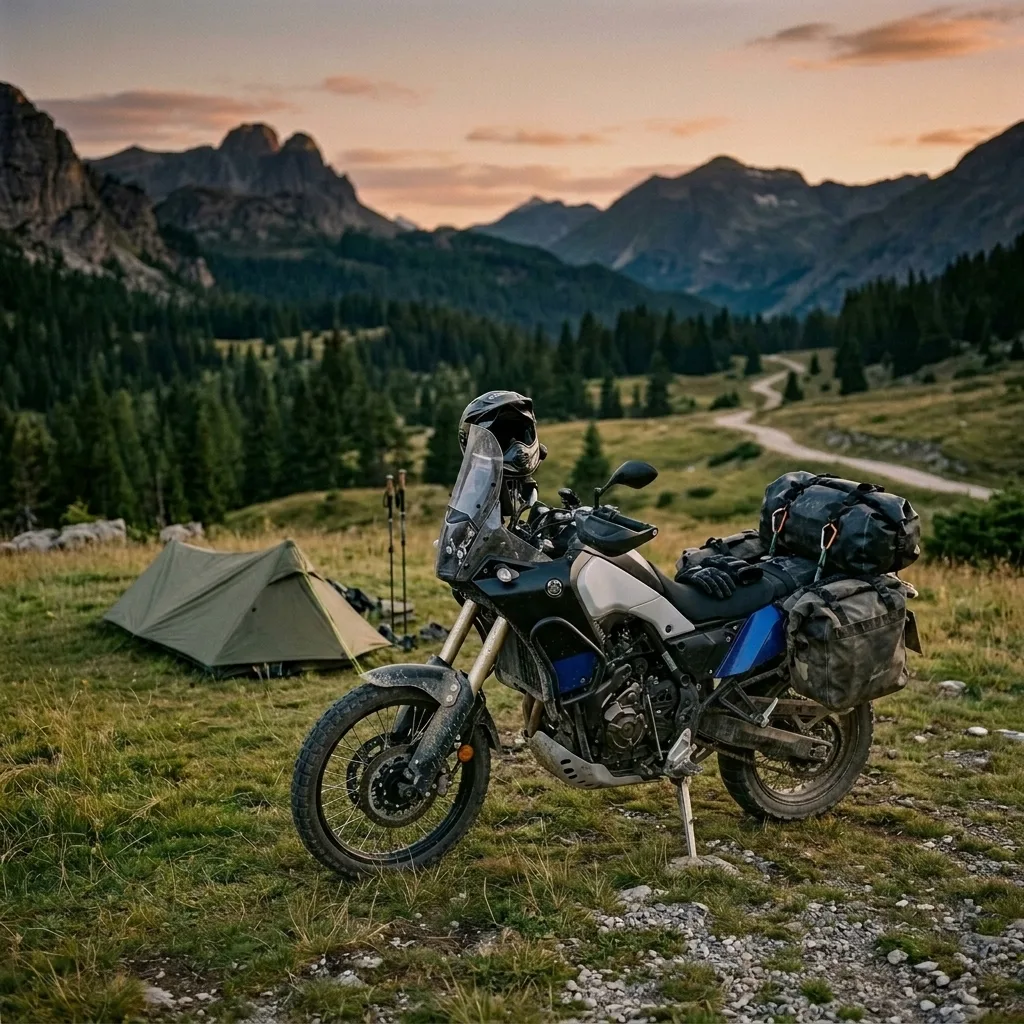
You’re somewhere above a lake in the Albanian Alps, the light’s going, and there’s a perfect flat shelf of grass twenty metres off the gravel road. Your panniers hold everything you need to spend the night there. The only thing you don’t have is a clear answer to a simple question: is pitching that tent free, tolerated, or a fineable offence?
That gap — between having the kit and having permission — is the whole problem with wild camping a motorcycle in the Balkans, and it’s harder here than almost anywhere in Europe because the rules are patchy, regional, inconsistently enforced, and often genuinely unclear even to locals. This guide is the country-by-country map for the core Balkan crossing: Albania, Montenegro, Bosnia & Herzegovina, North Macedonia, Bulgaria and Greece.
It’s also the post where I have to be most careful with you. I will not state a country’s camping law as hard fact unless I’m certain of it, because getting that wrong could cost you a fine or worse. Wherever a specific legal claim needs checking against a current official source, I’ve flagged it inline so you — and the site owner before publishing — can confirm it. Treat this as a practical riding guide and a research starting point, not legal advice.
This is the eastern-European companion to our Europe-wide wild camping legal guide; if you’re stitching a longer trip together, read the two side by side.
Heads up: Wild camping rules across the Balkans change, vary by region within each country, and are enforced locally and inconsistently. Treat every specific fine, date and legal status below as general guidance to re-confirm against a current official source before you rely on it. National parks, coastal zones and protected areas almost always have their own stricter rules. This is a riding guide, not legal advice.
Quick Answer: Wild Camping Legality by Country
| Country | General picture | Notes |
|---|---|---|
| 🟡 Albania | No explicit ban; most camping-friendly in region | Parks/coastal dunes tightening; beaches public below tide line |
| 🟡 Montenegro | Officially not permitted; tolerated if discreet | Coast fines commonly ~€400, up to ~€1,500 in parks |
| 🟡 Bosnia & Herzegovina | De facto tolerated outside settlements | ⚠️ Landmine/UXO risk — marked, established ground only |
| 🟡 North Macedonia | Not official, but widely tolerated | Avoid lakeshores (Ohrid), parks, government buildings |
| 🟡 Bulgaria | Tolerated rurally, but law is changing | Officially restricted; coast & parks stricter — verify current rule |
| 🔴 Greece | Illegal under national law | Fines up to ~€1,000+; coast & islands enforced in season |
Every one of those rows is a generalisation, and generalisations are exactly what gets riders fined. Below, what each actually means in practice — and where the bike can realistically go.
The Critical Distinction: Bivouac vs Wild Camping
Before the country list is useful, learn the one piece of vocabulary that does the heavy lifting across the whole region.
Wild camping is a full camp: you find a spot, set up, and stay. Multiple nights, visible in daylight, settled in. It’s a presence, and it’s what most camping bans are actually written to stop.
Bivouac is a stop, not a camp. One night only, pitched late after the day’s traffic and rangers have gone, broken down and gone early. Minimal footprint — often just a small tent tucked behind cover. You were barely there.
Across much of the Balkans, a discreet bivouac in an unremarkable rural spot is left alone in practice even where full wild camping isn’t formally permitted, while a visible multi-night camp on a popular beach or in a national-park hotspot is exactly what draws a fine. The practical rule that follows is the same one I give for the rest of Europe: when you’re unsure of the law, don’t wild camp — bivouac. Arrive late, stay low, leave early.
Albania
Albania has a reputation among overlanders as one of the most camping-friendly countries in the region. There’s no explicit national ban, locals are used to seeing travellers pitch up, and riders routinely bivouac in the highlands without trouble.
The thing to flag is the recent tightening: newer environmental rules restrict or ban unauthorised camping in specific national parks and on protected coastal dunes. In practice, tents are still common on the valley floors of Theth and Valbona even though those areas are regulated, and Llogara is stricter on fire rules. Beaches are public below the high-tide line, so a wild cove is generally fair game — but organised beach-club and municipal beaches are not. Steer clear of military bases, border posts and archaeological sites such as Butrint. Where it’s realistic on a bike: the inland Albanian Alps and mountain valleys, well away from the developed coast. The Adriatic coast is busier, more developed and less suited to wild nights — treat it as paid-campsite territory.
Bivouac nuance: keep clear of beach clubs, towns and protected areas; a late, discreet mountain pitch is the model.
Season: late spring to autumn for the valleys; high summer for the higher passes, which hold snow late.
Montenegro
Montenegro is small, dramatic, and heavily geared around its national parks (Durmitor, Biogradska Gora, Lovćen, Prokletije) and a busy, developed Adriatic coast. Wild camping is officially not permitted, but it’s tolerated if you’re discreet and well away from the coast, tourist areas and national parks.
Fines are a real risk, especially on the coast and beaches — commonly reported at around €400, with some sources citing up to €1,500 in national parks and tourist centres. Camping is explicitly against the rules inside Durmitor and Prokletije. One quirk worth knowing: sleeping in a vehicle “to restore driving ability” is allowed, but camping behaviour — chairs out, awning, tent pitched — is not. Where it’s realistic on a bike: the mountainous north and remote interior offer more discreet possibilities than the coast, but inside national parks you should expect to use designated sites. The coast is the hardest place in the country to wild camp.
Bivouac nuance: outside parks and away from the coast, a discreet one-nighter is the realistic approach; inside parks, follow posted rules and use official sites.
Season: coast from spring; Durmitor and the high north are summer-only at altitude.
Bosnia & Herzegovina
Bosnia is mountainous, green, and sparsely developed across much of its interior. The legal status is genuinely mixed in the sources — some say there’s no law against it, others that it’s forbidden but tolerated — and the net effect is that it’s de facto tolerated outside settlements, tourist areas and national parks. Ask permission on private or farmed land.
The serious caveat — landmines. Bosnia & Herzegovina remains one of Europe’s most mine-contaminated countries. The national mine-action centre estimates roughly 79,000 mines and items of unexploded ordnance still in the ground, across around 838 km² of suspected area, affecting half a million people in some 1,400 communities. Hikers have walked into minefields. So the rule here is absolute: never wild-camp off marked, established ground; never enter any area with warning tape or skull-and-crossbones signs; never camp on land that’s obviously been untended for years; and download and use the official “BH Mine Suspected Areas” app from BHMAC before you go. This is the one Balkan country where “find a quiet field” carries a risk that has nothing to do with camping law.
Also factor in wildlife: bears, wolves and three venomous snake species — store food well away from the tent.
Where it’s realistic on a bike: established rural pull-offs and used clearings in the interior highlands, never improvised ground in unfamiliar areas.
Season: roughly May to September for the mountains; lowlands are shoulder-season friendly.
North Macedonia
North Macedonia, with its big lakes (Ohrid, Prespa) and mountain national parks, is not officially allowed for wild camping but is widely tolerated by locals and authorities in practice. Be discreet, and ask permission on private land.
Avoid government buildings (penalties are specifically cited there), tourist areas and the popular lakeshores such as Ohrid, and stay out of the national parks (Galičica, Mavrovo, Pelister). Where it’s realistic on a bike: the mountain interior and quieter areas away from the lake tourist strips. Lake Ohrid’s shoreline is developed and busy — paid sites there.
Bivouac nuance: discreet, late, away from the lakeshore resorts and out of national-park hotspots.
Season: long riding season in the lowlands; mountains best in summer.
Bulgaria
Bulgaria is legally dynamic, and that’s worth flagging explicitly: it’s officially restricted, the government has repeatedly moved to forbid camping outside official campsites, and free-standing with a vehicle outside a campsite is treated as not allowed. The current rule is genuinely a moving target, so check it before you rely on it. In practice, discreet camping is tolerated across much of the mountains and rural interior, while enforcement is stricter on the Black Sea coast and beaches and in national parks and reserves (Rila, Pirin, Central Balkan). Wildlife includes brown bears and vipers.
Where it’s realistic on a bike: the Balkan and Rila/Pirin mountain interiors offer excellent discreet possibilities. The Black Sea coast is the busiest and most regulated zone — assume stricter enforcement there.
Bivouac nuance: mountains over coast; late and discreet near any town or resort.
Season: mountains in summer (high passes clear late); lowlands and coast spring through autumn.
Greece
Greece is the strict one. Free/wild camping is illegal under national law, though it’s tolerated in remote mountains well away from beaches, tourist areas, archaeological sites and national parks. Fines can be steep — sources historically cite figures up to around €1,000 or more — and enforcement concentrates on the coast and the islands during tourist season, while remote mainland mountains see little patrol. A foreign plate is easy to ticket. One practical upside: Greece is in the EU and Schengen, so your standard EU / Green Card motor insurance is valid here — unlike the non-EU Balkan states (more on that below).
Where it’s realistic on a bike: honestly, plan around organised campsites in Greece, especially anywhere coastal or on the islands. Remote mountainous mainland areas (Pindus, Epirus, the north) are where a discreet, careful bivouac is least likely to cause trouble — but the legal default is restrictive, so behave accordingly.
Bivouac nuance: if you must, it’s a true bivouac — utterly discreet, single night, no fire, gone at dawn, far from beaches and tourist areas.
Season: long season; high summer brings the strictest coastal/island enforcement.
For protected areas across all of these countries, Europe’s Natura 2000 network covers a large share of the best-looking wild ground in the Balkans, and protected status almost always means stricter camping rules — worth checking your route against it.
Insurance: Your Green Card Won’t Cover Most of These
A practical aside that catches a lot of riders out, because it’s nothing to do with camping but everything to do with crossing these borders. A standard European Green Card does NOT cover Albania, Bosnia & Herzegovina, North Macedonia, Montenegro or Serbia — for those you buy local third-party motor insurance at the border, the same way you would heading into Georgia. Greece is the exception: as an EU state it’s covered by your normal Green Card. Budget a little time and cash at each non-EU line for the local policy, and don’t ride uninsured between them.
The Other Balkan Countries, Briefly
Croatia, Serbia, Kosovo and Slovenia each have their own rules — Croatia and Slovenia in particular are known for being strict and fining wild campers, much like the western-European pattern. If your route crosses them, look each up individually; don’t assume the tolerant inland-Balkan pattern applies.
How to Bivouac Well Across the Region
The habits that keep you out of trouble are the same everywhere in the Balkans:
- Default to bivouac, not camp. Late pitch, early break, single night, minimal footprint.
- Stay out of national parks and off popular coasts unless you’re using a designated site.
- No fires. A gas stove only — wildfire risk and fire bans are taken seriously.
- Avoid border zones and anything signed or taped, especially in Bosnia.
- Pick durable, hidden ground out of sight of the road, never a dry riverbed or valley floor.
- Lock the bike, key in the tent, and tell someone your plan.
- Leave no trace. The tolerance you’re relying on exists because the last rider left nothing behind.
This is the same discipline I describe for wild camping in Turkey, and it carries straight across the border — including east, if you’re continuing on the Turkey-to-Georgia route toward the Caucasus.
FAQ
The questions I’m asked most — whether it’s legal at all, the bivouac distinction, the coast, fires, solo safety, and season — are answered in the box above. The honest one-line summary: the Balkans range from tolerant inland to strict on the coast and in Greece, enforcement is local and inconsistent, and the only reliable strategy is to bivouac discreetly away from protected areas and confirm each country’s current rule before you pitch. Every legal claim in this guide should be verified against a current official source first.
This guide is a practical riding and research starting point, not legal advice. Every fine, date and legal status here must be confirmed against a current official source before you rely on it. Some links in this article are affiliate links; if you buy gear through them, we may earn a small commission at no extra cost to you.
Frequently Asked Questions
Is wild camping legal in the Balkans?
It varies sharply by country and there's no single Balkan rule. Some countries tolerate a discreet one-night bivouac in practice even where full wild camping isn't explicitly permitted; others enforce fines, especially in national parks and on popular coastlines. Enforcement is often local and inconsistent. The safe approach across the whole region is to treat full wild camping as not-guaranteed, default to a discreet late-pitch/early-break bivouac away from protected areas, and always confirm the current local rule before you pitch.
What's the difference between bivouac and wild camping in the Balkans?
The same distinction that matters across Europe: wild camping is setting up a full camp and staying — multiple nights, visible, settled. A bivouac is a single overnight stop, pitched late and broken down early, minimal footprint. Many places that don't formally allow wild camping leave a discreet bivouac alone in practice, particularly away from towns, beaches and park hotspots. When you're unsure of a country's law, bivouac instead of camp.
Can I wild camp on the Montenegro and Albania coast?
Popular coastlines are the hardest place to wild camp anywhere in the Balkans — they're the most policed, the most developed, and often inside protected or municipal zones. Inland mountains are far more realistic on a motorcycle than the busy Adriatic strip. Treat the coast as paid-campsite territory and save the wild nights for the highlands. Always check national-park and municipal rules before pitching near the sea.
Are campfires allowed when wild camping in the Balkans?
Assume no. Open fires carry serious wildfire risk across the Mediterranean and Balkan summer, are restricted or banned in most protected areas, and a careless fire can become a criminal matter. A small gas canister stove is safer, packs tiny, and is legal almost everywhere a fire isn't. Cook on the stove and skip the campfire — the risk is never worth it.
Is it safe to wild camp solo on a motorcycle in the Balkans?
Generally yes, with normal precautions — the Balkans are not unusually dangerous for travellers, and rural hospitality is strong. The bigger risks are weather, terrain and choosing a bad spot rather than people. Camp out of sight of the road, avoid dry riverbeds and valley floors, watch for livestock-guardian dogs in mountain pasture, keep the bike locked with the key in your tent, and tell someone your plan. Avoid border zones and any area with unexploded-ordnance warnings.
When is the best season to wild camp the Balkans on a bike?
Late spring through early autumn for the lowlands and coast; high summer for the mountains, where snow lingers late and returns early on the higher passes. July and August give the widest open window for high terrain but bring heat, crowds and the strictest coastal enforcement. Shoulder seasons (June, September) are the sweet spot for cooler riding, quieter spots and fewer rangers.