For a UK rider, the Channel is the door to an entire continent of riding. The Alps, the Pyrenees, the Route des Grandes Alpes, or just a long weekend of empty D-roads and small-town lunches. And the crossing itself is the easy part of the whole trip. The part that catches riders out isn’t the water. It’s picking the wrong crossing and overpaying, fumbling the tie-down on a rolling car deck, or rolling into Paris without the one €5 sticker that turns a lovely day into a fine.
So here’s the whole thing in one place: every 2026 UK-to-France crossing compared on time and cost, exactly how your bike gets secured, and the French rules — some of them genuinely surprising — that you want sorted before you sail, not at a péage with a gendarme.
The Crossings, Compared
There are two ways across the short Channel — the tunnel and the Dover ferries — plus the longer western routes that land you deep into France and save a day’s motorway slog. Which is “best” depends entirely on where you’re headed.
UK–France Crossings for Motorcyclists (2026)
From-prices — see the note below| Route | Operator | Crossing | From (each way) |
|---|---|---|---|
| FastestFolkestone–Calais | Eurotunnel LeShuttle | 35 min | ~£55–70 |
| CheapestDover–Calais | DFDS | 1 hr 30 min | from ~£40 |
| Dover–Calais | P&O Ferries | 1 hr 30 min | ~£55–73 |
| Dover–Dunkirk | DFDS | ~2 hr | from ~£40 |
| Newhaven–Dieppe | DFDS | ~4 hr | varies (see note) |
| Portsmouth → Caen / Cherbourg / St-Malo | Brittany Ferries | 3–11 hr | higher, varies |
Read the prices as starting points, not fixed fares. Channel crossings are dynamically priced. The same sailing changes cost by the date, the time of day, how far ahead you book and how full the boat is. In practice you'll see the cheap Dover–Calais hops advertised from around £40 one way, while the tunnel and the busier ferries sit nearer £55–70, and a peak summer Saturday can run close to double a quiet winter night. The western Brittany Ferries routes cost more again but include a longer sailing (and often a cabin on the overnight ones). These are the typical 2026 figures we found; always price your own dates before you commit, because the spread is wide.
For most riders heading to the Alps, Italy or the south, the short Dover/Folkestone hop wins. It’s cheapest and most frequent, and you’d rather spend the money on fuel and passes than on a long ferry. Eurotunnel LeShuttle is the riders’ favourite for one reason: 35 minutes, no open water, you ride into a carriage and ride out the other side. Worth knowing, though — for safety reasons bikes are not boarded first, so the priority-boarding upgrade doesn’t apply to you.
The Dover ferries (DFDS and P&O) take about 90 minutes, run constantly, and are usually the cheapest way over. You get to stretch, grab a coffee, and watch the white cliffs shrink. DFDS also runs Dover–Dunkirk (a touch longer, often quieter, and handy if you’re aiming for Belgium or the northern route east).
If your trip is western France — Brittany, the Loire, the Atlantic coast, or a run down towards the Pyrenees — the Brittany Ferries crossings from Portsmouth (and Poole/Plymouth) to Caen, Cherbourg or St-Malo cost more but land you hundreds of miles closer to where you’re going, turning a motorway grind into a night’s sleep in a cabin. Motorcycle fares on these vary widely by season and how early you book, so price them directly. For the mirror-image trip further south, our UK to Spain motorcycle ferry guide covers the long Bay of Biscay crossings.
Getting the Bike On, and Keeping It Upright
Before any of that comes the part that starts at the port gate: arrive in good time. Motorcycle check-in typically closes 60 minutes before departure, and operators such as P&O ask riders to be there at least 90 minutes ahead on Dover–Calais — because you still clear UK exit checks and French border control before you roll onto the ramp. In peak summer or a holiday getaway, give yourself more; Dover’s queues are legendary for a reason. And unlike a train, a missed vehicle sailing isn’t something you shrug off as a foot passenger — you’ve missed a booked crossing.
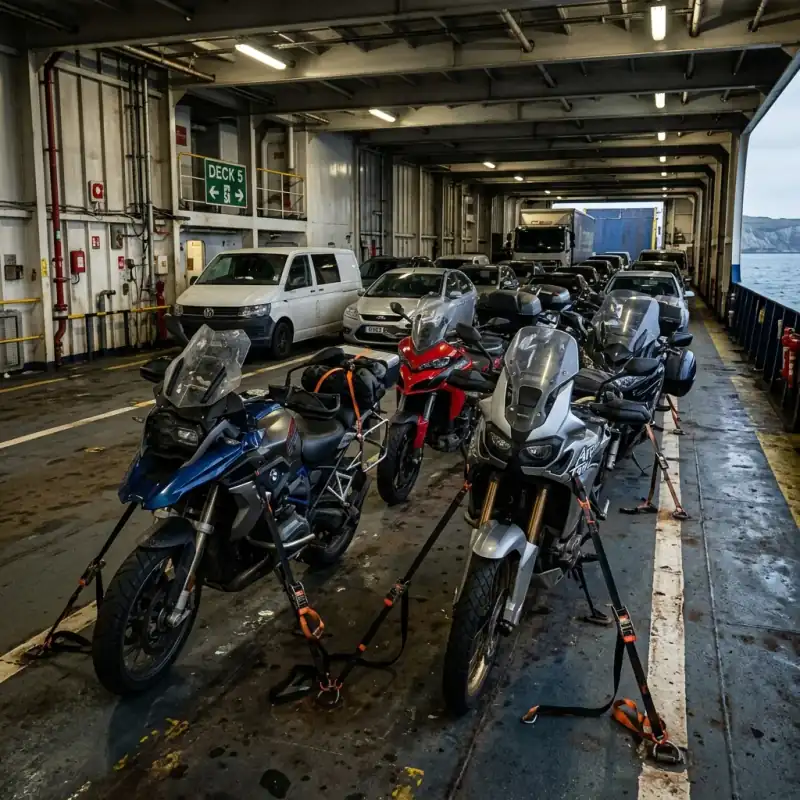
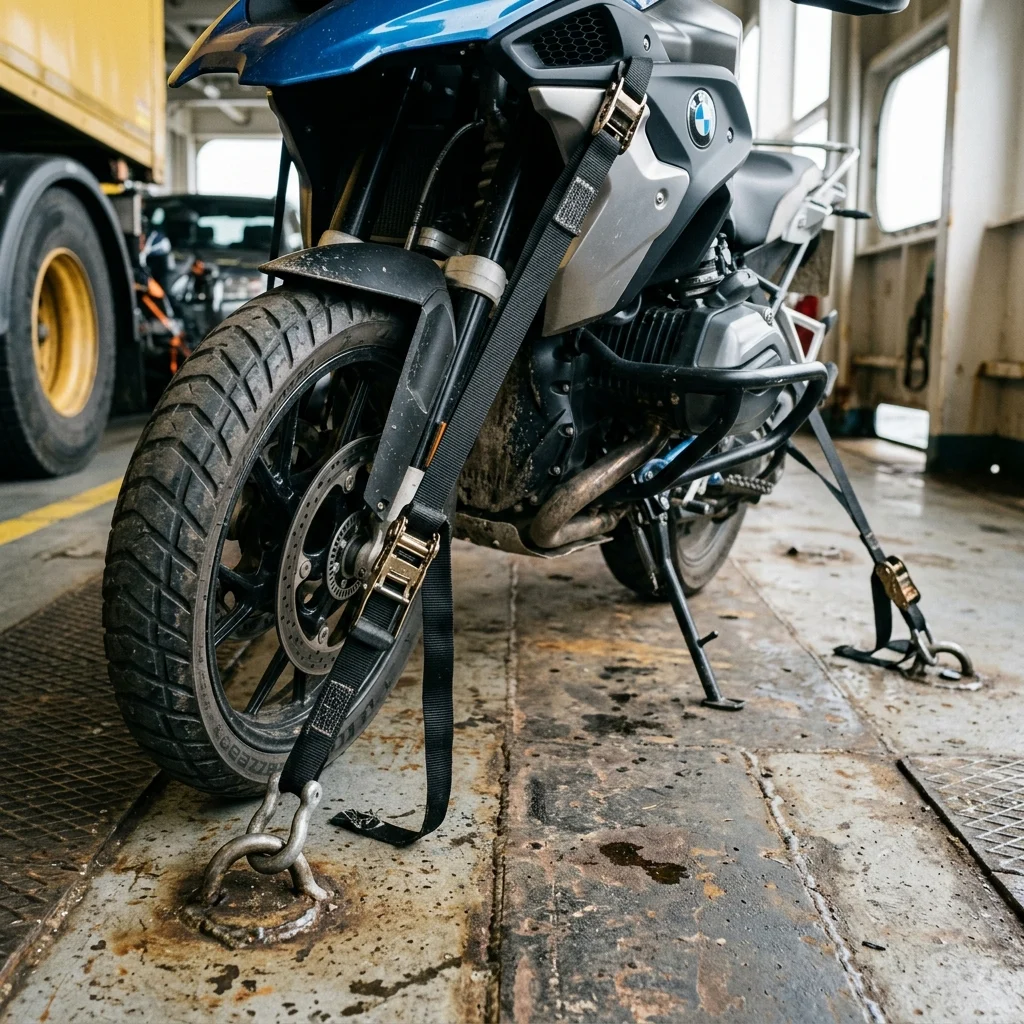
On the ferries, the drill is the same across operators and it’s worth doing properly, because a bike on a moving car deck is on its own. You ride on, the crew wave you to a spot along the side, and they hand you straps and point out the deck’s lashing points. But you strap the bike down yourself. If it goes over, that’s on you, not the ferry company.
The setup experienced riders use:
- First gear, side stand down — not the centre stand, which can let the bike “walk” and topple in a swell.
- Steering locked, alarm off (a rolling deck sets alarms off all night otherwise).
- Straps over the pillion pegs or lower yokes, compressing the front suspension slightly so the bike is pinned, not swinging. Don’t crank so hard you bottom the forks.
- Carry your own soft straps as a backup. The provided ratchet straps are fine but can be awkward to release, and having your own means you’re never at the mercy of a busy deckhand.
On Eurotunnel it’s simpler: you ride into the rail shuttle, and on the short, still, 35-minute run bikes are typically just left on their stands; no strapping, no drama.
The Paperwork: What Brexit Actually Changed
Post-Brexit rules have settled down, but two myths still cost riders time. Here’s the current, honest list for 2026.
You need to carry:
- Passport — issued less than 10 years before your travel date, with at least 3 months left on it on the day you plan to return.
- Driving licence (your photocard is fine; you only need an International Driving Permit in edge cases like an old paper licence).
- V5C registration document for the bike.
- Your certificate of insurance. You do not need a Green Card any more. That requirement was scrapped in 2024. Your normal cover works in the EU, but check your policy’s level of overseas cover before you go.
- A ‘UK’ sticker on the back of the bike. The old ‘GB’ sticker is no longer valid. You can skip the sticker only if your plate already displays ‘UK’ with the Union flag.
And keep in mind the Schengen 90-in-180-days limit now applies to UK riders like any other non-EU visitor — fine for a summer tour, worth counting if you’re a serial traveller.
The French Rules That Fine the Unprepared
This is the section that saves you money, because several French requirements simply don’t exist in the UK, so it’s easy to arrive without them.
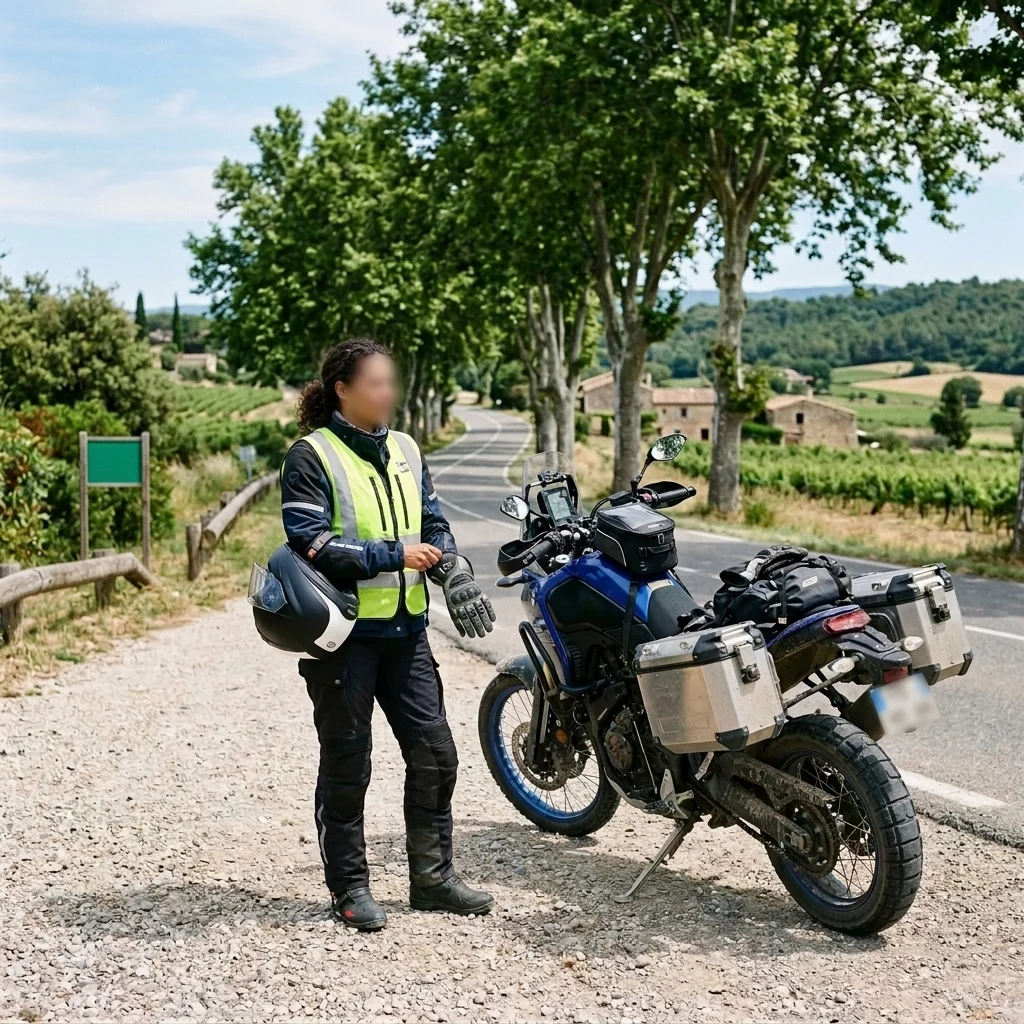
CE-marked gloves are compulsory, and enforced. Since 2016, French law requires the rider and pillion to wear CE-approved motorcycle gloves. Ride bare-handed or in fashion gloves and you risk an on-the-spot fine (commonly cited around €68). It applies to visitors exactly as to locals, so wear proper gloves from the moment you roll off the ferry.
Carry a hi-vis vest. You must have a CE-marked reflective vest with you, and put it on if you stop and get off the bike at the roadside (say, a breakdown). A compact packable one lives easily under the seat.
The Crit’Air sticker — required, but in flux. To ride into the low-emission “ZFE” zones of many French cities — Paris chief among them — your bike needs a Crit’Air anti-pollution sticker in the windscreen area or on the fork, including foreign-registered bikes. It’s a cheap official online order (a few euros) and the fine for going without is around €68. The honest caveat: France voted in 2025 to abolish these low-emission zones, and that reversal hasn’t fully taken legal effect, so the situation is changing — if your route goes through a major French city, check the current rules close to your travel date rather than assuming either way.
ETIAS — coming, but not for this year. You’ll have seen headlines about ETIAS, the EU’s new electronic visa-waiver for visa-exempt visitors like UK citizens. It’s expected to launch late in 2026 with a transitional grace period, which means it is not yet mandatory for a 2026 trip. You won’t be turned back at Calais without it this year. Apply once the system is live and enforced; until then, don’t let it worry you.
Cover for When It Goes Wrong
Two kinds of cover are worth sorting before you sail, because arranging them from a French lay-by is no fun at all.
First, check what your bike insurance actually gives you in the EU. Many UK policies quietly drop to the legal minimum — third-party only — the moment you leave the country, which means your own bike isn’t covered for damage or theft abroad. If you want full cover to travel with you, confirm it with your insurer in writing before you go; some include a set number of EU days, some charge to extend, some don’t offer it at all.
Second, European breakdown and recovery cover is the one riders skip most and regret hardest. A bike that won’t run 800 miles from home is a very expensive problem on your own. Put a number on it: comprehensive annual European cover that will recover both you and the bike back to the UK runs roughly £100–200 a year depending on your bike and provider (one big-name policy starts around £216), and a single-trip policy for one holiday costs less again — set against a four-figure bill to rescue a dead bike from the far side of France. Round it off with travel insurance that includes medical cover and repatriation.
One myth to bin while you’re at it: France’s warning-triangle and breathalyser rules apply to cars, not motorcycles — you don’t need to pack a triangle for the bike, whatever a checklist written for drivers tells you. Gloves, hi-vis and helmet are the motorcycle list.
The Bottom Line
Book the short hop, learn to strap the bike properly, pack CE gloves and a hi-vis vest, sort a Crit’Air sticker if you’re near a city, and square away your insurance and breakdown cover before you leave — and the Channel becomes exactly what it should be: a 35-minute pause between the UK and the best riding of your year.
When you get there, the ultimate Europe adventure motorcycle routes guide and the Alps route through Stelvio and the Dolomites are where the real trip begins, and the Europe border-crossing and documentation guide covers the paperwork for riding on beyond France.
A note on prices and rules: ferry and tunnel fares change constantly with date, demand and how far ahead you book, so every figure here is a typical 2026 starting point rather than a fixed quote — always price your own dates. Legal requirements (especially the shifting Crit’Air position and the ETIAS launch timing) can move too; this guide reflects the situation in July 2026, and it’s worth a quick check of the official sources close to your departure.
Frequently Asked Questions
How much does it cost to take a motorcycle to France by ferry or tunnel in 2026?
Expect a typical one-way starting price of around £40 on the cheapest Dover–Calais ferry sailings, rising to roughly £55–70 on Eurotunnel LeShuttle and P&O at busier times. But these are starting prices, not fixed fares: Channel crossings are dynamically priced, so a summer Saturday afternoon can cost close to double a February Tuesday at 2 a.m., and booking ahead usually beats turning up. Always price your actual dates rather than trusting a single headline figure — you'll see the same crossing quoted at very different prices depending on when you go.
How is a motorcycle secured on a cross-Channel ferry?
On the ferries (DFDS, P&O), you ride onto the car deck, park up, and the crew provide ratchet straps and show you where the deck's lashing points are — but you generally strap the bike down yourself, and if it falls it's treated as your responsibility, so it's worth learning to do it well. Leave the bike in first gear, on the side stand (not the centre stand, which can let it 'walk' in a swell), alarm off, steering locked. Many experienced riders carry their own soft straps as a backup. Eurotunnel is different: you ride into a rail carriage and, on a short 35-minute crossing in still air, bikes are typically left on their stands without strapping.
Do I still need a Green Card and a GB sticker to ride in France after Brexit?
No to both, and it's a common source of confusion. The insurance Green Card was scrapped for EU travel (abolished in 2024), so you no longer need to request one — you just carry your normal certificate of insurance. And the old 'GB' sticker is no longer valid: you now need a 'UK' sticker on the back of the bike, unless your number plate already shows 'UK' with the Union flag. You'll also need your passport (issued less than 10 years before you travel, with at least 3 months left on your return date), your driving licence and your V5C registration document.
Are CE gloves and a hi-vis vest really compulsory for motorcyclists in France?
Yes — and they're genuinely enforced, which surprises UK riders. Since 2016 French law requires the rider and any pillion to wear CE-marked motorcycle gloves; riding without them risks an on-the-spot fine (commonly around €68, and theoretically far higher). You must also carry a CE-marked hi-vis vest and put it on if you stop and step off the bike at the roadside. These rules apply to visitors exactly as they do to French riders, so pack the gloves and a compact vest before you sail.
Do I need a Crit'Air sticker and ETIAS to ride in France in 2026?
As of mid-2026 the Crit'Air low-emission sticker is still required to enter the ZFE zones in many French cities, including Paris, and foreign-registered bikes need one too — it's a cheap online order and the fine for going without is around €68. But there's a genuine caveat: France voted in 2025 to scrap the low-emission zones, and that change hasn't fully taken legal effect, so the rules are in flux — check the current position before you rely on it. ETIAS, the EU's new visa-waiver, is expected to launch late in 2026 but with a transitional period, so it is not yet mandatory for a 2026 trip; apply once it goes live, but you won't be turned away without it this year.