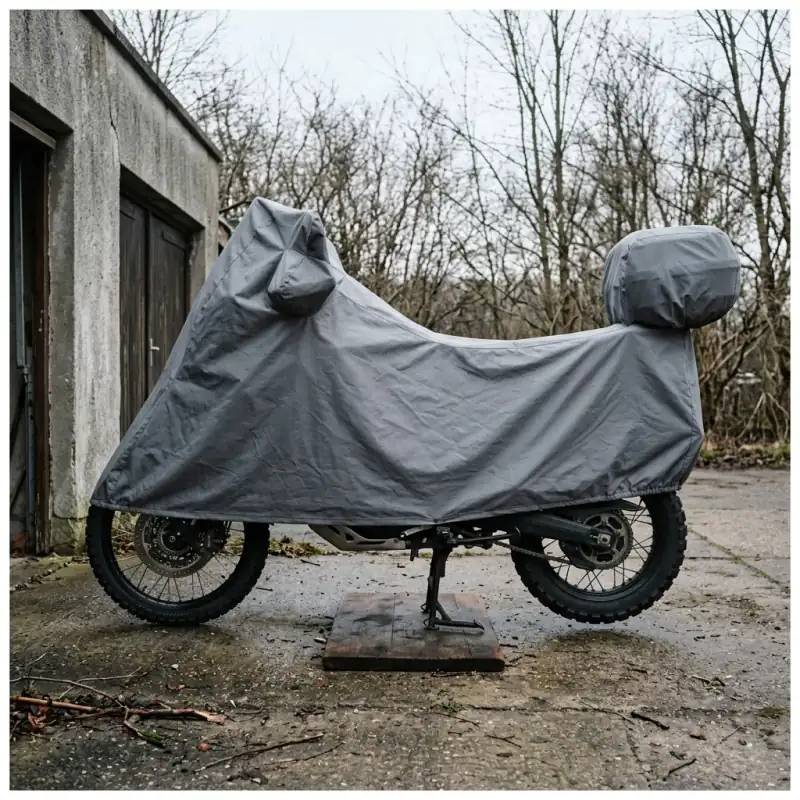
There is a shop-window logic to buying a motorcycle cover, and it is almost entirely wrong. You look for the most waterproof fabric, the heaviest material and the fullest coverage, you pull the hem down to the floor so nothing can get in, and in March you lift it off a bike that is beaded with water and starting to bloom at the fastener heads.
The manufacturers explain this themselves, in plain language, on their own websites. A winter cover is a ventilated roof, not a seal. The water that ruins a stored bike mostly is not rain, and the cover that keeps rain off best is not automatically the cover that keeps the bike driest.
Disclosure: some links below are affiliate links. If you buy through them we may earn a small commission at no extra cost to you.
The thing nobody publishes
Start with an absence, because it shapes everything below.
Buy a tent and you get a hydrostatic head figure in millimetres. Buy a riding jacket and you get a membrane name and a certification. Buy a sleeping pad and, since ASTM F3340, you get an R-value that is comparable between brands.
Buy a motorcycle cover and you get adjectives. Not one of the covers in this guide publishes a hydrostatic head, a moisture-vapour transmission rate, or any other number you could hold two products against. Nelson-Rigg says “100% waterproof”. Dowco says “waterproof and breathable”. Both statements can be true at once and neither can be compared, because there is no shared test behind them.
That is not a reason to give up on the category. It is a reason to shop it on the things manufacturers do describe concretely — the vent architecture, the seam treatment, where the heat panels sit, how the hem holds, and what the warranty says — and to ignore the adjectives entirely.
What the manufacturers actually publish
Specifications below come from each maker’s own product pages and documentation, read in September 2026. Two tables, because they answer two different questions: which shelf you are shopping from, and what the outdoor covers actually do about weather.
The five covers — which shelf, and what is published
| Cover | Use | Published size | Fabric | Warranty |
|---|---|---|---|---|
| ADV defaultNelson-Rigg Defender Extreme Adventure | Outdoor | 98″ × 64″ | "UltraMax" — no denier given | Lifetime |
| Most ventingDowco WeatherAll Plus, Adventure Touring | Outdoor | None published | 300D solution-dyed | Lifetime |
| Badass Moto adventure cover | Outdoor | 99″ × 63″ | 300D + PU | Lifetime |
| Dowco Guardian indoor | Indoor | Up to 109″ | Breathable | Not stated |
| Nelson-Rigg DC-505 | Indoor | None per size | Breathable | 1 year |
Read the last two columns together. Only one fabric here carries a published weight — the 300-denier figure Dowco and Badass Moto both give, and Nelson-Rigg does not. Only three of the five publish a size at all, which is a problem in a category where fit is most of the job: Dowco will sell you an Adventure Touring cover without telling you how long it is. And the warranty column splits indoor from outdoor more cleanly than any fabric claim does — lifetime against one year.
Now the three outdoor covers on the things that actually decide a wet winter.
Outdoor covers — airflow, seams, heat, security
| Cover | Vents | Seams | Heat panel | Lock point |
|---|---|---|---|---|
| Nelson-Rigg Defender Extreme Adventure | "Perma-Venting" | Heat-taped | Yes — exhaust panels | Front-wheel grommets |
| Dowco WeatherAll Plus, Adventure Touring | Moisture-Guard, 195% larger | Textile tape | Yes — cotton | Wheel-lock hole, alarm pockets |
| Badass Moto adventure cover | Dual airflow vents | Stitched + taped | Yes | Grommets, padlock pocket |
Neither indoor cover appears in that second table, and that is the point rather than an omission: they have no vents, no taped seams, no heat panel and nowhere to put a lock, because they are not built to be rained on. Nelson-Rigg’s instructions for the DC-505 go further and tell you not to put it on over hot pipes at all.
Why the sealed cover makes the wet bike
This is the mechanism, and Dowco sets it out step by step on its own site.
Warm, humid air gets trapped between the bike and the cover. Overnight, the air and the metal cool down together. Then the air temperature starts to rise again — and the machine, with far more mass, warms more slowly than the air around it. The humidity trapped under the cover now finds the coldest surface available, which is the engine, the frame, the exhaust and the fasteners, and it condenses there. Dowco’s own summary is blunt: warm air plus a cool cycle equals condensation, and the result creates the illusion that the cover leaks.
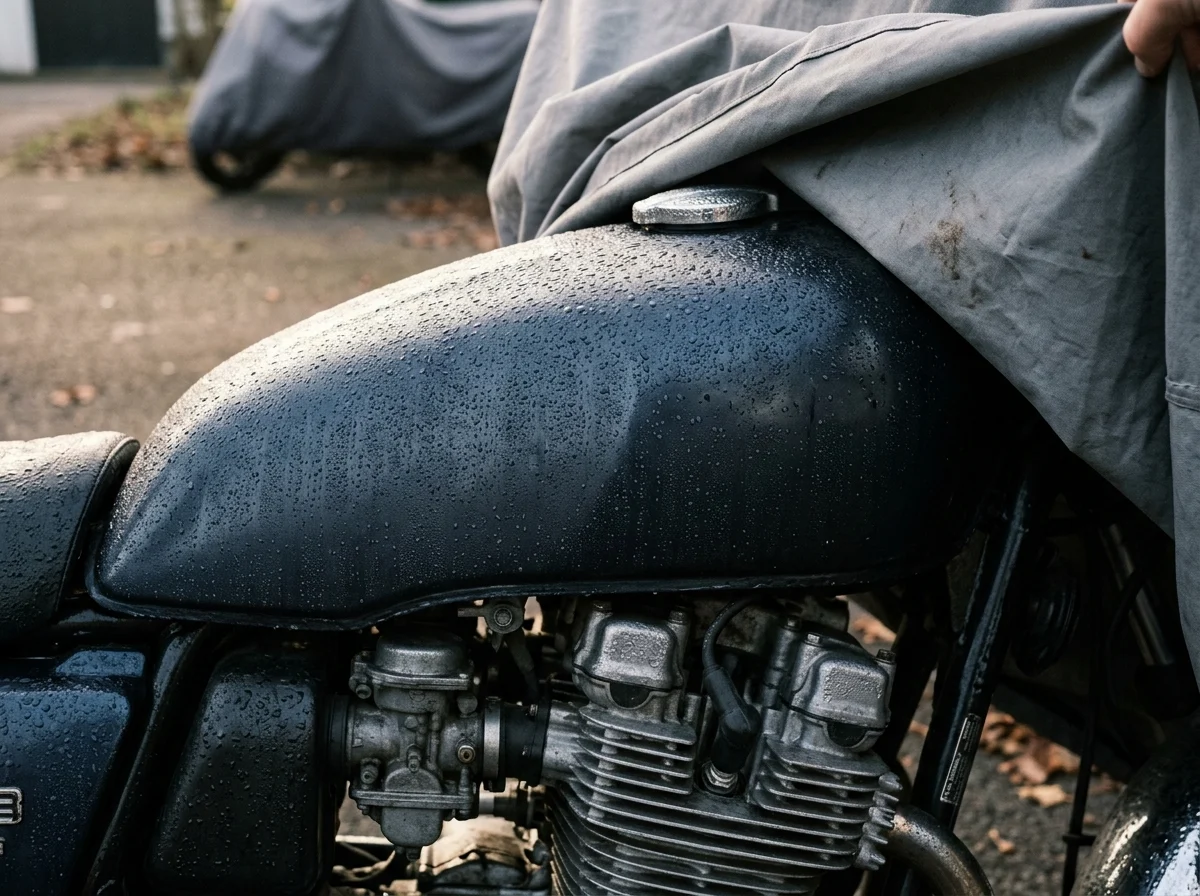
Nothing about that sequence is improved by making the cover more waterproof. It is improved by giving the moisture somewhere to go, which is why the design answers are geometric rather than chemical:
- Vents placed as high as possible. Warm air rises; a vent at the top of the cover lets it leave, and that outflow pulls cooler air in from the bottom. Dowco describes exactly this convection loop, which is why vent area matters more than vent count.
- A hem that deliberately does not reach the ground. Dowco states that its covers are designed to sit about one-half to three-quarters of the way over the wheels, leaving three to eight inches between the ground and the cover so cool air can enter underneath. The instinct to buy a cover long enough to skirt the floor defeats the ventilation the cover was designed around.
- A fabric that passes vapour, not just a coating that blocks liquid — which is what “breathable” is gesturing at, even without a number attached.
And then the honesty that makes the rest of it credible: Dowco says outright that condensation has many variables and that they have not yet found a way to prevent all of it. No cover on this page, or any other, is a dehumidifier. What a good one does is stop moisture accumulating faster than it can leave.
Which produces three free habits worth more than any upgrade: never cover a wet bike, park it on a board, mat or flattened cardboard rather than bare concrete so ground moisture is not drawn into the enclosed space, and in a closed garage hang a moisture absorber nearby. Those three, and the rest of the process, are in our winter storage guide — the cover is one step of about eight, and it is not the step that saves the battery.
Indoor and outdoor covers are different products
This is the second expensive mistake, and it runs in both directions.
An indoor dust cover is a breathable, non-scratch sheet whose entire job is dust, drips and the occasional shoulder brushing past in a tight garage. Nelson-Rigg describes the DC-505 as water-resistant and breathable and specifies it for indoor use only, with a one-year warranty. Use one outdoors and it wets through, holds that water against the paint, and does the opposite of its job.
An outdoor cover is coated, taped, vented and heat-panelled, and it is built to be rained on for months. Used indoors it works perfectly well, but you have paid for weatherproofing you are not using and given up some softness against the paint.
The case people get wrong most often is the unheated garage or carport — technically indoors, but with the temperature swinging like the outside and damp coming up off a concrete floor. That is an outdoor-cover environment with an indoor label on it. If the space is genuinely dry and stable, a breathable dust cover is the better and cheaper answer.
Check Dowco Guardian Indoor Cover on Amazon →
Check Nelson-Rigg DC-505 on Amazon →
The adventure-bike sizing problem
Cover sizing charts were built around cruisers and sportbikes, and an adventure bike breaks them in three places at once: the screen is tall, the bars are wide, and the luggage is bolted on.
Measure the bike as it will actually be stored, not as it looks in the brochure:
- Length, front tyre to rear tyre, including a top box if one stays on.
- Height, ground to the highest point — which is the top of the screen on almost every ADV, not the mirrors.
- Width, across the widest point, which is the panniers if they are fitted and the bars if they are not.
Then buy at or slightly above those numbers. Dowco makes the point that the dimensions it lists are the measurements of the cover itself, so you should allow one to two inches of allowance on length and width rather than buying to the exact figure. A cover bought tight does not stretch; it rides up, exposes a wheel, and flogs itself to death on the hem.
The reason adventure-specific sizes exist is precisely this. Badass Moto publishes 99 inches long by 63 inches high for its ADV cover and lists the R 1300 GS, Pan America, Multistrada V4 Rally, KTM 1390 and Tiger 1200 among the fits; Nelson-Rigg’s DEX-ADV is a distinct SKU from the standard Defender Extreme; Dowco sells an Adventure Touring fit alongside its cruiser and sport sizes. If you run hard luggage, the top-box adjustment on the Badass Moto cover is the feature that stops you sizing up an entire step just to clear the box.
One more thing that catches ADV riders specifically: if the bike is stored with the panniers off, buy for that, and store the empty cases separately. A cover sized for a fully loaded bike is a sail when the bike underneath it is narrow.
Our pannier guide covers the luggage side of that decision, including which cases come off easily enough that taking them off for the winter is realistic.
The outdoor picks
Nelson-Rigg Defender Extreme Adventure — the adventure-specific default
The DEX-ADV is the version of Nelson-Rigg’s outdoor cover cut for tall, upright bikes, and it is the most complete feature set here for a machine living outside all winter. Nelson-Rigg specifies UltraMax polyester, describes the cover as 100% waterproof including heat-sealed seams, and builds in the Perma-Venting system the company states minimises condensation and allows air circulation while the vehicle is covered. There are integrated heat-resistant panels for the exhaust, a soft liner where the fabric meets the screen, a reflective strip along the sides and back, an elastic hem with a quick-release belly strap, and grommets at the front wheel for a cable lock. It packs into a compression sack, and it carries Nelson-Rigg’s lifetime warranty.
It is also the only outdoor cover here that publishes measurements against the sizing method above: 98 inches long and 64 inches at the front height, with 36 inches of front width and 40 inches at the rear — and sellers note that the length figure is measured from the front tyre to the furthest rear point of the bike touching the cover, so a top box counts toward it. Take those as approximate, and hold them against the three measurements you took.
What it does not publish is a fabric weight. “UltraMax” is a brand name rather than a specification, and there is no denier figure to hold against the 300D its competitors state. If you want to compare fabric on paper, this is not the cover that lets you.
Check Nelson-Rigg Defender Extreme Adventure on Amazon →
Dowco Guardian WeatherAll Plus, Adventure Touring — the most ventilation, and the most published
This is the cover with the most ventilation area of the three, and the only one whose fabric is fully specified. Dowco states that the reflective Moisture-Guard vent system is 195% larger than the system it replaced, and it is the only cover here whose fabric is described in full: ClimaShield Plus, a 300-denier solution-dyed woven polyester with a marine-grade triple coating, a polyurethane and mildew-resistant undercoat, an anti-microbial finish applied during production, and seams taped with a textile-based tape.
The solution-dyed part is not marketing. In a solution-dyed fibre the pigment is mixed into the polymer melt before the fibre is spun, so the colour runs through the whole filament; in a surface-dyed fabric it sits on the outside. It is the standard construction for marine canvas and awnings for exactly one reason — UV has to destroy the fibre to reach the colour, rather than simply bleaching a coating off it. On a cover that will spend a winter, and then a summer, sitting in daylight, that is the difference between fading and failing.
The gap is dimensions. Dowco publishes no measurements for the Adventure Touring size — it sells the fit through a model lookup instead, and even its general fitment page only tells you to measure the bike and allow an inch or two. If you want to check a number against your own tape before buying, this is not the cover that lets you, and that is a real cost in a category where fit does most of the work.
The practical fittings are otherwise the same class as the Nelson-Rigg: soft cotton where the cover meets the screen, an elastic shock cord sewn into the hem, a polyester webbing belly strap specifically to stop the cover leaving in high wind, a sewn-in hole for a wheel lock, and pockets for a cover alarm. Limited lifetime warranty to the original purchaser.
Check Dowco WeatherAll Plus (Adventure Touring) on Amazon →
Badass Moto adventure cover — the one that tells you the dimensions
Two reasons this one earns its place against the established names, and neither of them is price. The first is that it publishes the numbers Dowco leaves to a fitment tool: 99 inches long, 63 inches high, in 300D polyester with a PU coating, double-stitched and taped seams, dual airflow vents, and a heat shield panel. The second is the top-case adjustment, which lets one cover serve a bike that sometimes wears a top box and sometimes does not — the single most annoying sizing variable on an adventure bike.
The hem is a heavy elastic cable rather than a thin cord, there is an adjustable buckle strap underneath, reflective striping down the sides, cable-lock grommets, and an underside pocket meant to keep a padlock off the ground rather than dangling against the paint. Lifetime defect warranty.
Check Badass Moto Adventure Cover on Amazon →
Heat, and why the panel is not permission
Every outdoor cover here builds heat-resistant material into the region that sits near the exhaust. Dowco is the most specific about what that material is — heavy-duty cotton heat shields, placed where the fabric may encounter warm pipes. Nelson-Rigg calls them integrated heat-resistant panels for exhaust pipe protection. Badass Moto fits a heat shield panel.
The word doing the work in all three descriptions is where. A heat panel is a defined area of the cover, positioned for a muffler in roughly the expected place. Headers, downpipes, a high-level exhaust on a dual-sport, or an aftermarket can mounted somewhere else may sit outside it entirely, and a cover pulled over a hot pipe outside the panel will mark, glaze or melt at the contact point.
Indoor covers do not have the panel at all. Nelson-Rigg’s instructions for the DC-505 are explicit: the vehicle should be dry before covering, and do not put the cover on with hot pipes or parts.
For winter storage this mostly resolves itself, because the bike should be going under the cover cold, washed and completely dry — the cover goes on at the end of the lay-up, not at the end of a ride. It matters far more for the other nine months, when the same cover gets thrown over a bike that was running twenty minutes ago. If that is your pattern, let it cool properly rather than trusting a panel whose edges you cannot see.
The hard points, and where covers actually wear out
There is a detail every maker here shares, and it points at something none of them says outright. All three outdoor covers put a soft liner in one specific place: where the fabric meets the screen. Nelson-Rigg calls it a soft windshield lining, Dowco specifies soft cotton at the same spot.
That single reinforcement is an admission. A cover does not wear evenly — it wears where the bike is hard, pointed and unmoving underneath it, and on an adventure bike the screen is not the only such point. Crash bar ends, pannier rack corners, bar-end mirrors, a GPS mount, an aftermarket luggage bracket: every one of those is a stress riser that gets a whole winter of the cover shifting fractionally against it in the wind. Nobody lines the cover for those, because nobody knows where yours are.
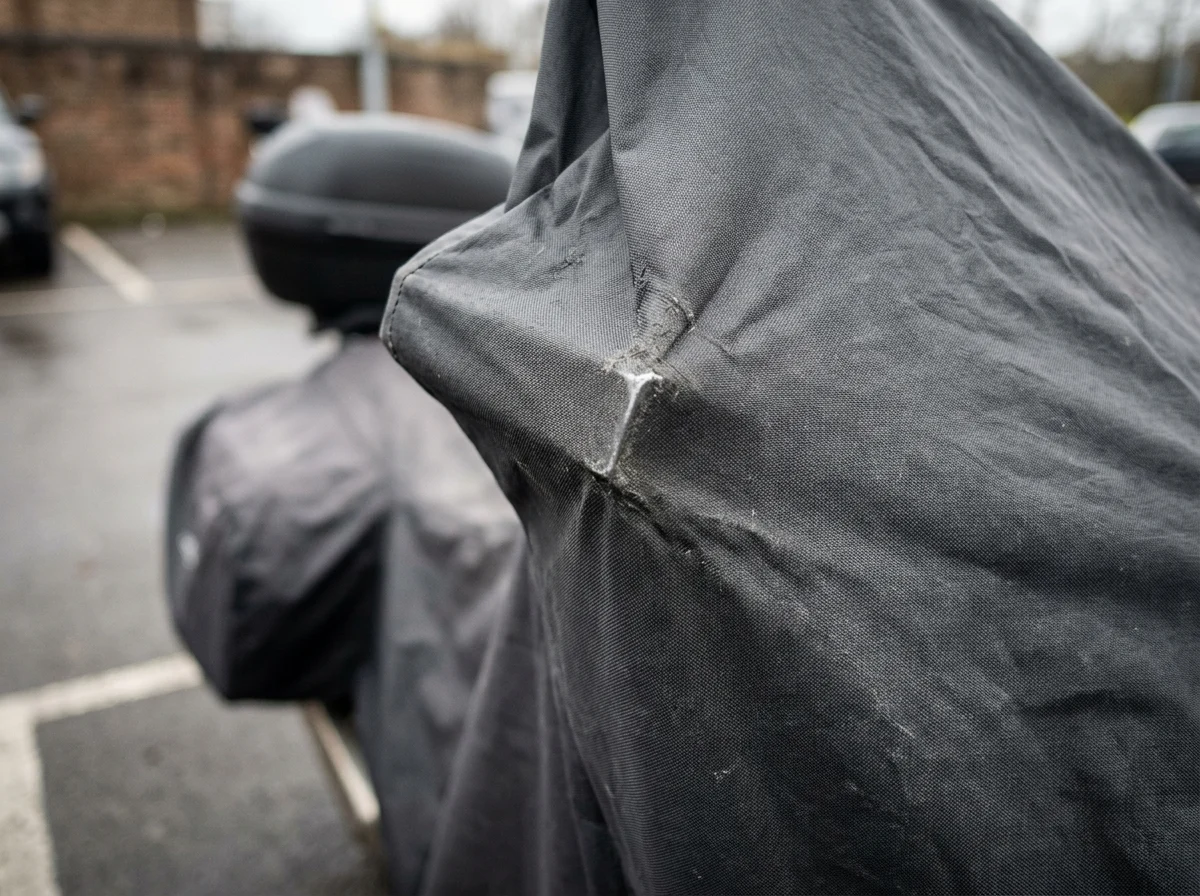
So do it yourself, once, when the cover goes on. Feel around the covered bike for the points where the fabric is tented over something sharp, and pad or tape the worst of them — a strip of pipe insulation or a folded rag over a rack corner costs nothing. Then check those same points once mid-winter. A cover that fails does not usually fail across a panel; it fails at a hole the size of a bolt head, and by the time you see it the water has been getting in for weeks.
What a cover does not do
It does not secure the bike. It hides it, which is genuinely useful — a plain cover in a neutral colour means nobody walking past can tell what is underneath, and a lot of theft is opportunistic and model-specific. But it is fabric, and it screens whoever is working under it just as well as it screens the bike. The cover makers themselves design for combination rather than substitution, which is why the security features on all three outdoor covers are ways of attaching a lock: grommets at the front wheel, a sewn-in hole for a wheel lock, alarm pockets, a pouch to keep a padlock off the ground. Use them with a real lock and, where possible, a ground anchor. The same logic applies on the road, where a cover is camouflage rather than protection — our guide to securing a bike while wild camping covers that use in detail.
It does not stop the battery dying, the fuel going stale, or the tyres flat-spotting. A cover is the last step of a lay-up, not a shortcut past one. If the bike is going to sit for months, the two purchases that actually decide what you find in spring are a cover and a maintainer, and only one of them is chemistry-sensitive — which maintainer matches your battery is the more consequential decision of the two.
It does not fix a bad parking spot. Under a tree means sap, bird mess and a permanent drip line. On grass or bare earth means ground moisture rising into the covered space all winter. Hard standing, off the ground, away from anything that drips, will do more for the bike than moving one tier up the cover range.
What to actually buy
- Adventure bike, stored outdoors, tall screen and luggage — Nelson-Rigg Defender Extreme Adventure.
- Outdoors in a genuinely wet, windy or high-UV spot — Dowco Guardian WeatherAll Plus in Adventure Touring, for the vent area, the taped seams and the solution-dyed fabric.
- Outdoors, and you want the dimensions before you buy, or the top box comes and goes — Badass Moto adventure cover.
- Dry, stable, heated garage — a breathable indoor dust cover; the Dowco Guardian indoor covers bikes up to 109 inches, the Nelson-Rigg DC-505 is the alternative.
- Unheated garage or carport — treat it as outdoors and buy a vented outdoor cover, whatever the roof suggests.
And the thing that is not a cover: something to park on. A board, a rubber mat, even flattened cardboard. It costs nothing, it breaks the path ground moisture takes into the covered space, and it is the single cheapest improvement to everything above.
If you are buying into a November sale, what a good price looks like by category and the gear buying calendar both cover where discounts are real — though a cover for a bike that is about to sit is not a purchase worth postponing to catch one.
A note on these numbers
Every specification above came from the manufacturer’s own product pages, product documentation, or retailer listings carrying the manufacturer’s copy, read in September 2026. Where a figure appears only in a retailer listing rather than on the maker’s own site — the Adventure Touring vent figure and the heat-shield material description among them — that is because Nelson-Rigg’s and Dowco’s own product pages were not reachable for direct verification at the time of writing, and the wording was cross-checked across more than one seller carrying the same manufacturer text.
Four deliberate gaps. No waterproof ratings appear here, because none of these manufacturers publish one; “100% waterproof” is a claim, not a measurement, and there is no hydrostatic head figure behind it to compare. No breathability figures appear, for the same reason. And no lifespan estimates appear — the three-year and five-year numbers that circulate in this category come from vendor blogs rather than from anyone who tests fabric, and we could not source a single one to a manufacturer or a standard.
The fourth is prices, and the reason is different from the other three, so it is worth stating rather than leaving you to guess. This site earns through the Amazon affiliate programme, whose terms require any price we state to come from live product data rather than from a number typed into an article months earlier. We do not have that data feed, so quoting a figure here would be both stale and against the rules we operate under. What we can tell you is the shape of the market: the indoor dust covers are the cheapest thing on this page by a wide margin, the three outdoor adventure covers sit close enough to each other that price should not decide between them, and the gap between a cheap universal cover and any of these is smaller than the gap in how long they last. Check the current figure on the listing before you buy.
One brand is missing on purpose. If you ride in the UK or Europe you will have seen Oxford’s covers — the Stormex, Rainex and Aquatex — recommended constantly, and they are well regarded. They are not here because we could not find an amazon.com listing for them in a size correct for an adventure bike, and this site does not feature products you cannot buy through the link you are given. That is an availability decision, not a verdict on the product.
Related guides
- How to store a motorcycle over winter — the full lay-up, scaled to how cold your winter actually gets. The cover is the last step of it.
- Motorcycle battery maintainers — the other half of a winter lay-up, and the one where buying the wrong chemistry costs you a battery.
- Securing a motorcycle while wild camping — where a cover works as camouflage, and what has to go with it.
- Best adventure motorcycle panniers — because whether the luggage stays on decides which cover size you need.
- The gear buying calendar — when each category actually drops, and which ones are not worth waiting for.
Frequently Asked Questions
Should a winter motorcycle cover be waterproof or breathable?
Outdoors it needs to be both, and the second half is the one buyers skip. A coated, taped cover keeps rain off, but the bike also produces a moisture problem of its own: Dowco's explanation is that warm humid air is trapped under the cover, and when the air temperature rises the bike warms more slowly, so that humidity condenses on the cool machine — which they note creates the illusion that the cover leaks. The answer manufacturers build in is airflow rather than a tighter seal: vents placed as high as possible so warm air escapes, and a hem that stops partway down the wheels so cooler air is drawn in underneath. Indoors, in a dry garage, the calculation is different and a breathable dust cover is the better product.
Why is my motorcycle wet under the cover when it hasn't rained?
Because that water condensed out of the air rather than coming through the fabric — the bike is simply the coldest thing under there, so moisture in the trapped air collects on it. Four fixes, all free. Never cover a wet or freshly washed bike. Keep the vents clear and the hem off the ground, because the cover is designed to draw air in underneath. Park on a board, mat or flattened cardboard rather than bare concrete or earth, which are a constant source of rising damp. And in a closed garage, hang a moisture absorber nearby. Worth knowing before you spend more money on it: Dowco, which builds the vent system, says outright that it has not found a way to prevent all condensation.
What size cover fits an adventure bike with panniers and a top box?
Not the size you would buy for the same bike naked, which is the most common sizing mistake in this category. A tall screen raises the peak height and hard luggage widens the tail, so measure the bike as it will actually be stored — wheel to wheel for length, ground to the top of the screen for height, and the widest point across the panniers — then buy a cover rated at or slightly above those figures. Adventure-specific sizes exist for exactly this reason: Badass Moto publishes 99 inches long by 63 inches high for its ADV cover, and both Nelson-Rigg and Dowco sell dedicated adventure fits. Dowco also warns that its published dimensions are the measurements of the cover itself, so allow one to two inches of slack on length and width rather than buying to the exact number.
Can you put a cover on a hot motorcycle?
Not straight off a ride, and the heat-shield panel on a good outdoor cover is a margin of safety rather than permission. Outdoor covers from Nelson-Rigg, Dowco and Badass Moto all build heat-resistant material into the areas that sit near the exhaust — Dowco describes heavy-duty cotton heat shields placed where the fabric may encounter warm pipes — but that panel is a defined area, and headers and downpipes are not always inside it. Indoor dust covers have no heat protection at all: Nelson-Rigg's own instruction for the DC-505 is that the vehicle should be dry before covering and not to put the cover on with hot pipes or parts. For a bike going into winter storage the question is mostly academic, because it should be going under the cover cold, clean and dry anyway.
Does a motorcycle cover help against theft?
It helps by hiding, not by holding. A plain cover in a neutral colour means a passing thief cannot see which bike is underneath, which matters because a lot of motorcycle theft is opportunistic and model-specific, and it adds one more obstacle to deal with. But fabric is not security, and it also screens whoever is working underneath it from view. Cover makers are honest enough about this to design for the combination rather than the substitute: Nelson-Rigg puts grommets at the front wheel for a cable lock, Dowco sews in a hole for a wheel lock to pass through plus pockets for a cover alarm, and Badass Moto adds an underside pocket to keep a padlock off the ground. Treat the cover as camouflage layered over a real lock and, where possible, a ground anchor.