
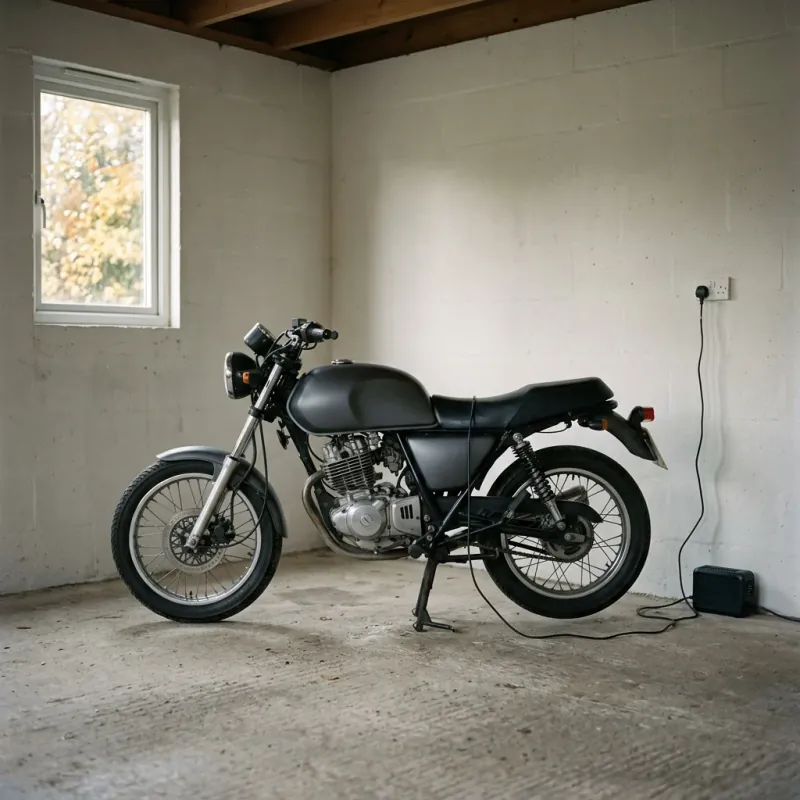
Every autumn the same question goes round, and the answers are usually a list of brand names. NOCO. CTEK. Battery Tender. OptiMate. All good hardware, all recommended by people who have used one for years.
What the answers usually skip is the specification that decides whether a charger is right for your bike at all: what chemistry is in the battery.
That was a non-question for decades, because every motorcycle battery was lead-acid. It mostly still is — mainstream bikes ship with lead-acid — but lithium (LiFePO4) packs are now a common weight-saving replacement, and once one is in the bike, three of the most-recommended maintainers in motorcycling are not specified to charge it at all.
Disclosure: some links below are affiliate links. If you buy through them we may earn a small commission at no extra cost to you.
What the manufacturers actually publish
Specifications below come from each maker’s own product pages and documentation, checked in August 2026.
| Charger | Current | Ah range | Chemistry, as specified | Stages | Price |
|---|---|---|---|---|---|
| NOCO GENIUS1 | 1 A | Not published | Lead-acid plus a 12V LITHIUM mode | — | Check price → |
| Battery Tender Junior 021-0123 | 750 mA | 3–30 Ah | Lead-acid only; lithium not listed | 4 | Check price → |
| Battery Tender Junior selectable 022-0199-DL-WH | 0–2 A | — | Lead-acid or LiFePO4, switched | 4 | Check price → |
| CTEK MXS 5.0 (40-206) | 4.3 A max | 1.2–110 Ah | Lead-acid only; lithium not listed | 8 | Check price → |
| OptiMate 4 Dual Program TM-341 | 1 A | 3–50 Ah | Lead-acid only; lithium not listed | 9 | Check price → |
| OptiMate Lithium 4s TM-471 | 800 mA | 1–10 Ah | LiFePO4 only | 8 | Check price → |
Read the chemistry column again, because it is the whole article. Three of the six list lead-acid chemistries and nothing else, and they are the three most likely to be recommended to you by someone who bought theirs before lithium bike batteries were common.
If your bike has a lead-acid battery
Which is still most bikes. Here the decision is genuinely about what else you want the charger to do.
The default: Battery Tender Junior 021-0123. 12 V, 750 mA, a four-step programme — initialisation, bulk, absorption, float — and a stated range of 3–30 Ah, which covers essentially every motorcycle battery. It is the cheapest way to stop a winter lay-up killing a battery, and the reason it gets recommended endlessly is that it has been doing this job unchanged for a very long time. Deltran’s own page lists what it works with — flooded, AGM, gel and sealed maintenance-free — and lithium is simply not among them.
Check Battery Tender Junior 021-0123 on Amazon →
The one that also charges the car: CTEK MXS 5.0. CTEK publishes 4.3 A maximum output, an eight-step programme, a 1.2–110 Ah charging range with maintenance up to 160 Ah, and IP65 ingress protection. It has an AGM mode that raises charging voltage to 14.7 V and a Recond mode at 15.8 V intended to recover tired batteries. There is a 0.8 A programme for small batteries, which is what you use on the bike. If you have one vehicle to look after this is more charger than you need; if you have a bike, a car and a mower, it is one charger instead of three.
Check CTEK MXS 5.0 on Amazon →
The one for a modern BMW: OptiMate 4 Dual Program. TecMate’s nine-step 12 V 1 A unit is here for one specific reason. Its second programme is a CAN-bus mode, which TecMate describes as charging and maintaining through the DIN socket on BMW motorcycles from 2004 onwards — the accessory socket that a lot of ordinary chargers simply cannot work through, because the bike’s electronics decide when it is live. If you have been fighting that socket, this is the unit that answers it. TecMate specifies the charger for AGM, GEL and STD 12 V batteries from 3–50 Ah, and quotes recovery of a dead-flat battery from as low as 0.5 V.
Check OptiMate 4 Dual Program on Amazon →
If your bike has a lithium battery
Now the list gets short, and it is worth being clear about why rather than just naming a product.
A lead-acid charge cycle ends in a float stage — a small permanent voltage that offsets self-discharge. Many lead-acid chargers also run desulfation pulses at elevated voltage to break down sulphate crystals on the plates. A LiFePO4 pack wants neither: different charge voltage, different termination behaviour, and a battery management system sitting between the terminals and the cells that was not designed to be argued with by a desulfator.
That is why the chemistry column above matters more than the amps.
NOCO GENIUS1 is the straightforward dual-purpose answer. NOCO specifies it for lead-acid batteries — flooded, gel, AGM, maintenance-free — and lithium-ion, and its user guide lists six modes: Standby, 12V, 12V AGM, 12V LITHIUM, 6V and Force. One wrinkle worth knowing before you buy: the product page says “lithium-ion” without naming the chemistry, and it is the user guide that spells out LiFePO4. If your pack is unusual, NOCO’s own advice in that guide is to check with the battery maker. Two features are worth calling out. It has an integrated thermal sensor that adjusts the charging cycle to ambient temperature, which NOCO frames as avoiding undercharging in cold weather down to −4 °F (−20 °C) and overcharging in heat up to 104 °F (40 °C). And Force Mode will detect and charge a battery that has fallen below 1 V, which ordinary chargers refuse to see at all.
Check NOCO GENIUS1 on Amazon →
OptiMate Lithium 4s is the single-purpose alternative: 800 mA, LiFePO4 only, an eight-step programme, in a sealed weatherproof case. Check the capacity range before you buy it, because it is narrower than people assume — TecMate’s own page specifies 1–10 Ah, and lithium bike batteries are often advertised by their much larger lead-acid-equivalent rating rather than their actual amp-hours. Where it fits, a lithium-specific charger removes the possibility of leaving a dual-chemistry unit in the wrong mode.
Battery Tender Junior selectable (022-0199-DL-WH) sits between the two: a manual switch picks lead-acid or lithium (LiFePO4) and the charger runs the matching algorithm. Note the model number, because it is the only thing that tells the two apart. The selectable unit and the classic 021-0123 are both sold as “Battery Tender Junior”, and only one of them has a lithium setting.
The temperature problem no charger solves
This is the part that gets left out of most winter-storage advice, and it is the one that costs real money.
Charging a LiFePO4 cell below 0 °C causes lithium plating: metallic lithium deposits on the anode instead of intercalating into it. The damage is permanent, it compounds every time it happens, and — this is the counter-intuitive bit — charging more slowly does not prevent it, because the driver is temperature, not current. Plating is documented even at very low charge rates below freezing.
The protection against this is a low-temperature charging cutoff, and it lives in the battery’s management system, not in the charger. Quality LiFePO4 packs include one; it typically blocks charging below 0 °C and re-enables it a few degrees above. Cheaper cells sometimes do not, and will accept charge at any temperature while destroying themselves silently.
So the practical rules for a lithium bike battery in a cold climate are:
- Find out whether your battery has a low-temperature charge cutoff. The manufacturer either publishes it or does not, and “does not” is an answer.
- If the garage goes below freezing, bring the battery indoors to charge and maintain it. This is the same conclusion our winter storage guide reaches from the other direction.
- Do not treat a lithium mode on a charger as cold-weather protection. It sets the charge profile. It does not know how cold your battery is.
Lead-acid, incidentally, has the opposite failure mode and a much friendlier one: a fully charged lead-acid battery resists freezing to extraordinary lows, while a flat one can freeze at around 0 °C and crack. Keeping it charged is the cold protection.
What to actually buy
- Lead-acid bike, one vehicle, minimum spend — Battery Tender Junior 021-0123.
- Lead-acid bike, and a car and mower to look after — CTEK MXS 5.0.
- Modern BMW with a CAN-bus accessory socket — OptiMate 4 Dual Program.
- Lithium bike, or a household with both chemistries — NOCO GENIUS1.
- Lithium bike, permanently — OptiMate Lithium 4s.
And one thing that is not a charger: a fused ring-terminal lead, left permanently on the battery with the connector tucked somewhere reachable. Every unit here ships with one. Fitting it is what turns “I should put the bike on charge” into a five-second job, which is the difference between owning a maintainer and using one.
A note on these numbers
Every specification above came from the manufacturer’s own product page or documentation in August 2026, and the chemistry claims in particular were taken from the makers’ published battery-type lists rather than from retailer descriptions, which are inconsistent on exactly this point.
Two gaps worth naming. NOCO does not publish a maximum battery capacity for the GENIUS1 on its own product page — retailers commonly quote 30 Ah, and we have left that figure out rather than attribute it to NOCO. And no manufacturer here publishes a low-temperature charging cutoff for lithium as a charger feature, which is precisely why the section above puts that responsibility on the battery.
Prices move constantly in this category and we have not quoted any. If you are buying into a seasonal sale, when to buy motorcycle gear covers which categories are worth waiting on — a maintainer, for a bike that is about to sit, is not one of them.
Related guides
- How to store a motorcycle over winter — the full lay-up process, scaled to how cold your winter actually gets.
- Best motorcycle covers for winter storage — the other thing the bike needs while it sits, and why the most waterproof cover is the wrong buy.
- Best power banks and charging for motorcycle camping — the other battery problem, on the road rather than in the garage.
- Black Friday motorcycle gear — what a good price looks like in each category, and where discounts are meaningless.
- Gifts for adventure motorcyclists — a maintainer is the unglamorous gift that gets used every year.
Frequently Asked Questions
Can you use a normal battery tender on a lithium motorcycle battery?
Not unless it has an explicit lithium mode, and several of the chargers riders recommend most often do not. Deltran's page for the classic Battery Tender Junior 021-0123 lists flooded, AGM, gel and sealed maintenance-free — every chemistry it names is lead-acid, none of them is lithium, and Deltran sells a separate switch-selectable model for that job. CTEK's MXS 5.0 product page lists its battery types as WET, MF, Ca/Ca, AGM, EFB and GEL, with no lithium among them; CTEK's LiFePO4 charger is a different product, the LITHIUM XS. The reason is the charge profile: lead-acid chargers use absorption and float stages, and often a desulfation pulse, and a LiFePO4 pack wants neither. Buy the charger for the chemistry that is in the bike, not for the brand you have heard of.
Is it safe to leave a battery maintainer connected all winter?
That is what a maintainer is for, as distinct from a plain trickle charger. A modern smart maintainer charges the battery, then drops to a maintenance stage and only tops it up when the voltage falls, which is why it can stay connected for months without cooking the battery. What it cannot do is protect a lithium battery from being charged in the cold — see the temperature question below — and it cannot rescue a battery that is already dead from neglect. Two practical points: use a fused ring-terminal lead so connecting the charger doesn't mean reaching for the battery every time, and if the bike lives outdoors, check the charger's ingress rating before you leave it out in the weather.
Can you charge a lithium battery below freezing?
No, and this is the single most important thing to understand about lithium in a cold garage. Charging a LiFePO4 cell below 0°C causes lithium plating on the anode — a permanent loss of capacity that gets worse each time it happens, and it is not fixed by charging more slowly, because temperature rather than current is what drives it. The protection against this lives in the battery's own management system as a low-temperature charging cutoff, not in the charger, and not every lithium battery has one — budget cells sometimes accept charge at any temperature and quietly destroy themselves. If your bike runs lithium and your garage goes below freezing, the safe answer is the one in our winter storage guide: bring the battery indoors.
How many amps do you need for a motorcycle battery?
Far fewer than car chargers suggest. For maintenance over a winter lay-up, the classic powersports units sit between 750 mA and 1 A — the Battery Tender Junior 021-0123 is 750 mA, the NOCO GENIUS1 is 1 A, the OptiMate 4 is 1 A — and that is enough to hold a motorcycle battery topped up indefinitely. Higher current only matters if you also want to recharge a flat battery quickly, which is where something like the CTEK MXS 5.0 at 4.3 A comes in, and it charges car batteries too. The trade is not really speed versus safety on a smart charger; it is what else you want the unit to do.
What is the difference between a trickle charger and a battery maintainer?
A true trickle charger pushes a small constant current whether the battery needs it or not, which over months can overcharge and damage a battery — that is the reputation the category is still living down. A maintainer is microprocessor-controlled: it runs a multi-stage charge, then monitors and only intervenes when voltage drops. The chargers in this guide are all maintainers, and their step counts reflect how granular that control is — four stages on the 021-0123, eight on the CTEK MXS 5.0, nine on the OptiMate 4. In everyday use the number of stages matters less than two things: whether the charger matches your battery chemistry, and whether it is safe to leave connected unattended.