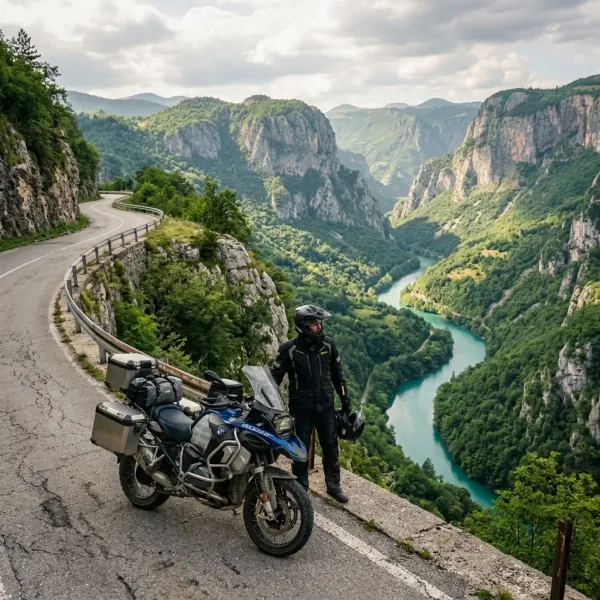
The first time I rode through the Balkans I crossed from Croatia into Bosnia at Neum without realizing Bosnia has a 20-kilometer coastline. The road on Google Maps showed Croatian highway, I assumed I’d be in Croatia the whole way to Dubrovnik, and I was 5 kilometers into Bosnia before I noticed the signs were Cyrillic and the border was already behind me. The officer at the next crossing — back into Croatia 20 minutes later — laughed and stamped my passport twice in the same hour.
That trip taught me everything about the Balkans on a motorcycle. The borders aren’t where you expect. The roads change quality and signage between every country. The countries that look small on the map take longer to ride than you’d think because the roads are mountain roads, the GDP is low, and the infrastructure is still catching up to EU standards.
This guide is the working version. Riding motorcycle Balkans guide — the classic loop that links the best of seven countries, the border crossing realities, and the documentation requirements that get more complicated in 2026 with new EU systems coming online.
Why the Balkans Is ADV Riding’s Best Kept Secret
The Balkans pack more variety into 1,500 kilometers than any comparable region in Europe. You can ride the Slovenian Alps on Monday, Adriatic coast on Tuesday, Bosnian mountains on Wednesday, Albanian backcountry on Thursday, and Greek beach on Friday. Each country has distinct landscape, distinct food, distinct language, distinct character. The borders are where you notice the changes happening.
The roads are excellent for adventure touring. Coastal Croatia (D8 Adriatic Highway) is paved, fast, and dramatic. Bosnian mountain roads through Sarajevo and Mostar are quieter than equivalent Alpine routes and equally scenic. Montenegro’s Durmitor and Albania’s Accursed Mountains are some of the best ADV riding in Europe, with paved-to-rough gradient that suits any bike from a sport tourer to a fully knobbied dirt bike.
The cost is half what equivalent Western European touring costs. Accommodation is €25-50/night for guest houses, restaurant meals €8-15, fuel only slightly cheaper than the EU. A two-week Balkan trip lands at €60-90/day all-in, half the cost of a comparable Italy or France trip.
The catch: complexity. Seven countries means seven sets of road signs, seven currencies (or rather a mix of euros, kuna replaced by euro, marks, dinars, leks, denar), and the borders between them all add time you’d never plan for in Western Europe.
Planning Your Route: The Classic Balkan Loop
The route that hits the highlights without overcommitting:
| Day | Stage | Distance |
|---|---|---|
| 1-2 | Ljubljana, Slovenia | Base + Triglav Park ride |
| 3 | Slovenia → Zagreb, Croatia | 140 km |
| 4-5 | Zagreb → Plitvice → Split coast | 350 km |
| 6 | Split → Mostar, Bosnia | 160 km |
| 7-8 | Mostar → Sarajevo → Trebinje | 250 km |
| 9 | Trebinje → Durmitor, Montenegro | 180 km |
| 10 | Durmitor → Kotor Bay | 150 km |
| 11 | Kotor → Theth, Albania | 130 km |
| 12-13 | Theth → Tirana → Berat | 200 km |
| 14 | Berat → return via coast | 350 km |
Total: roughly 2,100 km over 14 days. The pacing is realistic — average 150 km/day with rest days in major destinations.
For a 21-day version, add: Slovenian Alps loop (Vršič Pass), Croatian islands (Hvar ferry from Split), Lake Skadar (Montenegro-Albania border), and a Greek extension to Meteora.
Understanding Balkan Border Crossings
EU Schengen Borders: Invisible Lines
Since January 1, 2023, Croatia is fully in Schengen. The Slovenia-Croatia border (previously the busiest queue in summer) is now invisible — no checks, no stops, you just keep riding. Hungary-Slovenia, Greece-Bulgaria, and Romania-Hungary are similarly seamless.
You still need to carry your documents (passport, license, registration, insurance) — the absence of checks doesn’t mean the absence of legal requirement. Random police stops inside a country can request documents at any time.
Non-Schengen Borders: What to Expect
Crossings between Croatia and Bosnia, Bosnia and Montenegro, Montenegro and Albania, and so on are real border stops with passport control, vehicle inspection, and insurance verification.
Typical crossing time: 15-30 minutes off-peak (weekday mornings, mid-afternoon).
Worst crossings:
- Montenegro-Albania at Karasovići/Bozaj — main coastal crossing, 1-3 hour queues 10:00-15:00 in summer
- Croatia-Bosnia at Neum corridor — short but high-volume, 30-90 minutes in summer
- Serbia-Hungary at Horgoš — major regional crossing, 2-4 hours in summer peak
- Bulgaria-Turkey at Kapikule — outside the loop but relevant if extending — can hit 6+ hours in summer
Strategies that work:
- Cross early (06:00-08:00) or late (after 19:00) in summer
- Avoid Saturdays and Sundays at the busiest crossings
- Use secondary crossings where available — they’re slower drives but faster border experiences
- Have all documents ready and accessible before reaching the booth — license, registration, Green Card, passport
EES and ETIAS in 2026: New Rules for UK and Non-EU Riders
Two new EU systems come into force in 2026 for non-EU nationals.
Entry/Exit System (EES) — live April 2026. Replaces passport stamping for non-EU nationals entering the Schengen zone. First entry requires biometric registration (fingerprints, facial photo) at the border. Subsequent entries are faster but still electronic. For motorcycle riders, this adds 5-15 minutes at the first Schengen entry of any trip.
European Travel Information and Authorisation System (ETIAS) — live October 2026. Pre-travel authorisation required for UK, US, Canadian, Australian, and other non-visa nationals entering Schengen. Apply online before travel, costs €7, valid 3 years, takes minutes to a few days to process. Not an insurance product — a security pre-screening like the US ESTA.
For a Balkan trip in 2026, this means: if entering the Schengen zone (Slovenia, Croatia, Bulgaria, Greece) from a non-Schengen country (Bosnia, Montenegro, Albania, Serbia), you’ll hit EES at the Schengen-entry border and ETIAS will need to be valid in your passport from October 2026 onward.
Required Documents Checklist
Six items, all of which need to be on the bike and accessible at every border crossing:
- Valid passport with 6+ months remaining (0 g)
- International Driving Permit if required by country (minimal)
- Vehicle registration document original not copy (minimal)
- Green Card insurance certificate covering all countries (minimal)
- Travel insurance covering motorcycle riding (minimal)
- Emergency contact and consulate numbers saved offline (0 g)
The “registration original” point is critical. Some non-EU border officers refuse to accept photocopies even if your home country issued the registration as a card. Carry the original in a waterproof document holder.
Check Document Holders on Amazon →
For the deeper documentation requirements that apply more broadly across Europe, see the dedicated Europe motorcycle border crossing documentation guide.
Country-by-Country Road Quality Guide
Slovenia: Excellent. EU-standard infrastructure throughout. The Alps roads (Vršič Pass) are technical mountain roads with switchbacks but well-maintained.
Croatia: Excellent on the A-roads (A1 motorway, D8 coastal). Smaller D-roads and county roads are well-paved but narrower. Coastal road from Zadar south to Dubrovnik is one of the great touring roads in Europe.
Bosnia and Herzegovina: Variable. Main highways improving but mountain roads can be rough. Sarajevo-Mostar M17 is a fantastic ride. Avoid rural roads after dark — pothole risk is real.
Montenegro: Mixed. Coastal roads (E80 Bar to Kotor) are good. Inland mountain roads (Durmitor area) are paved but tight and technical. The P14 from Žabljak through the Tara canyon is one of the great roads in the Balkans.
Albania: Improving rapidly. A1 motorway is EU-standard. Rural roads vary from new pavement to bad gravel. Theth-Valbona pass is technical mixed surface — only for ADV or dual-sport bikes.
Kosovo: Generally good main roads, secondary roads variable. Less developed tourism infrastructure than neighbors.
North Macedonia: Improving. Main routes good, mountain roads narrow. Lake Ohrid area is the standout.
Serbia: EU-standard main highways. Rural roads variable. Western Serbia (Tara National Park) has some of the best ADV riding in the region.
Best Balkan Motorcycle Highlights
Durmitor National Park, Montenegro
Plateau and mountain area in northern Montenegro. The P14 ring road around the park is 70 km of paved mountain riding with views of glacial lakes and 2,500m peaks. The town of Žabljak is the natural base.
Tara River Canyon
Deepest canyon in Europe at 1,300 meters. The road along the canyon rim (continuing the Durmitor P14) is dramatic in places that feel staged by tourism boards. Multiple viewpoint pull-offs, bridges across the canyon, and small villages along the route.
Theth National Park, Albania
Remote alpine valley in the Albanian Accursed Mountains. Accessible via a paved-but-narrow road from Shkodër (recently improved — used to be 4-hour gravel hell, now 2-hour paved climb). The valley itself has medieval stone tower houses, hiking trails, and minimal infrastructure. The pass continuing to Valbona is mixed paved and gravel — for ADV bikes only.
Mostar, Bosnia — Stari Most Bridge
Reconstructed Ottoman bridge spanning the Neretva River in Mostar’s old town. UNESCO World Heritage. Worth a half-day stop on any Bosnia trip. The road approaching Mostar from either Sarajevo or Split is excellent in its own right.
Wild Camping in the Balkans
Tolerance varies sharply.
Slovenia and Croatia: Officially restricted, increasingly enforced near beaches. Mountain forest camping generally tolerated if discreet.
Bosnia, Montenegro, Albania: Widely tolerated. Wild camping is normal practice, no objections in remote areas.
Serbia, North Macedonia, Kosovo: Tolerated in rural areas, restricted in protected zones.
The universal rule: one night, leave no trace, no fires in summer, choose remote spots not visible from main roads. The Balkans are some of the best wild-camping destinations in Europe for moto travelers willing to be self-sufficient.
For practical wild camping technique, see solo motorcycle camping safety for remote tenting. For Mediterranean-coast specific bay options that overlap with this region, see best wild camping bays in the Mediterranean.
Internal Connections
This guide pairs with related route and documentation content:
- Trans-Euro Trail for beginners — the TET passes through several Balkan countries
- Europe motorcycle border crossing documentation — broader documentation requirements
FAQ
Five common questions are answered at the top of this page. The short version: ride the classic loop over 2-3 weeks, time border crossings for off-peak, carry an IDP and Green Card for non-EU countries, expect EES from April 2026, and ride in May-June or September.
Whatever your version of a riding motorcycle Balkans guide looks like, the region rewards riders who plan the documentation properly and pace the trip realistically. The countries are small on the map and large on the ground. Two weeks is the minimum to do the loop justice. Three weeks is better.
Disclosure: Some links in this article are affiliate links. If you buy gear through them, we may earn a small commission at no extra cost to you.
Frequently Asked Questions
Do I need an International Driving Permit in the Balkans?
Required in Albania, Bosnia and Herzegovina, North Macedonia, and recommended in Montenegro and Serbia. Not required for EU citizens in EU countries (Croatia, Slovenia, Bulgaria, Romania). For non-EU riders, get an IDP from your home country auto club — it's a translation of your license, takes 10 minutes to obtain, and costs $20-30. Carry it alongside your home license. Border officers ask for it inconsistently, but the one time they do, not having it is a fine and a delay.
Is Green Card insurance mandatory in 2026?
For EU citizens riding within the EU, no — your standard EU insurance certificate covers all EU countries. For non-EU countries inside the Balkan loop (Albania, Bosnia, Kosovo, Montenegro, North Macedonia), yes, Green Card insurance is required and verified at borders. Most EU insurance providers issue a Green Card on request. Buy it before you leave. Border-purchased insurance is available but more expensive and inconvenient.
How long do the worst Balkan border crossings actually take?
Most crossings take 15-30 minutes outside peak times. The worst are the Montenegro-Albania crossing at Karasovići and the Croatia-Bosnia crossing at Neum, both of which can hit 2+ hours during summer weekends. Time your crossings for early morning (before 09:00) or evening (after 19:00) to avoid the worst queues. Schengen-internal crossings (Slovenia-Croatia from January 2023 onward) are no-stop and effectively invisible.
Are the roads safe in Albania?
The main roads have improved dramatically in the last 5 years. The A1 motorway from the Kosovo border to Durres and the SH4 connecting Tirana to the south are good-quality paved roads. Rural roads vary — many are paved but narrow, with frequent potholes and occasional unfenced sections at cliff edges. The Theth-to-Valbona mountain pass is technical and partly gravel. Traffic culture is improving but still aggressive in cities (Tirana, Shkodër). Defensive riding, no riding after dark on rural roads, and conservative cornering in mountains is the right approach.
What's the best season for a Balkan motorcycle trip?
May-June or September-early October. Spring gives you wildflowers in the mountains, manageable temperatures in the coastal areas, and minimal border queues. Autumn gives you stable warm weather, the harvest season (good food everywhere), and quiet roads after summer crowds leave. July-August is hot (35°C+ on coasts), border queues are at their worst, and accommodation prices spike. Winter is possible on coastal routes but mountain passes (Durmitor, Theth) close after first snowfall.