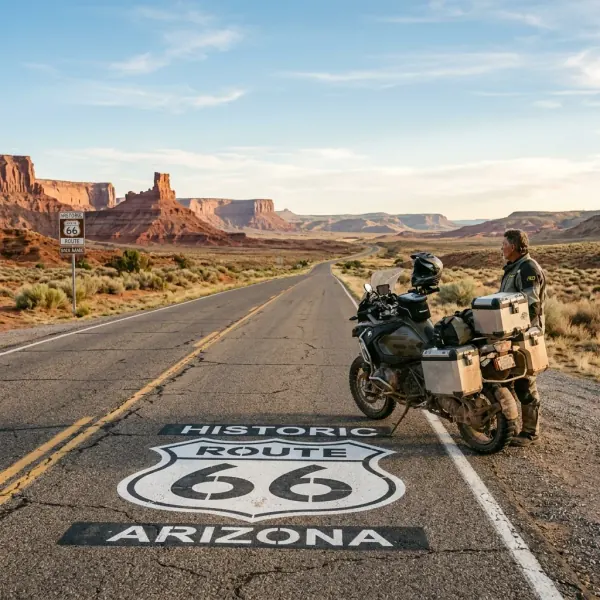
The first thing nobody tells you about Route 66 is that there is no Route 66 anymore. The original federal highway was decommissioned in 1985 and large sections have been replaced, bypassed, or buried under interstate. What you ride today is a stitched-together patchwork of original alignment, brown “Historic Route 66” signage, and Interstate 40 where the original road no longer exists.
The second thing nobody tells you is that this doesn’t matter. The road that exists is still 2,448 miles of American small towns, neon-sign motels, and a slow geographic dissolve from Midwest farmland through Plains scrub to Southwest desert to Pacific coast. Riding it isn’t about following one specific tarmac. It’s about riding through the country in a way that flying never replicates. Riders who finish at Santa Monica often extend the trip north on Highway 1 — the Pacific Coast Highway motorcycle trip guide covers that continuation.
This guide is the working version of the planning. Route 66 motorcycle trip cost and packing — what it actually costs in 2026, how to pack for 2,448 miles across nine states and three climate zones, and the budget reality that nobody at the tourism boards mentions.
How Long Does Route 66 Take on a Motorcycle?
The honest answer depends on how you ride.
7-10 days is the “I can say I did it” pace. 250-350 miles per day, mostly interstate when the original alignment slows you down. You’ll see the road but not the towns. Suitable if you’re constrained by vacation time and the trip is about the act of doing it.
10-14 days is the standard. 180-250 miles per day, mixing original alignment with interstate. You stop for lunch in towns, walk the small museums, photograph the neon signs, and arrive at your motel by 17:00 with time for dinner and a beer. Most riders’ first Route 66 trip lands here.
14-21 days is the route at its best. 100-180 miles per day, almost all on original alignment where it exists. You stay two nights in Tucumcari, do the Grand Canyon side trip, ride the Old Trails Road past Oatman, take an extra day in Flagstaff. The pace lets the road become the place, not just the corridor.
I’d recommend 12-14 days as the right balance for most riders. Enough time to see the road, not so much that the routine becomes monotony.
Realistic Budget Breakdown
Own Bike vs Rental
Bringing your own bike is the cheapest option for trips 14+ days. The cost is fuel, accommodation, food, and the wear on your motorcycle. For US-based riders this is the obvious choice. For non-US riders, shipping a bike from Europe runs $2,000-3,500 each way plus customs paperwork — only worth it for longer trips or multi-route tours.
Renting one-way (Chicago to LA) is the most popular option for non-US riders. EagleRider’s standard cruiser rental in 2026 runs $84-150/day depending on bike. The one-way drop fee from Chicago to LA is the killer: $1,200-1,500. A 14-day rental with drop fee totals $2,400-3,600 just for the bike.
Renting round-trip (Chicago-to-Chicago, putting the bike on a trailer return) eliminates the drop fee but adds 4-5 days of riding back through interstate. Workable if you have time, not if you don’t.
Guided tour packages include bike, accommodation, and most meals for $4,600-6,000 per person for a 15-day tour. Expensive but removes all planning. EagleRider, MCT Touring, and Toursaurus offer the major Route 66 tours.
Accommodation
Three tiers for Route 66.
Budget ($50-80/night): Motels off the original alignment. Tucumcari, Albuquerque, Williams, Barstow all have motels in this range. Quality varies but most are clean and motorcycle-friendly. Look for places with covered parking or motel-style outdoor parking where you can see your bike from the room.
Mid-range ($100-150/night): Better-quality chain motels (Holiday Inn Express, Best Western) on the interstate. Reliable, breakfast included, indoor pool. Less character than the route motels but consistent quality.
Iconic ($150-300/night): The Wigwam Motel in Holbrook, the Blue Swallow in Tucumcari, La Posada in Winslow. Book 6 months ahead for summer. Sleeping in a concrete wigwam or a 1939 Mary Colter masterpiece is part of the trip.
Mix the tiers. Budget motels for the routine nights, iconic stays for the milestone nights (one in Tucumcari, one in Winslow or Holbrook, one in Santa Monica).
Fuel
A typical Route 66 trip burns 50-60 gallons of fuel on a cruiser doing 40-50 mpg, or 35-45 gallons on a smaller bike. At 2026 US gas prices ($3.50-4.50/gallon depending on state), fuel for the full route runs $180-280. Add another $50-100 if you do the Grand Canyon side trip.
Food and Daily Expenses
Budget $30-60/day for food if you mix gas station breakfasts ($8), diner lunches ($15), and restaurant dinners ($25-35). The route is full of legendary roadside diners (Lou Mitchell’s in Chicago, Cozy Dog Drive In in Springfield IL, Rod’s Steak House in Williams). Save the splurge meals for those.
Add $20-30/day for incidentals — water, snacks, parking, entry fees to small museums.
Total daily budget at standard pace, own bike, mid-range: $130-180/day all-in. At budget pace with motel-and-diner basics: $80-100/day.
Route 66 Packing Checklist
What you actually carry beyond standard touring gear:
- Heat-rated gear for Texas and Arizona summer (0 g extra — wear it)
- Hydration pack minimum 2L for desert sections (250 g empty)
- Paper map as GPS backup — cell signal gaps in Oklahoma/Texas (80 g)
- Cash for rural stretches — not all Route 66 stops take cards (minimal)
- Sunscreen SPF50+ desert essential (100 g)
- Tyre plug kit (180 g)
- Rain shell for Plains thunderstorms (400 g)
- Layer for California marine layer mornings (300 g)
The hydration pack is non-negotiable for the Texas-to-California segment in any month from May through September. The desert heat lies — you don’t feel sweaty because it evaporates instantly, but you’re losing 1-1.5L per hour at riding speed. Dehydration sneaks up fast.
Check Hydration Packs on Amazon →
Cash matters more than people expect. Several iconic stops on the route — the Cadillac Ranch viewing pull-off (free but donations expected), small diners in Oklahoma and New Mexico, some gas stations in rural Texas — operate cash-only or with sketchy card readers. Carry $200-300 in small bills.
Check Summer Mesh Gloves on Amazon →
State-by-State Route Overview

Illinois (300 mi): Chicago start, Joliet, Springfield, then south to St Louis. Mostly preserved original alignment. Cozy Dog Drive In and Lincoln’s tomb in Springfield earn the day.
Missouri (300 mi): St Louis to Joplin via Springfield. Meramec Caverns, Devil’s Elbow, the old steel-truss bridge at Gasconade. Rolling Ozarks, humid in summer.
Kansas (13 mi): The shortest state section, but the Galena tour and the Eisler Brothers Old Riverton Store are landmark stops. Don’t blow through.
Oklahoma (400 mi): The longest original alignment of any state. Tulsa, Oklahoma City, the Blue Whale at Catoosa. Tornado country May-June — check weather daily.
Texas (180 mi): Panhandle straight-line riding. Amarillo, Cadillac Ranch (free, mandatory), the Mid-Point Cafe at Adrian (geographic midpoint of the route).
New Mexico (400 mi): Where the route changes character. Tucumcari (Blue Swallow Motel), Santa Fe (pre-1937 alignment loop), Albuquerque. Altitude rising, climate drying.
Arizona (400 mi): Best Route 66 riding state. Holbrook (Wigwam Motel), Winslow (“standing on a corner”), Flagstaff, Williams, Seligman, Kingman, the Oatman switchback. Grand Canyon side trip from Williams adds 2-3 days.
California (300 mi): Across the Mojave to Barstow, then Victorville, San Bernardino, and the long urban approach to Santa Monica Pier. Lane splitting becomes legal at the state line.
Best Motorcycle Rental Options for Route 66
EagleRider is the dominant Route 66 rental company. Locations in Chicago and LA support one-way rentals. Fleet is mostly Harley-Davidson (Road King, Heritage Classic, Street Glide). Insurance included in headline rate. Roadside assistance via the EagleRider network nationwide. Premium pricing, premium experience.
Twisted Road and Riders Share are peer-to-peer rental platforms (motorcycle Airbnb). Cheaper than EagleRider, more bike variety (BMW, Honda, KTM), but no one-way drop options — you return to the original location. Best for round-trip routes or shorter sections.
Local rental shops in Chicago and LA exist but most don’t offer one-way to the other coast. Use them for spot rentals if you’ve shipped your own bike for the main trip and want a different bike for a side trip.
Top 10 Must-Stop Points on Route 66
- Lou Mitchell’s, Chicago — breakfast at the official start of the route
- Gemini Giant, Wilmington IL — 28-foot fiberglass spaceman
- Cozy Dog Drive In, Springfield IL — birthplace of the corn dog (1949)
- Meramec Caverns, MO — Jesse James hideout turned tourist cave
- Cadillac Ranch, Amarillo TX — ten half-buried Cadillacs, free to paint
- Blue Swallow Motel, Tucumcari NM — restored 1939 neon-sign motel
- Standin’ on the Corner Park, Winslow AZ — the Eagles reference
- Wigwam Motel, Holbrook AZ — sleep in a concrete wigwam
- Seligman, AZ — the town that started the Route 66 preservation movement
- Santa Monica Pier, CA — the end-of-route sign and the Pacific
Internal Connections
For longer US-region riding planning, see related route content as it grows on Bikes and Bays. For the gear that handles long-distance touring generally, see essential motorcycle tool kit for overlanding and how to pack a motorcycle for a 2-week camping trip.
FAQ
Five common questions are answered at the top of this page. The short version: budget $80-150/day on your own bike, $4,600+ on a guided tour, ride east-to-west in May or September, carry a hydration pack in the desert, and bring cash for rural stretches.
Whatever your version of the route 66 motorcycle trip cost and packing strategy looks like, the road rewards riders who treat it as a slow tour of a country in transition. The original alignment is patchy. The neon signs are fading. The Mother Road as it existed in 1955 is mostly gone. What remains is still worth two weeks of your life.
Disclosure: Some links in this article are affiliate links. If you buy gear through them, we may earn a small commission at no extra cost to you.
Frequently Asked Questions
How much does a Route 66 motorcycle trip actually cost?
On your own bike, riding budget: about $80-110 per day all-in including motels, fuel, and food — $1,200-1,600 for a 14-day trip. Renting a bike one-way (Chicago to LA) adds $84-150/day for the bike plus one-way drop fees that can exceed $1,200. A guided 15-day tour with everything included runs $4,600-6,000 per person. Camping where possible and eating cheap drops the daily number to $50-60. Luxury hotels and restaurant dinners push it past $200/day.
Should I ride east-to-west or west-to-east?
East-to-west (Chicago to Santa Monica) is the traditional direction, the way the route originally signposted, and the way the prevailing winds blow. Riding into a Pacific sunset at the Santa Monica Pier is the iconic ending. West-to-east avoids the most brutal desert heat by hitting Arizona and New Mexico early in the day in late spring, but you lose the narrative arc and ride into wind for most of the trip. Most riders go east-to-west.
Do I need a special license to rent a motorcycle in the US?
Non-US riders typically need a valid home-country motorcycle license plus an International Driving Permit (IDP). Some rental companies (EagleRider) accept foreign licenses without an IDP but having one removes friction at police stops. Riders under 25 face higher rental rates and some companies require minimum 25 years and 2+ years riding experience. Bring proof of insurance from home — US rental insurance is expensive.
How dangerous is the Texas-Arizona desert section in summer?
Hot enough to be a real concern. July and August daytime temperatures reach 110°F+ (43°C+) in Amarillo, Albuquerque, and Flagstaff approaches. Dehydration is the actual risk, not heatstroke from sitting still. Drink 1L per hour minimum, ride before 11:00 and after 17:00 in peak summer, and carry a hydration pack. Late spring (May) and early fall (September) are the right times to ride this section.
Is lane splitting legal on Route 66?
Only in California. California is the only US state where lane splitting is explicitly legal, and California is also the only state where Route 66 ends (Santa Monica). For the other 2,200+ miles through Illinois, Missouri, Kansas, Oklahoma, Texas, New Mexico, and Arizona, lane splitting and filtering are illegal. Ride accordingly — sit in traffic in cities, especially Chicago and St Louis.