The first time I rode from the UK to Spain I took the Channel Tunnel, crossed France in two long days on the motorway, and arrived at the Spanish border so tired I checked into the first roadside hotel I found and slept 11 hours. The riding wasn’t hard — French motorways are smooth and fast. The cumulative effect of 1,000 miles in two days, plus tolls, plus motorway service-station food, was a level of fatigue that ruined the first two days of the actual trip in Spain.
The second time I took the ferry from Portsmouth to Santander. Boarded at 22:00, ate a real dinner on the ship, slept eight hours in a cabin, watched the Spanish coast appear at breakfast, rode off the ferry at 12:00 the next day completely rested. The 33 hours on the ship felt like a holiday rather than a transit.
This guide is the working version. UK to Spain motorcycle ferry guide covering Brittany Ferries’ three routes, the booking strategy that gets you the best price, what the crossing is actually like, and the rider-specific details (vehicle deck, tie-downs, sea sickness) that ferry company marketing skips.
Skip 1,000 Miles of French Motorway — Take the Ferry
The arithmetic of UK-to-Spain travel is straightforward.
Via France: Calais (or Dover-Calais ferry / Channel Tunnel) → French motorway A28/A10/A63 → Spanish border at Hendaye/Irun. Total: roughly 1,000 miles from Calais to Bilbao. Two long riding days minimum, three comfortable days. Fuel cost £100-130, toll cost £80-100, two nights’ accommodation £160-240. Total £340-470 plus your time.
Via Brittany Ferries: Portsmouth → Santander or Bilbao. One ride to Portsmouth (variable from your origin), one ferry of 22-36 hours, ride off at the Spanish port. Cost £600-900 for a single motorcycle plus cabin plus passenger. No fuel for the crossing, no tolls, no road fatigue.
In direct money terms, the ferry is more expensive. In time and tiredness, the ferry wins by a wide margin. For a 2-3 week motorcycle trip in Spain or Portugal, the ferry is the right choice for most riders who can afford it. It pays for itself in arrival energy and avoided motorway fatigue.
The Routes: Portsmouth, Plymouth, Bilbao, Santander
Brittany Ferries operates three UK-Spain routes as of 2026:
Portsmouth → Santander. The most popular route. 32-33 hours. Operates year-round, 2 sailings per week (typically Sunday and Wednesday evenings from Portsmouth). Ships: Salamanca (newest, 2022, hybrid LNG-powered) and Santoña (2023, similar specifications). Both have cabins, restaurants, bars, cinemas, sun decks, shops.
Portsmouth → Bilbao. Slower (32-36 hours depending on routing), often cheaper. 1-2 sailings per week. Bilbao is a great Spanish starting point with old town, Guggenheim Museum, and easy access to Pyrenees riding.
Plymouth → Santander. Seasonal, April through November. Slower than Portsmouth route at 22-25 hours but Plymouth saves you 200 miles of UK driving if you’re starting from the West Country, Wales, or southern Midlands. 1 sailing per week typically.
For most riders the Portsmouth-Santander route is the default. Bilbao route is worth checking if your dates are flexible — sometimes 30-40% cheaper for the same crossing. Plymouth route worth it if you’re west-based.
Portsmouth to Santander: The Most Popular Crossing
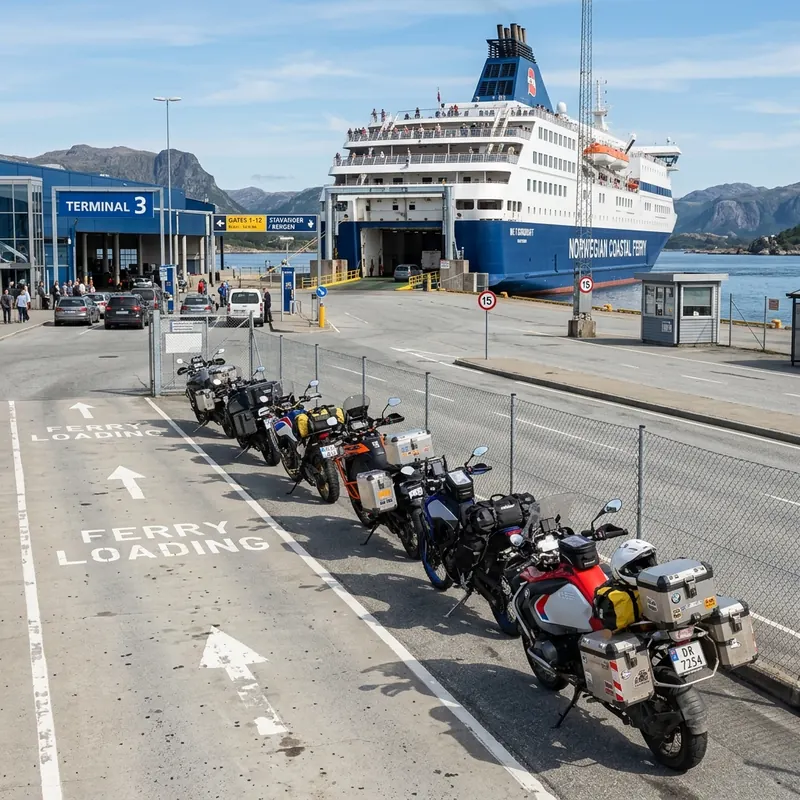
Departure from Portsmouth International Port, typically 21:00-22:00. Arrival in Santander typically morning two days later (so departing Sunday 21:00 arrives Tuesday morning around 12:00 local time).
Check-in: Arrive at the port at least 45 minutes before departure. 90 minutes if traveling with pets. Vehicle check-in is at a specific marshalling area — follow signs for “Brittany Ferries Vehicle Check-In.” Have booking reference, passports, and vehicle registration ready.
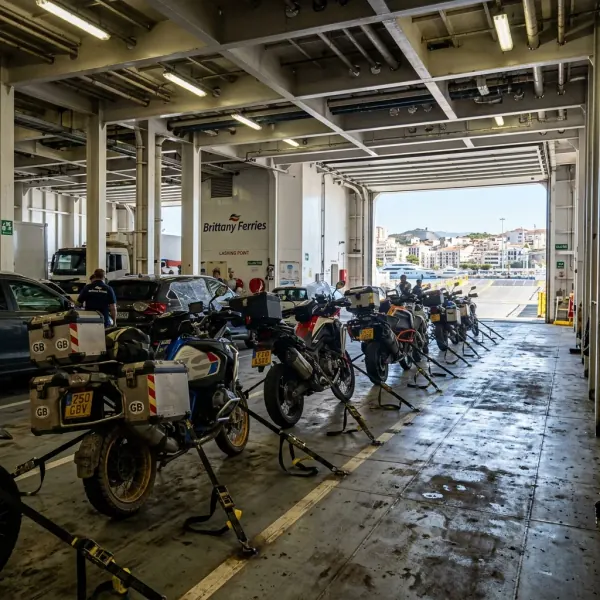
Boarding: Motorcycles board through the same vehicle ramp as cars, typically after the cars have loaded. You’ll be directed to a motorcycle area on the vehicle deck. Crew will help with tie-down straps — they use ratchet straps and crash bar or frame points. You can supplement with your own straps if you prefer.
On board: You cannot access the vehicle deck during the voyage. Pack everything you need for 33 hours in a hand-carry bag — toothbrush, change of clothes, medications, charger, book or tablet.
Disembarkation: Vehicle announcements are made before arrival. Return to your bike, remove your tie-downs (or wait for crew to remove them), and ride off through the Spanish port. Customs and passport control are at the port exit — typically routine but EES will apply from April 2026.
What the Crossing Is Actually Like (33 Hours Onboard)
The Brittany Ferries ships on the Spain routes are essentially small cruise ships. Salamanca has 27,500 GT, accommodates 1,200 passengers and 600+ vehicles, and runs across 9 decks.
Cabins: Range from interior 4-berth bunk cabins (basic) to outside cabins with a window (better) to commodore-class suites (luxury). Even basic cabins have an en-suite shower, towels provided, and air conditioning. The crossing is one full night minimum — book a cabin. The few hundred pounds spent on the cabin is what makes the ferry worth taking instead of riding through France.
Restaurants: Multiple options. The main self-service restaurant (“Le Café”) is reasonable mid-range pricing — typical dinner £15-20. There’s usually a more formal à la carte restaurant for evening dining. Bars on multiple decks. Coffee shops for breakfast.
Entertainment: Cinema (typically a current release each evening), live music in the bars some evenings, kids’ activities for families, sun deck for daylight hours, on-board shopping. Standard cruise ship offering scaled to the size of the vessel.
Connectivity: Onboard Wi-Fi available but slow and expensive. Mobile signal works close to coasts at departure and arrival but you’re out of range for most of the crossing. Treat it as a digital detox.
Motion: The Bay of Biscay is one of the rougher European sea routes. The modern Brittany Ferries ships have active stabilization but cannot eliminate motion entirely. Most crossings have noticeable but manageable motion. Some are smooth. Some are genuinely rough with significant pitching and rolling. Bring seasickness tablets and take them prophylactically.
Booking Strategy: How to Get the Best Price
Brittany Ferries uses dynamic pricing — fares rise as sailings fill. The pattern:
- 6+ months out: Lowest prices available. Choice of all sailing dates and cabin grades.
- 3-6 months out: Prices rise modestly. Still good choice of cabin grades.
- 1-3 months out: Prices rise noticeably for summer dates. Popular sailings start filling.
- Under 1 month: Premium prices on summer dates. Cabin availability limited.
For summer crossings (July-August), book at least 4-6 months ahead. For shoulder season (May-June, September), 6-10 weeks. For off-season (October-April), 2-4 weeks is usually enough.
Club Voyage membership is Brittany Ferries’ loyalty program. Costs £49/year. Gives 10% discount on all bookings plus priority access to release dates. Pays back if you book more than one crossing per year, or one expensive summer crossing.
Compare Portsmouth-Santander vs Portsmouth-Bilbao on your dates. The Bilbao route is sometimes 30-40% cheaper for the same week. If your Spanish itinerary works from either port, check both.
Look at sailing days. Sunday and Tuesday departures from Portsmouth are typically cheaper than Wednesday and Saturday. Off-season dates within school holidays can still be premium-priced.
Motorcycle Ferry Preparation Checklist
What you actually do before boarding:
- Booking confirmed and reference saved offline (0 g)
- Ferry port address and check-in time noted — 45 min before departure (0 g)
- Fuel tank below half for fire safety regulations on board (0 g)
- UK sticker on motorcycle — not GB (5 g)
- Motorcycle covered or secured with straps in vehicle deck (0 g)
- Seasickness tablets if Bay of Biscay is rough — it often is (10 g)
- Cabin booked for 33-hour crossing — worth it (0 g)
The fuel-below-half rule is real. Brittany Ferries’ safety rules require vehicles to have less than half a tank of fuel when boarding. Calculate your distance from your last petrol station to the port; arrive at the port with around 40-50% of tank remaining. Filling up at a service station 10 km from the port is the right approach.
The UK sticker rule catches British riders out post-Brexit. Old “GB” stickers (and registrations bearing GB markings) are no longer valid for European travel. You need a “UK” sticker on the bike or UK identifier in your plate. Brittany Ferries staff will check.
Check Motorcycle Tie-Down Straps on Amazon →
Check Seasickness Tablets on Amazon →
What to Do with 33 Hours on the Ferry
The crossing is a full day plus a night plus most of another day. Planning for the time prevents boredom.
Evening 1 (departure): Settle into cabin, dinner in restaurant, evening drink in a bar, watch the lights of Portsmouth disappear.
Night 1: Sleep. Cabin beds are reasonably comfortable. Set an alarm for breakfast.
Day 1 (full day at sea): Breakfast, walk the sun deck if weather permits, lunch in restaurant, afternoon reading or cinema, late lunch or early dinner. Most of the day is unstructured time — perfect for reading the books you’d been meaning to read.
Evening 2: Dinner, sunset on sun deck if visible, drink in bar, sleep.
Morning 2 (arrival): Breakfast, watch Spanish coast appear from sun deck, return to cabin to pack, disembark.
For families: the kids’ activity programs and cinema make the crossing easier than it looks. For solo riders: bring a book you’ll actually finish.
On the Other Side: Riding from Santander into Spain
Santander is a small Spanish port city on the northern coast. The disembarkation puts you on the A-67 motorway heading south into Spain proper, or the N-611 if you want to take the coastal road.
Heading west to Galicia and Portugal: Take the A-8 along the northern coast. Beautiful Asturias and Galicia riding. Fuel and accommodation widely available.
Heading south to central Spain: A-67 south to Burgos, then continue to Madrid, Toledo, or Andalucia. Direct route.
Heading east to Pyrenees and France: A-8 east along the coast to San Sebastian, then up into the Pyrenees via the AP-1 or smaller roads.
Heading to Bilbao: Two hours east on the A-8 coastal motorway.
Most riders allow at least the rest of arrival day in Santander itself — the city has a beautiful old town, good seafood restaurants, and the El Sardinero beach. Recovering from the ferry crossing before launching into hard riding is sensible.
Internal Connections
This guide pairs with related European route content:
- Europe motorcycle border crossing documentation — UK rider documentation requirements
- Best coastal motorcycle routes Mediterranean — Spanish and Portuguese coastal options after the ferry
FAQ
Five common questions are answered at the top of this page. The short version: book early for summer, cabin is non-optional, Bay of Biscay can be rough, fuel under half before boarding, UK sticker not GB.
Whatever your specific trip, the UK to Spain motorcycle ferry guide strategy is consistent: the ferry isn’t cheaper than riding through France, but it’s faster in calendar time, gentler in fatigue, and arrives you in Spain ready to start the trip you actually came for. Worth the premium for any 2-3 week Spanish or Portuguese tour.
Disclosure: Some links in this article are affiliate links. If you buy gear through them, we may earn a small commission at no extra cost to you.
Frequently Asked Questions
Is the ferry cheaper than riding across France?
In direct fuel terms, no. Riding through France from Calais to the Spanish border burns about £100-130 in fuel plus £80-100 in tolls plus 2 nights of accommodation at £80-120 each — total £340-470. The Portsmouth-Santander ferry with motorcycle, two passengers, and a cabin runs £600-900. In money the ferry is more expensive. In time, riding is 2-3 days; ferry is 33 hours. In tiredness, ferry wins by a wide margin — you arrive in Spain rested instead of after 1,000 miles of motorway. Most riders who can afford it choose the ferry.
How far ahead do I need to book?
For July-August sailings, 4-6 months ahead. For May-June and September, 6-10 weeks ahead. For October-April off-season, 2-4 weeks is usually fine. Brittany Ferries pricing rises sharply as a sailing fills — a £600 motorcycle-plus-cabin booking 4 months ahead can be £900-1,100 if you book 4 weeks ahead for the same date. Brittany Ferries also offers a Club Voyage membership that gives 10% discount and priority booking, useful if you cross more than once a year.
What's the Bay of Biscay actually like?
Variable, frequently rough. The Bay of Biscay has one of the highest average wave heights in European waters — 3-5 meter swells are common, 6-8 meter swells happen during autumn and winter storms. The Brittany Ferries ships (Salamanca, Santoña) have active stabilizers that handle most conditions but cannot fully neutralize the motion. Bring seasickness tablets even if you don't think you need them. Take them BEFORE boarding, not after you feel sick — they work prophylactically, not retroactively.
Where do I keep the motorcycle during the crossing?
On the vehicle deck, secured by the ferry crew with motorcycle-specific tie-down straps. The crew handles the tie-downs — your job is to ride on, dismount, and walk to passenger decks. Bring your own backup straps if you're particular about how the bike is secured. Bring a soft cover if you want to protect the bike from salt spray (some vehicle decks get spray during rough crossings). You cannot access the vehicle deck during the voyage — pack everything you'll need for 33 hours in your hand luggage.
Should I book a cabin or save money with a reclining seat?
Book a cabin. The 33-hour Portsmouth-Santander crossing is one full night minimum (Portsmouth departures 21:00-22:00 land Santander in the morning two days later). Sleeping in a reclining seat in a public lounge for that duration is miserable. Cabins range from interior 4-berth (cheapest, ~£100-150 supplement) to outside doubles with a window (~£200-300 supplement) to premium suites. The basic interior cabin is fine for the crossing — quiet, dark, private. Saving the cabin money to be exhausted on arrival is a false economy.