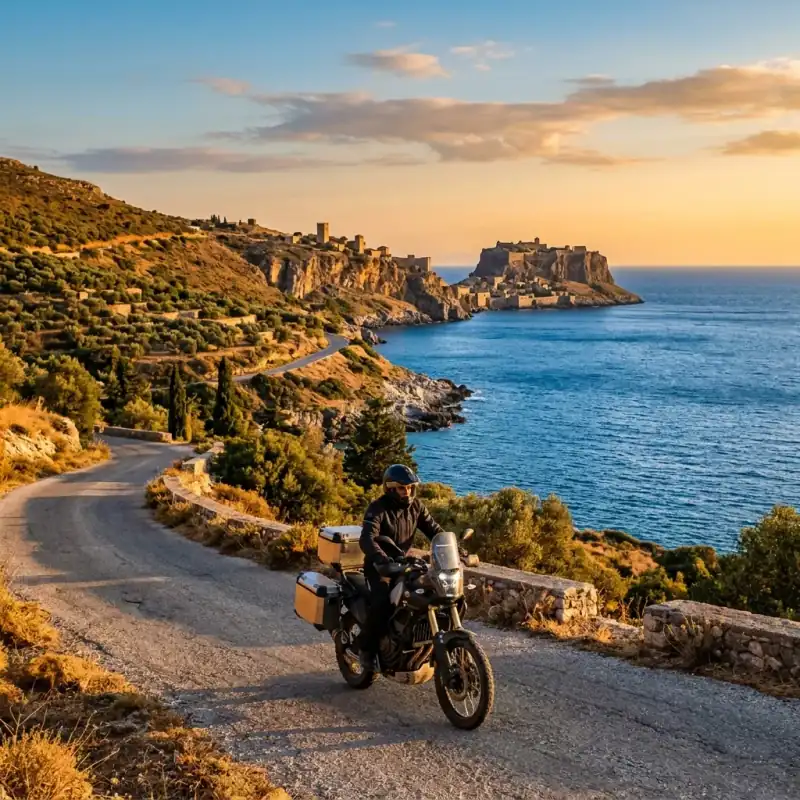
Greece, for most riders, means the islands, and the islands are wonderful, but you can’t really ride them, not properly. The mainland is where Greece becomes a motorcycle country, and the Peloponnese is the best of the mainland: a great four-fingered peninsula hanging off the bottom of the country, ringed by coast road and threaded with mountain passes, studded with more history per kilometer than almost anywhere on earth.
I came to it almost by accident, rolling off the ferry from Italy at Patras with a vague plan to ride south and a week to do it in. That week turned into one of my favourite trips in Europe. This is the route I’d give anyone arriving the same way: a Peloponnese motorcycle route that loops the whole peninsula in seven days. The Venetian sea-fortress towns, the wild stone villages of the Mani, the Taygetos mountain road, and a string of seaside campsites where you can pitch a tent on the sand and swim before breakfast.
It connects straight to the Italy–Greece ferry guide, which is how most riders arrive, and it leans on the best seaside campgrounds in Greece for where to sleep along the way.
Why the Peloponnese Beats the Islands for Riding
You can’t string a real ride together on a Greek island. They’re too small, and you spend half your trip on ferries. The Peloponnese gives you everything the islands are famous for. The turquoise water, the white villages, the ancient sites, the slow tavernas — with the one thing they can’t: hundreds of kilometers of continuous, varied, brilliant road to link it all.
In a single loop you get fast modern motorway, sweeping coastal corniches, and great mountain roads through the Parnonas and Taygetos ranges. You ride from a Mycenaean citadel to a Venetian sea fortress to a Byzantine ghost town to a Spartan ruin, with swimming stops in between, and you sleep on the beach for the price of a coffee in Cortina. It’s the most complete riding-and-history-and-coast package in southern Europe, and outside high summer it’s quiet.
It’s also the natural southern bookend to a longer European trip — ride down through the Balkans or across on the ferry from Italy, and the Peloponnese is where the road finally runs out at the bottom of the continent.
The Route at a Glance
| Day | Stage | Distance | Highlight |
|---|---|---|---|
| 1 | Patras/Athens → Nafplio | 200 km | Corinth Canal, Mycenae, Epidaurus |
| 2 | Nafplio → Monemvasia | 200 km | Leonidio cliffs, Parnonas mountains |
| 3 | Monemvasia → Gythio (Mani) | 100 km | Sea-fortress town, Mavrovouni beach |
| 4 | Mani loop (Areopoli base) | 130 km | Diros caves, Cape Tainaron, tower villages |
| 5 | Mani → Kalamata → Sparta | 170 km | Taygetos mountain road, Mystras |
| 6 | Kalamata → Pylos / Finikounda | 110 km | Methoni castle, southwest beaches |
| 7 | Pylos → Olympia → north | 180 km | Ancient Olympia, ride out |
Total: roughly 1,090 km over seven days, with the riding split between fast northern transit, slow coastal exploring, and two superb mountain crossings. Most days leave the afternoons free for sites and swimming.
Day 1: Patras or Athens to Nafplio (200 km)
However you arrive — off the ferry at Patras or west out of Athens over the Corinth Canal (stop on the bridge and look down at that astonishing slot cut through the isthmus) — aim for Nafplio, the most beautiful town in the Peloponnese and the ideal first base. On the way, the great Bronze Age citadel of Mycenae and the perfectly preserved ancient theater at Epidaurus are both short detours and both worth it.
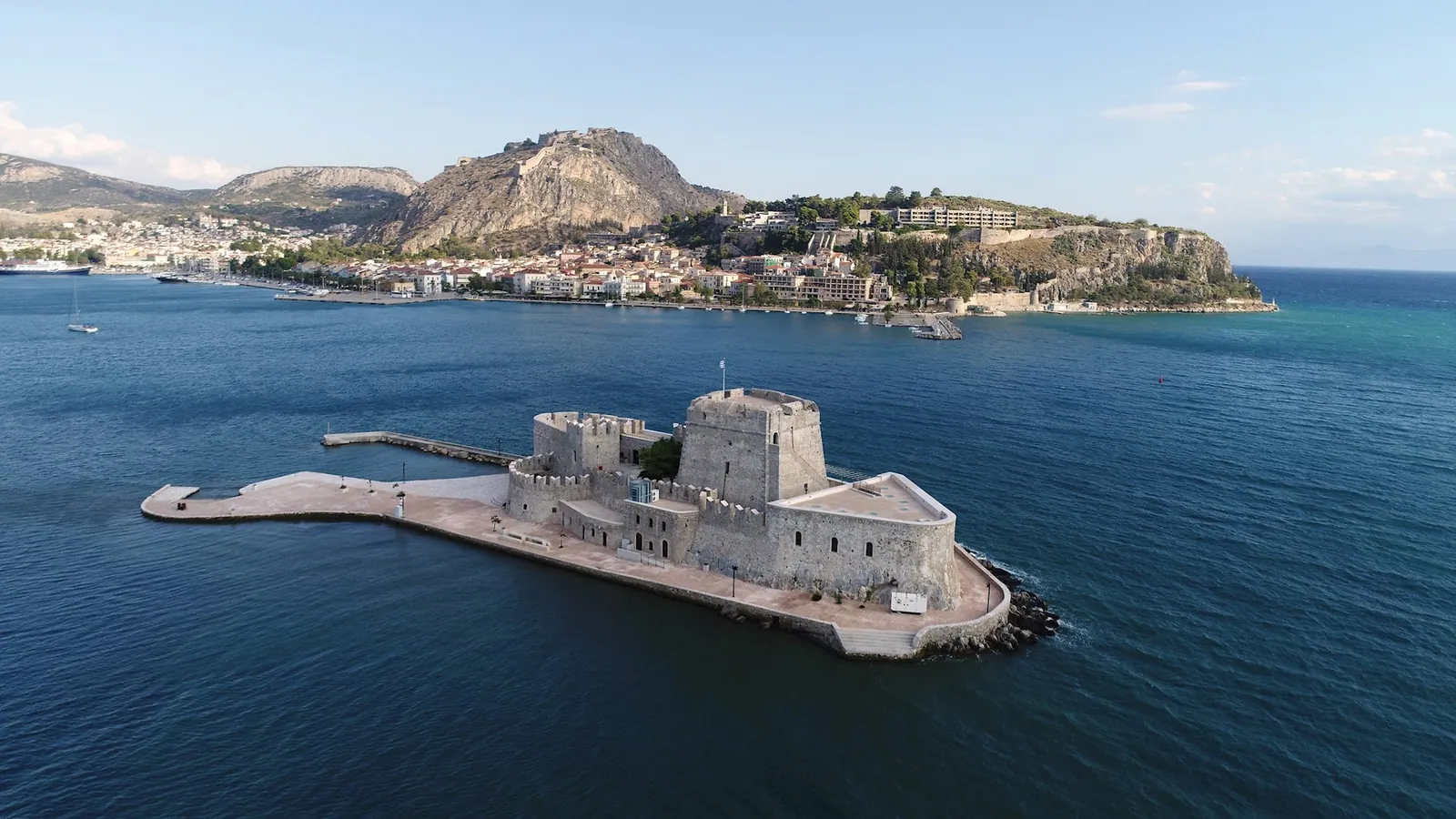
Nafplio itself is a stunner: a Venetian old town below two fortresses, narrow marble streets, waterfront cafés, and the little Bourtzi castle sitting on its island in the harbor. Settle in for the night and walk the old town in the evening.
Road notes: Fast tolled motorway from Patras or Athens for the transit, then easy roads to Nafplio. Greek motorway tolls apply on this leg. Fuel widely available — fill up, because it gets pricier and sparser as you head south.
Day 2: Nafplio to Monemvasia (200 km)
One of the great days of the trip, and a long one. Head south down the east coast and inland into the Parnonas mountains. The standout stretch runs through Leonidio, a town tucked under huge red cliffs, and up the spectacular mountain road to the stone village of Kosmas — a sinuous climb through forest that’s some of the best riding on the peninsula. Then descend toward the southeast coast.
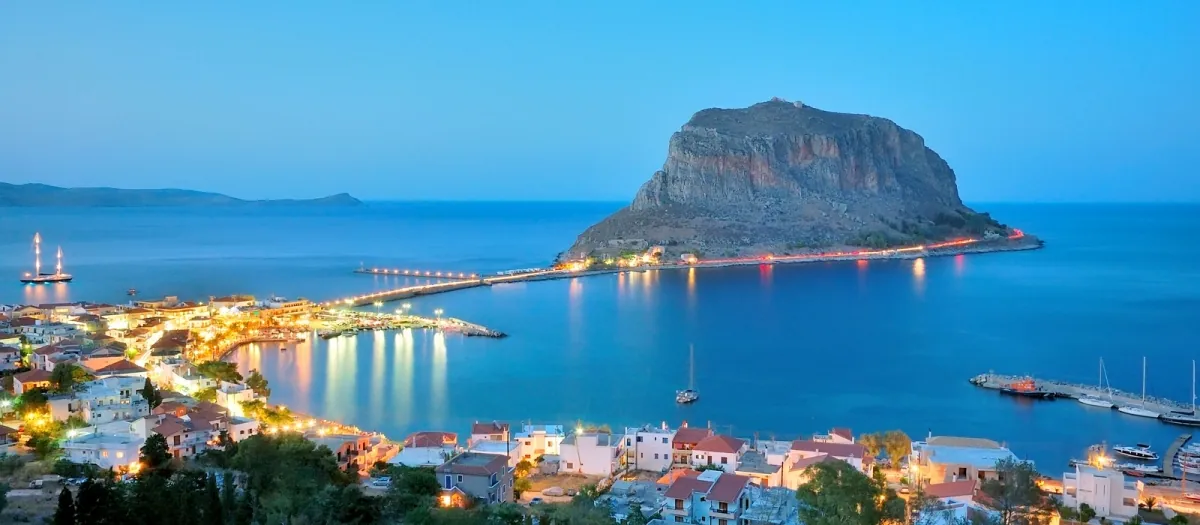
The day ends at Monemvasia, and it’s a showstopper: a fortified Byzantine town built into the seaward face of a vast rock joined to the mainland by a single causeway, completely hidden until you ride around the back of the rock and the medieval streets appear. Park outside the gate (no vehicles in the lower town), walk in, and stay the night in the car-free old town if you can swing it.
Road notes: The Leonidio–Kosmas mountain road is the highlight — narrow, twisty, brilliant. Fuel before you head into the mountains; stations thin out. Watch for gravel on the high bends.
Day 3: Monemvasia to Gythio and the Mani (100 km)
A shorter day west across the base of the middle finger of the Peloponnese to Gythio, the gateway to the Mani peninsula. Gythio is a pleasant working port town, and just south of it lies Mavrovouni, a 5 km sweep of sandy beach that’s the best camping base in the south — Gythion Bay Camping sits right on it and rarely feels crowded. Pitch the tent, swim, and set up here for the Mani exploring to come.
This is the day the landscape turns wild. The Mani is the rugged, arid, end-of-the-world middle peninsula — bare mountains dropping into the sea, stone tower-houses clustered in fortified villages, and a fierce, proud history of a region that was never fully conquered.
Road notes: Easy riding to Gythio. The Mani roads beyond are narrower and rougher — a taste of what’s coming tomorrow. Stock up on water and supplies in Gythio.
Day 4: The Mani Loop from Areopoli (130 km)
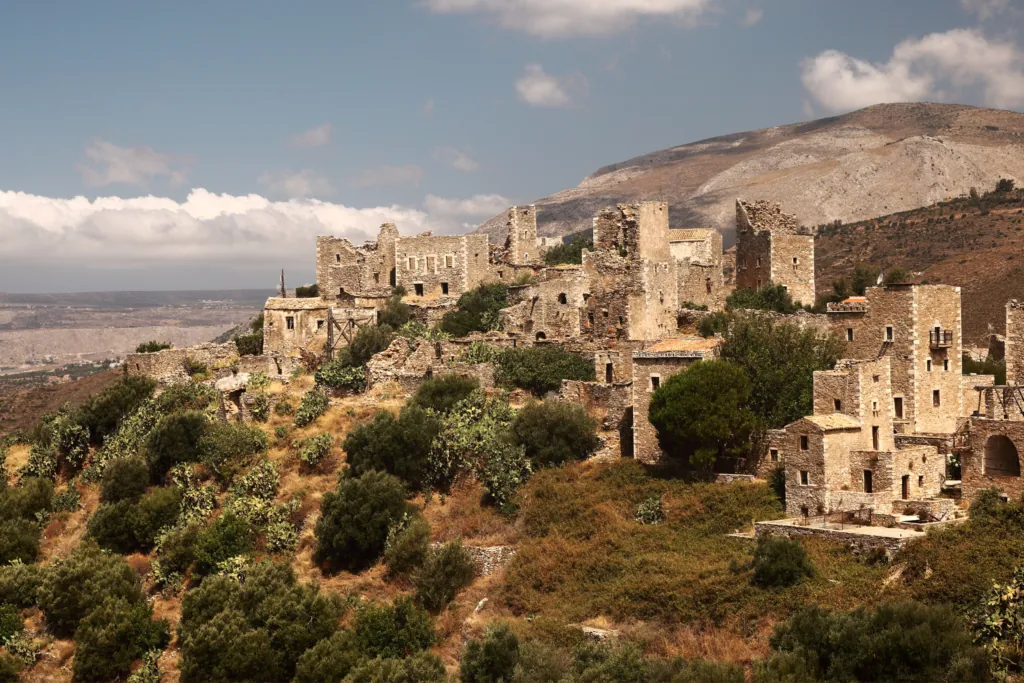
Spend a full day exploring the deep Mani, basing yourself out of Areopoli, a handsome stone town of cobbled lanes and tower-houses. The loop down the peninsula and back is one of the most atmospheric rides in Greece.
Three things not to miss. The Diros Caves, near Areopoli, where you glide by boat through a flooded cavern of stalactites — an easy, surreal stop. Cape Tainaron at the very tip, the southernmost point of mainland Greece, where a short walk past Roman mosaics leads to a lighthouse at the literal end of the line, with sea on three sides and a sense that you’ve ridden as far south as the continent goes. And the tower village of Vathia, a cluster of stone war-towers on a ridge that looks like nowhere else in Europe.
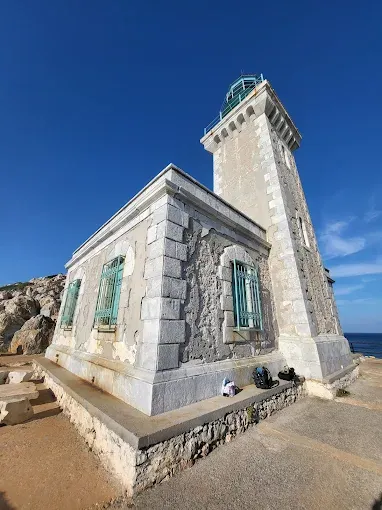
Ride back to your camp at Gythio, or stay in Areopoli for the night.
Road notes: Narrow, winding, remote roads with little traffic and stunning coastal views. Fuel in Areopoli before the run to the cape. The tip has nothing. Take it steady; surfaces vary and goats wander.
Day 5: The Mani to Kalamata and Sparta (170 km)
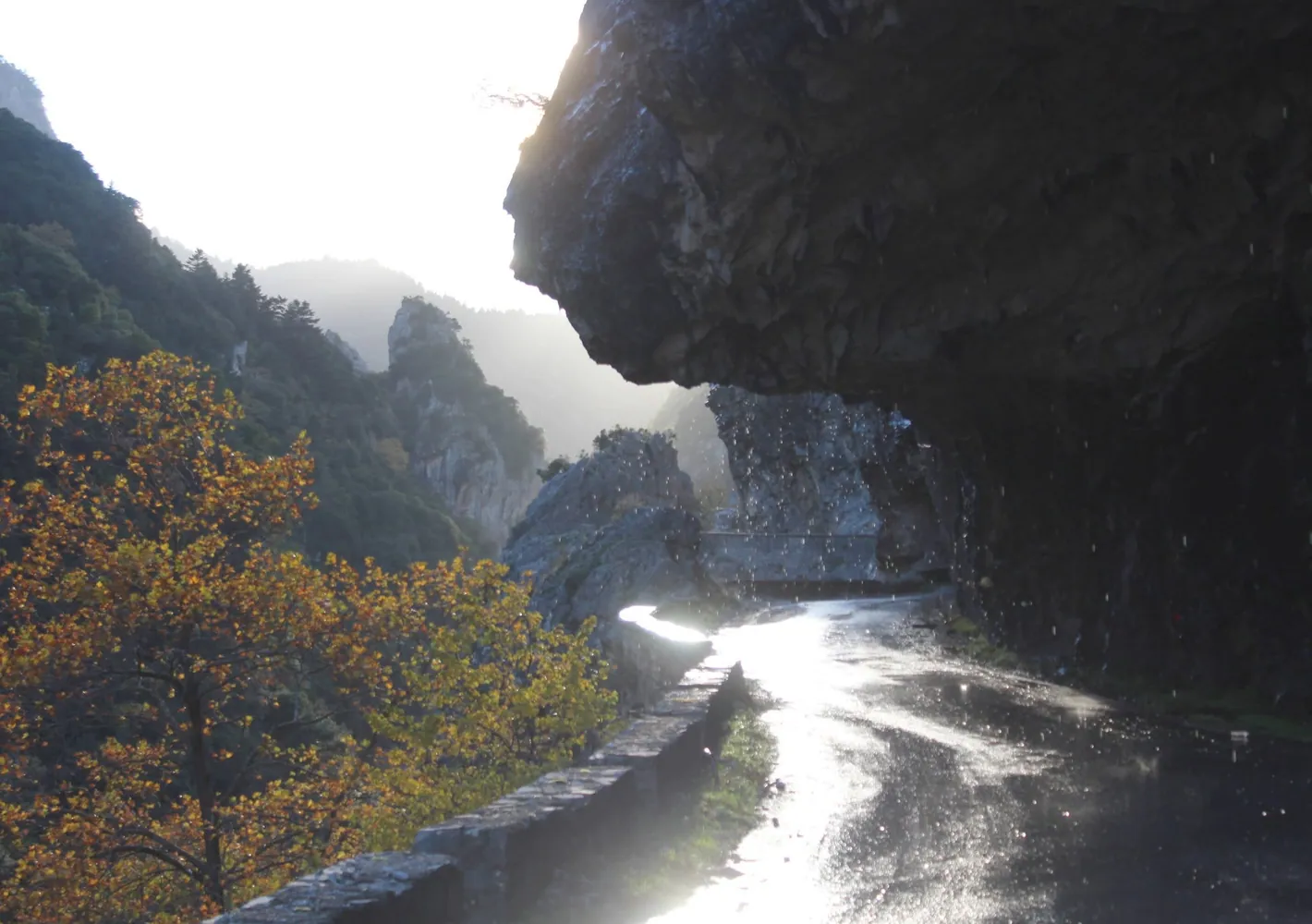
Ride up the western side of the Mani through Kardamyli — a beautiful seaside village under the Taygetos mountains, made famous by the travel writer Patrick Leigh Fermor, who settled here, and on to Kalamata. Then comes one of the finest roads in Greece: the mountain crossing of the Taygetos range from Kalamata over to Sparta, a high, sweeping climb and descent with views back over the Messinian Gulf.
On the Sparta side, don’t miss Mystras, the extraordinary ruined Byzantine city cascading down a hillside below a Frankish castle — churches, palaces and monasteries spread across the slope, one of the great medieval sites of Greece. Overnight in the Sparta area or back over toward Kalamata.
Road notes: The Kardamyli coast road and the Taygetos crossing are both highlights — superb riding. Fuel in Kalamata. The mountain road is high; carry a layer in shoulder season.
Day 6: Kalamata to Pylos and Finikounda (110 km)
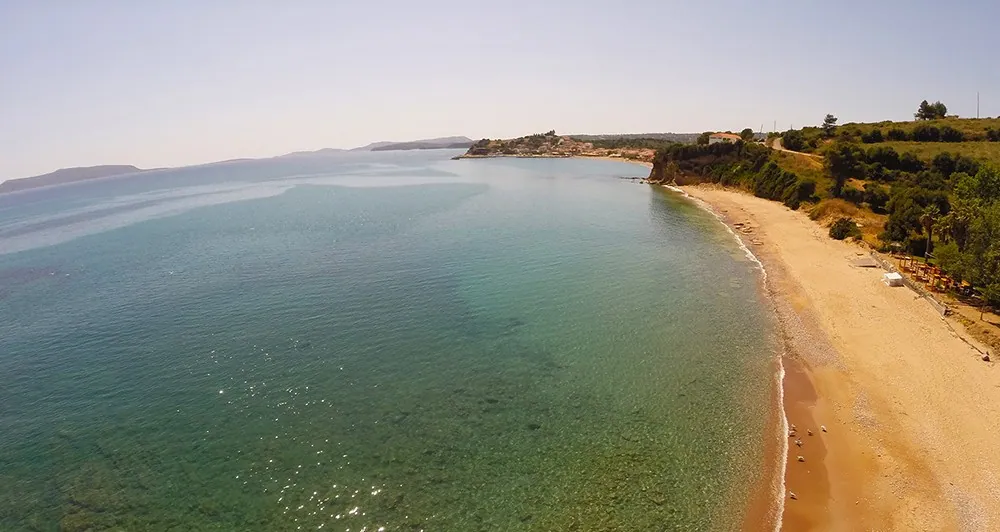
Drop down to the southwest corner. The gentlest, greenest, most beach-rich part of the peninsula. Ride the coast to Methoni and Koroni, twin towns each guarding a dramatic Venetian sea castle, and around to Pylos on its beautiful bay (the site of the Battle of Navarino). Just east, Finikounda is the camping base down here — Camping Thines and Camping Finikes both sit right on wide sandy beaches with calm, swimmable water.
This is the day to slow right down. Swim at Methoni below the castle walls, eat grilled fish in a Pylos taverna, and pitch the tent within sight of the sea at Finikounda.
Road notes: Easy, scenic coastal roads. Plenty of fuel and supplies. The southwest beaches are the best swimming on the loop; leave time for them.
Day 7: Pylos to Olympia and the Ride Out (180 km)
Head north up the west coast toward Ancient Olympia, birthplace of the Olympic Games. The stadium, the temples, and the museum make a fitting final stop, history-wise, on a trip stuffed with it. From Olympia it’s an easy run north to Patras for the ferry back to Italy, or onward up into the mainland and the road home.
You close the loop having ridden fortress towns, the wildest peninsula in Greece, two great mountain ranges and a coast full of empty beaches; in a week, on roads that never got boring.
Road notes: Easy west-coast riding. Tolled motorway again near Patras. Fuel up before the ferry or the long ride north.
What the Peloponnese Costs in Fuel and Tolls (2026)
Greece is the expensive part of this trip, so plan for it. As of mid-2026, unleaded 95 runs around €2.01/litre — among the highest in Europe — with diesel noticeably cheaper at about €1.75. Prices climb further on the islands and in remote corners, so fill up in the bigger towns where you can.
The northern motorways (Patras–Corinth–Tripoli) are tolled, so budget a handful of euros for the transit legs on days 1 and 7; the southern and mountain roads are toll-free. If you arrive by ferry from Italy, that crossing is the other big line item — see the ferry guide for current fares. The good news: organised seaside campsites are cheap, most of the ancient sites cost only a few euros to enter, and tavernas off the tourist strips are excellent value. Fuel aside, the Peloponnese is an affordable week, and a nimble, economical bike keeps the one expensive part in check.
Peloponnese Packing Notes
What this loop specifically asks for beyond standard touring kit:
- A proper seaside-camping setup — a tent, sleeping pad and small stove open up the cheap beachfront sites
- Swimming gear within reach. You’ll stop two or three times a day
- A layer for the Taygetos and Parnonas mountain crossings, cool even in summer
- Cash in euros for tolls, campsites and small tavernas
- High-factor sunscreen; the southern Greek sun is brutal
- Offline maps. The Mani and the mountain interior have patchy signal
Best Season and Weather
April to mid-June: green, flowering, comfortable, with the sea warming up. The best all-round window and quiet on the roads.
September to October: the other sweet spot — summer-warm water, settled weather, and the campsites emptying out after August. Arguably the nicest time to ride the south.
July-August: hot (high 30s) and busy, with the beaches and campsites full and prices up. Rideable if you start early and swim through the afternoons, but not the Peloponnese at its best.
November to March: the mainland cools and the mountains can get cold and wet, but the southern Mani stays mild enough that some riders treat it as a winter escape. The ancient sites are blissfully empty.
Internal Connections
This loop ties into the rest of the Greece and Mediterranean coverage on Bikes and Bays:
- For how a Greek loop fits alongside Europe’s other great rides — and how to sequence several into one summer — see our ultimate Europe adventure motorcycle routes guide.
- It begins where the Italy–Greece ferry guide leaves off, that’s how most riders arrive with a bike.
- For where to sleep along the coast, see the top seaside campgrounds in Greece for riders.
- To see how Greece’s coast ranks against the wider region, read the best coastal motorcycle routes in the Mediterranean.
- To reach the Peloponnese overland from the north, ride down through the Balkans first.
FAQ
Five common questions are answered at the top of this page. The short version: loop the Peloponnese in seven days, make the Mani the centerpiece, camp at Gythio and Finikounda, and ride it in spring or autumn rather than the August heat.
The mainland is the Greece you can actually ride, and the Peloponnese is its best week. Whatever shape your own Peloponnese motorcycle route takes, give the Mani an extra day if you can spare it — Cape Tainaron at the bottom of the continent, with the bike ticking as it cools and the sea on three sides, is the kind of place you ride a long way to find.
This guide is based on personal trips along the route. Some links in this article are affiliate links — if you buy gear through them, we may earn a small commission at no extra cost to you.
Frequently Asked Questions
How do I get to the Peloponnese with my bike?
Two main ways. If you're coming from Italy, take the ferry across the Adriatic to Patras, which lands you right at the northwest corner of the Peloponnese — the crossings and how to book a bike on are covered in the Italy–Greece ferry guide. If you're flying in or starting from Athens, it's a short hop west over the Corinth Canal onto the peninsula. Either way you're on Peloponnese roads within an hour or two of arriving, and the loop in this guide works from either entry point.
When is the best time to ride the Peloponnese?
April to mid-June and September to October. Spring is green and flowering with comfortable temperatures and warming sea; autumn gives you summer-warm water, stable weather and quiet roads once the August rush clears. Avoid July and August if you can — the heat sits in the high 30s, the popular beaches and campsites fill with Greek and European holidaymakers, and prices climb. Uniquely, the southern Mani is mild enough that some riders treat it as a winter destination too.
Where can I camp on the route?
There's a good network of organised seaside campsites, especially in the south and southwest. Gythion Bay Camping on the 5 km Mavrovouni beach is the standout base for the Mani; around Finikounda in the southwest, Camping Thines and Camping Finikes both sit right on sandy beaches. Wild camping in Greece is officially restricted and enforcement varies, so the organised sites are the sensible default — they're cheap, well-placed, and right on the water. The seaside campgrounds guide covers the best of them in detail.
What are the roads like, and do I need a big bike?
The roads are excellent fun and suit any bike. You get fast modern motorway across the north (tolled), then a brilliant mix of coastal corniches and mountain roads through the interior — the Taygetos crossing between Kalamata and Sparta is a genuine highlight. The mountain and Mani roads are narrow and winding but well surfaced; a mid-size or even small bike is perfect, and I'd take a nimble bike over a heavy tourer here every time. Watch for gravel, goats and the odd pothole on the remote southern roads.
How much does a week in the Peloponnese cost?
Fuel is the pricey part — Greece has some of the most expensive petrol in Europe (see the cost section). Beyond that it's reasonable: organised campsites run cheap, tavernas are good value off the tourist strips, and the sites are mostly free or low-cost to enter. Budget roughly €45-75 per person per day camping and self-catering with taverna meals, more if you hotel it. Northern motorway tolls and the ferry (if you come from Italy) are the other line items to plan for.