The first time I rode in Scotland it rained for four days straight. I’d brought a waterproof jacket I’d worn twice in five years and trusted on faith. By day two it had wetted out at the seams and I was riding in damp insulation. By day three my boots were waterlogged. By day four I checked into a B&B in Ullapool at 4 in the afternoon, hung everything I owned over a radiator, and ate fish and chips in bed with a whisky watching rain hammer the bay outside.
That trip taught me everything I needed to know about Scotland. The weather is real. The gear has to be honest. And when you do get a clear hour with the sea lochs lit by low northern sun, the trip earns every soaked sock.
The NC500 — the North Coast 500 — is the route that anchors most foreign riders’ Scotland trips, and for good reason. 516 miles of single-track coast roads, sea lochs, and mountain passes, looping out of Inverness and back. This guide is the working version. North coast 500 motorcycle guide that treats the weather honestly, plans the fuel realistically, and tells you which sections actually earn the kilometers.
Why the NC500 Is Every UK Rider’s Rite of Passage
The route was branded in 2015 by the North Highland Initiative as a way to drive tourism into the sparsely populated north of Scotland. It worked. Motorcycle tourism to the region has grown roughly 34% year-over-year since launch. The route itself isn’t a single named road — it follows brown tourist signs through a network of A-roads and single-track B-roads, looping from Inverness through Wick, John o’ Groats, Durness, Ullapool, Applecross, and back via the Black Isle.
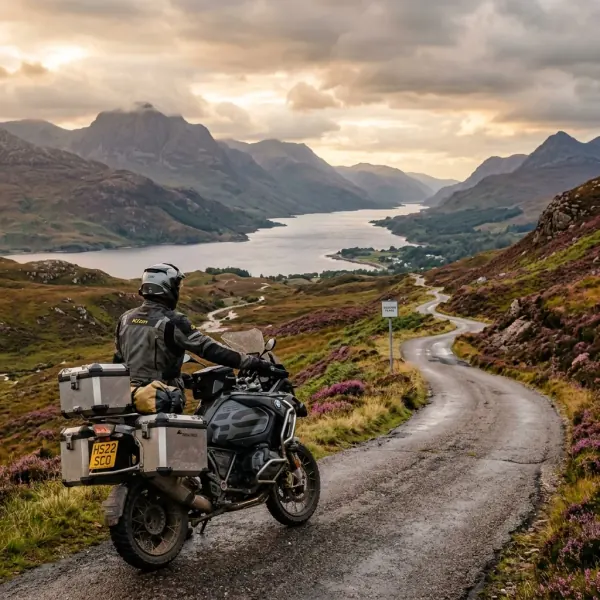
What makes it work as a motorcycle trip isn’t novelty. It’s that the roads themselves are excellent. The A832 west of Ullapool is a sequence of medium-speed sweepers along sea lochs. The B869 north of Lochinver climbs and descends through bog and mountain in 5-mile sets of tight corners. The Bealach na Bà pass into Applecross is the steepest paved road in the UK and the most dramatic single piece of motorcycle tarmac in the country.
The route isn’t perfect. The east coast section between Inverness and Wick is long, flat, and visually unremarkable compared to the west. The single-track roads with passing places frustrate riders who want to ride hard. And in peak summer the route gets clogged with motorhomes that struggle to use passing places correctly.
Treat it as a tour, not a TT lap, and the NC500 is the best week of motorcycle riding in the United Kingdom.
The Route at a Glance: 516 Miles Around the Scottish Highlands
| Stage | Distance | What You’ll Remember |
|---|---|---|
| Inverness → John o’ Groats (east coast) | 130 mi | Coastal A9 then A99 north |
| John o’ Groats → Durness | 110 mi | Empty north coast, Smoo Cave |
| Durness → Lochinver | 80 mi | Sutherland mountains and lochs |
| Lochinver → Ullapool | 70 mi | The B869 — best single-track on the route |
| Ullapool → Applecross | 90 mi | Bealach na Bà, the highlight |
| Applecross → Inverness | 90 mi | Glen Carron back to base |
Total: roughly 516 miles. The east-coast section is the longest single stage and the least visually interesting. Some riders skip it by going clockwise and starting the loop at Tain. Most should still ride the full loop — even the east coast has moments (Dunbeath Castle, the Whaligoe Steps) that justify the kilometers.
Clockwise or Anti-Clockwise? (Answer: Anti-Clockwise)
For motorcycles specifically, anti-clockwise is the better direction. Three reasons.
First, the views are on your left. Going east to west along the north coast and then south down the west coast puts the sea on your left as the rider. That’s the easier side to glance at while riding. Clockwise riders spend the route craning their necks across the bike to see what they’re paying to ride past.
Second, Bealach na Bà rides better anti-clockwise. Approaching the pass from the east (Glen Carron side), you climb a gentler grade through Tornapress. The descent into Applecross drops you down the dramatic switchback face of the pass with the sea opening below. Clockwise you climb the switchback face — slower, more frustrating in traffic, less rewarding.
Third, the route builds. Anti-clockwise saves the most spectacular section (Ullapool through Applecross) for the back half of the trip when you’re settled into the rhythm. Clockwise burns through the highlight on day 2 and leaves the east coast for the final days.
The Must-Ride Sections
Bealach na Bà: The UK’s Most Dramatic Pass

The 11-mile road from Tornapress to Applecross is the single most-photographed piece of motorcycle road in Scotland. It climbs from sea level to 626 meters over a series of tight switchbacks with no guardrails and gradients reaching 20%. Signs at the bottom warn caravans not to attempt it. Motorcyclists, paradoxically, find it easier than most road vehicles — narrow, agile, and at home in tight corners.
Ride it midweek if possible. Weekend traffic includes nervous car drivers who freeze in the switchbacks. Ride it early morning or late evening for the best light. The summit has a small parking area; the descent into Applecross village rewards you with one of the best-placed pubs in the UK (the Applecross Inn) on the seafront.
Durness to Applecross: Best Scenery on the Entire Route
The 170-mile stretch from Durness south along the A838, A894, A837, A835, and A832 through Lochinver, Ullapool, and onto Applecross is where the NC500 earns its reputation. The road threads between sea lochs and mountain massifs — Suilven, Stac Pollaidh, An Teallach — each rising 600-1,000 meters from sea level in single dramatic peaks.
The B869 detour out of Lochinver is the best 30 miles on the route. Single-track, with passing places, looping past empty sandy beaches at Achmelvich and Stoer. Most riders skip it. Don’t. It’s the road the rest of the NC500 is trying to live up to.
Cape Wrath: The Northern Extreme
Cape Wrath is the northwesternmost point of mainland Britain. Reaching it requires a ferry across the Kyle of Durness and then a minibus or a 12-km walk on a military training road. Motorcycles can’t make the crossing — it’s foot passenger ferry only.
If you can spare half a day, do the ferry and minibus trip. The lighthouse at the cape is the end of mainland Britain, and on a clear day you can see Orkney. If you can’t spare the time, don’t feel guilty skipping it — the NC500 doesn’t actually go to Cape Wrath; the official route stays on the public road.
NC500 Motorcycle Packing Checklist
The 6-item list that handles 90% of what Scotland will throw at you.
- Waterproof jacket and trousers — Scottish weather mandatory (0 g, already wearing)
- Spare fuel plan — stations 80 miles apart in NW Scotland (0 g)
- Offline maps downloaded — OsmAnd or Scenic app (0 g)
- Accommodation booked — don’t wild-card in summer (0 g)
- Tyre plug kit — single track roads and gravel sections (180 g)
- First aid kit — remote sections far from help (350 g)
Waterproofs are non-negotiable. The forecast will tell you sunny in the morning. By 14:00 you’ll be in a passing rain front. The right kit is a fully waterproof outer jacket and trousers (Klim, Rev’It, or Aerostich), worn over a layered base. Not a “water-resistant” textile suit that wets out after an hour. Not a flapping ponchotype add-on. Real, sealed-seam, waterproof riding gear.
Check Waterproof Touring Gear on Amazon →
Fuel discipline matters. Fill every chance you get in the northwest. The next station might be closed, might be Sunday, might be 40 miles further than you thought. A 5L spare fuel canister strapped to the bike adds peace of mind for sub-150-mile-range bikes.
Wild Camping in Scotland: The Legal Reality
Scotland’s Land Reform Act 2003 created a legal right to wild camp on most unenclosed land. The Scottish Outdoor Access Code lays out the practice: stay one or two nights at a single spot, leave no trace, avoid cultivated land, don’t camp near houses or buildings without permission, don’t camp in laybys, take out all litter.
For NC500 riders, this means you can legally pitch a tent on most of the moorland, beachhead, and headland along the route. The exceptions:
- The Loch Lomond and Trossachs National Park has restricted camping zones (mostly south of the NC500 route, but check if you’re approaching from Glasgow)
- Private gardens, cultivated agricultural land, and managed sporting estates require landowner permission
- Roadside laybys are not legal camping spots
In practice, the NC500 has hundreds of pull-offs, beach approaches, and rough tracks where a small tent for one night is welcomed. The midges in summer are the bigger problem — bring permethrin-treated clothing and a midge net for your head if you camp June through September.
Best Time to Ride the NC500
Late May to mid-June. The best window. Daylight extends past 22:00 (you can ride until 23:00 in June at the latitude of Durness). Temperatures 12-18°C. Wildflowers along the verges. Accommodation still available with 1-2 months notice. Midges starting to emerge but manageable.
September. The second-best window. Stable autumn weather, heather in bloom on the moors, sea temperatures still warm enough for the brave to swim. Midges declining. Accommodation easier to find. Daylight shorter (sunset around 19:30) but enough for a full riding day.
July-August. Avoid if you can. Accommodation books out 6 months ahead, prices spike 30-50%, motorhomes clog single-track roads, and midges peak. Possible if you’re flexible and willing to wild camp or book very early, but the experience suffers.
October-April. Possible on the A-roads. The narrow B-roads in the northwest can ice over. Daylight short (sunset 16:30 in December). Accommodation thin as many tourist businesses close. A different trip — quieter, more atmospheric, riskier.
Fuel and Logistics Planning
The fuel map of the NC500 is the single planning item most often underestimated. In the northwest, the practical stations are:
- Ullapool (24-hour Tesco)
- Lochinver (limited hours)
- Kinlochbervie (limited hours)
- Durness (limited hours, often closes 18:00)
- Bettyhill (limited hours)
- Tongue (limited hours)
The gap between Durness and Ullapool via the west coast is the longest single stretch — 90 miles with only Kinlochbervie and Lochinver as intermediate options, both with restricted hours and not always Sunday-open. Fill at Ullapool going north. Fill again at Durness if open. Plan to arrive at Lochinver with at least 50 miles of range remaining.
For accommodation, book 3-4 months ahead for May-June, 6 months ahead for July-August. Wild camping is a legitimate plan B but should not be plan A in changeable weather.
Internal Connections
For longer European routes that connect from the NC500, see Trans-Euro Trail for beginners. For the tool kit that handles the route’s mechanical realities, see essential motorcycle tool kit for overlanding.
FAQ
Five common questions are answered at the top of this page. The short version: ride anti-clockwise, give it a week, book accommodation early, plan fuel carefully, and bring real waterproofs.
Whatever your version of the north coast 500 motorcycle guide looks like in practice, the route rewards riders who treat it as a tour rather than a target. The roads are excellent. The weather is what it is. The country is older and emptier than most of Europe, and the week you spend riding it changes how you think about long-distance touring.
Disclosure: Some links in this article are affiliate links. If you buy gear through them, we may earn a small commission at no extra cost to you.
Frequently Asked Questions
When is the best time to ride the NC500?
Late May through mid-June, or September. Spring gives you long daylight hours (sunset past 22:00), wildflowers, and most accommodation still available. September gives you stable weather, the heather in bloom on the moors, and fewer midges than peak summer. Avoid July-August — accommodation books out 6 months ahead, single-track roads clog with motorhomes, and prices spike. Winter is technically possible on the A9 and A99 but the northwest's narrow B-roads become risky in ice and snow.
Clockwise or anti-clockwise for motorcycles?
Anti-clockwise. Going east-to-west across the top puts the sea views and the dramatic coast on your left — easier to look at as the rider, and the road builds toward the most spectacular sections (Durness, Applecross) instead of frontloading them. The Bealach na Bà pass also rides better anti-clockwise — you climb the gentler east side and descend the dramatic switchbacks toward the coast.
What's the realistic fuel range I need?
Plan for 130-150 miles between reliable fills in the northwest. The stretch from Ullapool to Durness can be 80+ miles without a guaranteed station, and rural pumps close on Sundays and after 18:00. A bike with a 200+ mile range handles the route without anxiety. Smaller-tank bikes (250-400cc with 150-mile range) work if you fill at every village and don't skip a station thinking the next one will be open.
Can I really wild camp anywhere in Scotland?
Yes, under the Land Reform (Scotland) Act 2003. The Scottish Outdoor Access Code grants the right to wild camp on most unenclosed land as long as you follow leave-no-trace principles, avoid private gardens and cultivated land, and don't camp in laybys (which are for parking). The exception is the Loch Lomond and Trossachs National Park, which has byelaws restricting wild camping in some areas March-September. The NC500 itself is mostly outside that restriction zone.
How long does the NC500 really take on a motorcycle?
5 days minimum, 7-10 days to actually enjoy it. The 516-mile loop sounds like a 2-day blast on a sport bike. It isn't. Single-track roads with passing places limit your speed to 30-45 mph average. Frequent stops for views, ferry crossings, and weather pauses add time. Riding the NC500 in 3 days means seeing the road but not the place. Give it a week.